Mathematicians Solve Decades-Old Topology Puzzle By Proving Universal Color Limit In Four Dimensions And Beyond
A new recursive truncation method shows that a famous topological color bound holds true across all higher dimensions for small covers and quasitoric manifolds.
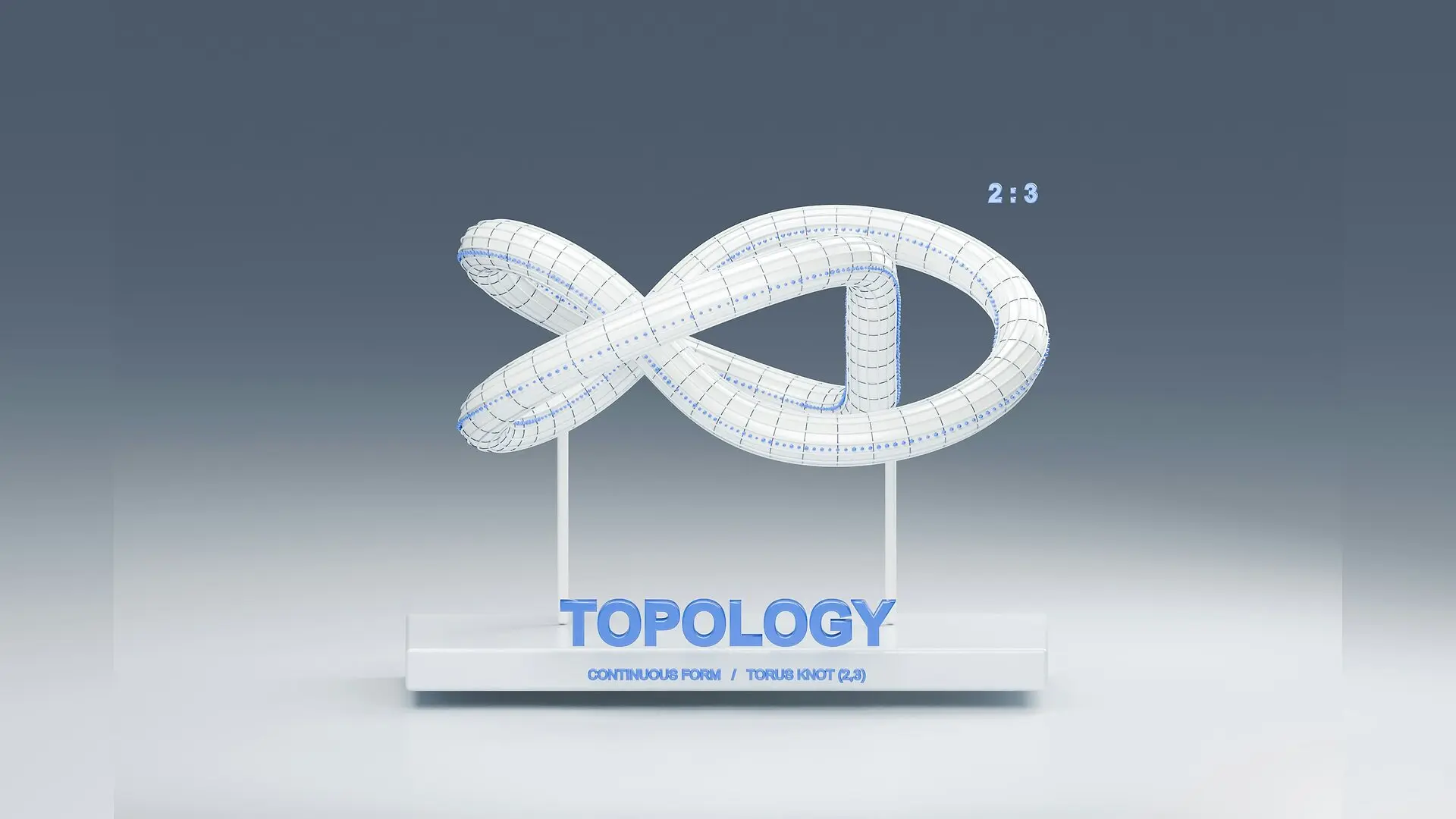
Mathematicians have settled a long-standing topological puzzle by proving that a famous color limit holds true in every dimension of four or higher. The breakthrough resolves a decades-old question about geometric shapes known as simple polytopes, which serve as foundational maps in modern algebraic topology.
To understand the challenge, picture coloring a complex multidimensional object where every boundary face, or facet, represents a territory. A proper coloring requires that any two adjacent territories sharing a vertex must receive different colors. In mathematical terms, the minimum number of colors needed is called the chromatic number. Back in 1991, topologists Michael Davis and Tadeusz Januszkiewicz established that for any simple $n$-dimensional polytope that functions as the orbit space of a small cover, the maximum possible chromatic number is capped at two to the power of $n$ minus one. While this upper bound worked neatly for two-dimensional polygons, it famously failed in three dimensions due to the classic Four Color Theorem. Whether the limit held for five dimensions and beyond remained an open problem ever since a four-dimensional example was constructed.
How Did Researchers Prove the Color Bound in Higher Dimensions?
In a study published on the arXiv preprint server, mathematicians Djordje Baralić from the Mathematical Institute of the Serbian Academy of Sciences and Arts and Riste Škrekovski from the University of Ljubljana tackled the higher-dimensional puzzle. They demonstrated that the theoretical upper bound is indeed attained for every dimension of four or higher. Their approach builds upon geometric structures derived from duals of cyclic polytopes, which are highly interconnected shapes where every pair of facets intersects. By applying a meticulous system of face truncations in dimensions of three or higher, the authors systematically repaired singular points without disrupting the underlying facet intersections.
The resolution method works by examining labellings of facets using vector spaces over finite fields and integers. When certain configurations create illegal dependencies, the team truncates specific substructures recursively. This prevents the formation of problematic geometric intersections that previously halted attempts in dimensions of five and higher. Through this recursive framework, the researchers showed that the maximum color bound is reached across all higher dimensions.
What Does This Mean for Quasitoric Manifolds and Oriented Spaces?
Beyond basic color limits, the findings have profound implications for two major classes of geometric spaces, namely small covers and quasitoric manifolds, which generalize complex algebraic varieties. The authors established that for every dimension of four or higher, there exists a simple polytope with a chromatic number matching the maximum limit that simultaneously functions as the orbit space of both a small cover and a quasitoric manifold. Furthermore, by restricting their vector labellings to elements of odd weight, the team proved that the same sharp bound applies to orientable small covers in all dimensions of four and higher. Computer verifications confirmed these configurations for dimensions four, five, six, and even seven, where the resulting polytope contains more than thirteen thousand facets and hundreds of thousands of vertices.
The study was posted to the arXiv preprint server on November 23, 2026.
This article has been fact checked for accuracy, with information verified against reputable sources. Learn more about us and our editorial process.
Last reviewed on .
Article history
- Latest version
Reference(s)
- Baralic, Djordje. “Upper bound $2^{n}-1$ for chromatic number of orbit polytope of a small cover is attained for every $n\geq4$.” arXiv.org <http://arxiv.org/abs/2611.31219v1>.
Cite this page:
- Posted by Joseph Jackson