Why Ordinary Viewers And Designers Judge AI Movie Art So Differently
A multi-dimensional study reveals that physical spatial logic and narrative cues shape how people accept artificial intelligence in film pre-production.
When people look at concept art dreamed up by artificial intelligence for science-fiction and fantasy films, what makes them decide whether the picture works or fails? A new study reveals that everyday viewers and trained design professionals look at AI-generated cinematic scenes through very different lenses, with ordinary audiences placing heavy weight on whether a fictional world looks physically believable.
The research, published in PLOS One, investigates how human psychology and aesthetic judgment interact with computer-generated imagery during the high-stakes pre-production phase of filmmaking. As generative artificial intelligence reshapes how movies are conceptualized, understanding how audiences and creators judge these synthetic worlds has become a major question for the entertainment industry.
Testing Synthetic Concept Art Across Five Key Dimensions
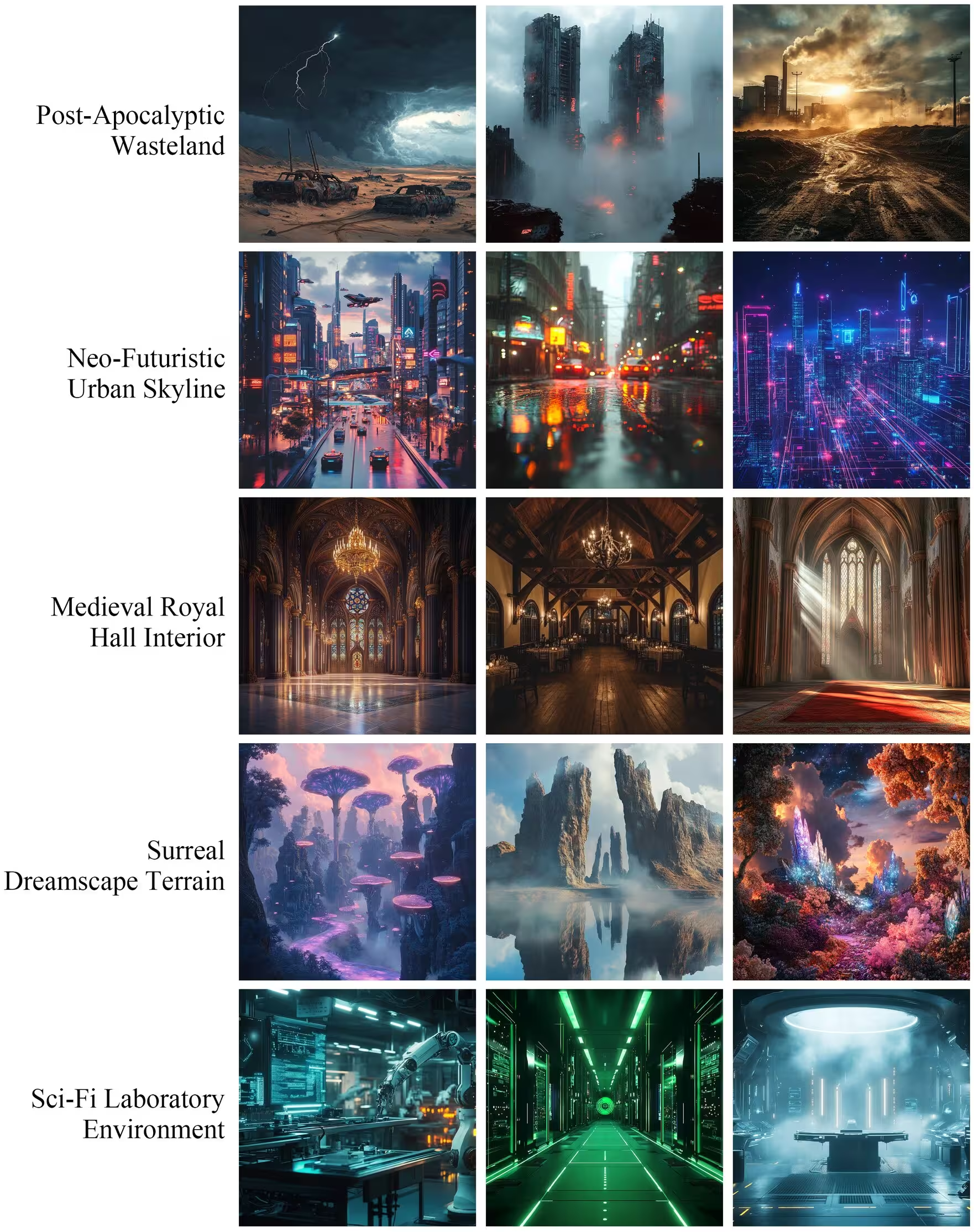
To unpack how people evaluate computer-generated concept art, researchers focused on Midjourney v5.2, a popular text-to-image diffusion model known for producing visually rich graphics. The team generated 60 high-resolution images spanning five distinct cinematic genres, including post-apocalyptic wastelands, neo-futuristic urban skylines, medieval royal halls, surreal dreamscapes, and high-tech science-fiction laboratories.
To isolate how viewers judge environmental design, the prompts were deliberately designed without human characters or figures. A total of 384 participants from South Korea and China evaluated the images, split equally between trained design professionals and non-design participants. The evaluation framework measured five specific dimensions: visual reasonability, narrative potential, aesthetic appeal, immersion, and overall acceptance.
Spatial Logic Drives Acceptance for Novices
Across the entire sample, narrative potential received the highest average rating, indicating that static AI images successfully sparked viewers’ imaginations regarding what might happen before or after the depicted moment. However, when researchers ran regression models to see what actually predicted whether participants would accept an image for actual film production, visual reasonability emerged as the strongest overall predictor.
The study found a notable divide between experts and novices. For non-design participants, physical and spatial logic, such as correct perspective, proper object scaling, and coherent lighting, was paramount in determining whether an AI-generated scene was acceptable. When an image violated basic spatial laws, ordinary viewers were much less likely to endorse it.
Design professionals, on the other hand, focused more heavily on narrative potential and aesthetic appeal when evaluating acceptance, showing less statistical sensitivity to minor spatial or immersive flaws. The authors suggest this may happen because trained artists view AI outputs primarily as exploratory ideation tools, whereas non-design participants tend to judge the images as finished visual products.
Caveats and What Comes Next in AI Filmmaking
The authors note several important limitations to their findings. Because the study did not include a comparison group of human-created concept art, the observed differences between experts and novices cannot be definitively labeled as specific to artificial intelligence, as similar perceptual gaps might occur when evaluating traditional artwork.
Furthermore, the exclusion of human characters narrowed the emotional scope of the test scenes, and the research was restricted to a single text-to-image platform and a specific regional demographic pool. Future research will need to test whether these perceptual patterns hold up when examining human-drawn concept art and emerging video generation models.
The research was published in PLOS One on November 19, 2026.
This article has been fact checked for accuracy, with information verified against reputable sources. Learn more about us and our editorial process.
Last reviewed on .
Article history
- Latest version
Reference(s)
- Luo, Bolin., et al. “User acceptance of AI-generated cinematic concept art: A multi-dimensional perceptual study in East Asia.” PLOS One, vol. 21, no. 11, November 19, 2026, pp. e0361809 Public Library of Science (PLoS), doi: 10.1371/journal.pone.0361809. <https://doi.org/10.1371/journal.pone.0361809>.
Cite this page:
- Posted by Joseph Jackson