New Two-Layer Diagnostic Model Significantly Improves Differential Diagnosis of Acute Febrile Illnesses
A novel decision-support framework successfully combined symptom frequencies and laboratory biomarkers to narrow down overlapping tropical infections in validation datasets.

Acute febrile illness presents a major global health challenge because dozens of distinct infections cause nearly identical early symptoms such as sudden fever, body aches, and headaches. Clinicians in resource-limited regions frequently struggle to determine the correct underlying cause from physical examinations alone, leading to high rates of empiric treatment, potential therapeutic failure, and the overprescription of antibiotics that worsens antimicrobial resistance. A research team led by Yasmine M. Mohamed and Hassan M. E. Azzazy from the American University in Cairo has developed and validated a transparent two-layer diagnostic model to help healthcare professionals differentiate between ten common tropical fever-causing conditions. The study is published in PLOS Digital Health.
How Can Physicians Better Differentiate Overlapping Fever Symptoms?
Many tropical infectious diseases share striking clinical resemblances during their early stages, making bedside separation exceptionally difficult. Leptospirosis, often termed the great mimicker, can look identical to dengue fever, malaria, or influenza. Because rapid diagnostic tests are sometimes costly or unavailable, patients are frequently treated presumptively for malaria or bacterial infections even after testing negative. To address this gap without relying on opaque black-box machine learning algorithms that require massive patient datasets, the researchers created a structured decision framework.
What Does the Two-Layer Diagnostic Architecture Involve?
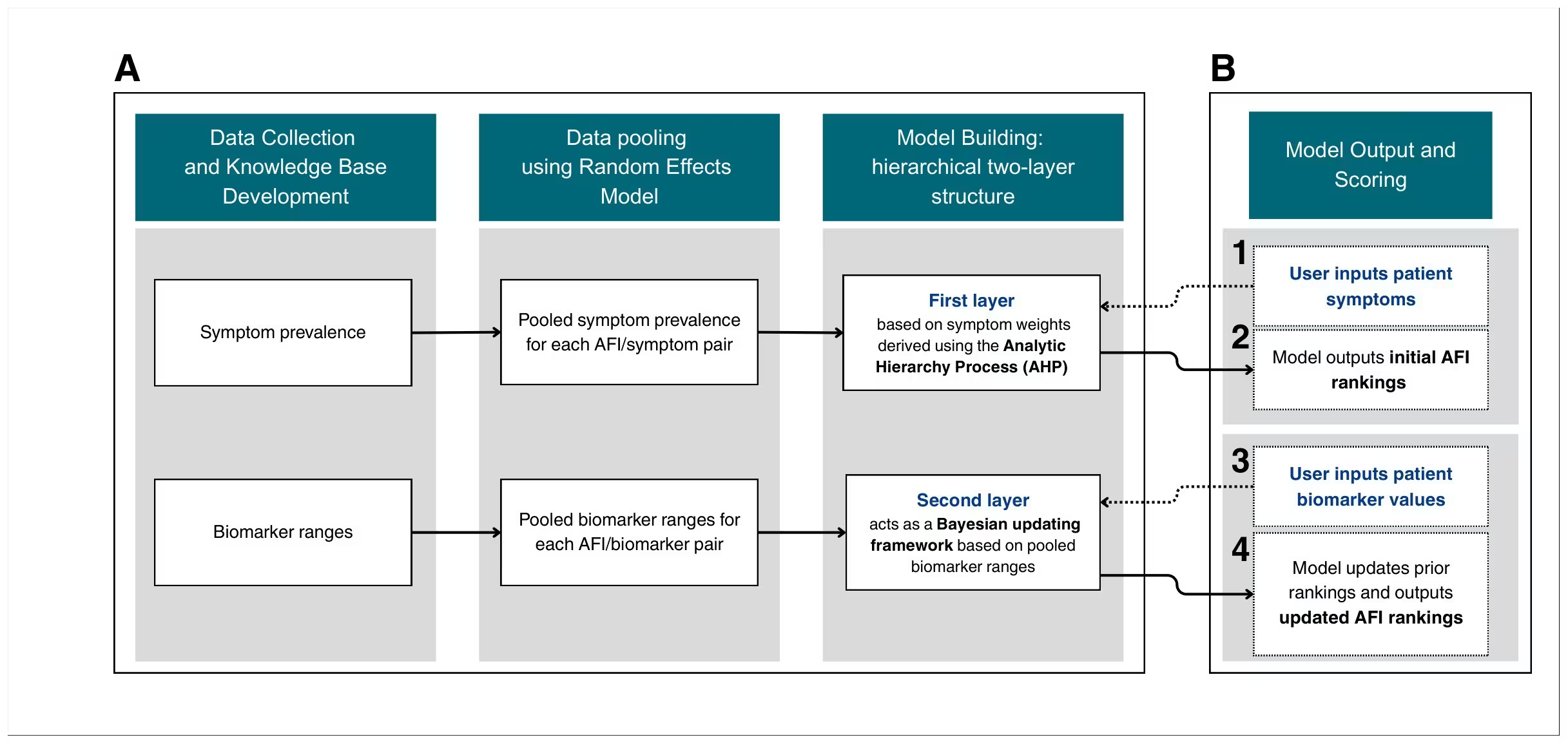
The newly devised system mimics the intuitive reasoning process of a clinician through two distinct analytical steps. The first layer applies a multi-criteria decision technique known as the Analytic Hierarchy Process, utilizing symptom prevalences pooled from over two hundred and eighty peer-reviewed studies to generate an initial disease ranking. The second layer refines these scores by incorporating routinely available laboratory biomarkers, such as platelet counts, hematocrit levels, liver enzymes, and C-reactive protein measurements, through a Bayesian updating framework.
How Well Did the Model Perform on Real-World Patient Data?
The investigators tested their framework retrospectively against four independent clinical datasets comprising thousands of patients from regions including Malaysia, Vietnam, Tanzania, and Sri Lanka. Performance was measured by the top-three accuracy metric, reflecting how often the correct diagnosis appeared among the top three model recommendations. Across mixed-etiology cases, using symptoms alone yielded a mean top-three accuracy of about thirty-six percent, which jumped to over seventy-one percent when laboratory biomarkers were added. In datasets dedicated to dengue fever, combining clinical signs and biomarkers achieved top-three diagnostic accuracies ranging from eighty-five to nearly ninety-two percent.
What Are the Practical Limits and Next Steps for This Tool?
The authors note several important limitations, including the assumption of single infections per patient, the use of clinical reference ranges to impute missing biomarker data, and considerable geographic heterogeneity in the underlying literature. Furthermore, the model currently accounts for ten major tropical infections and excludes demographic variables such as age and gender. To operationalize their findings, the research team built an exploratory web-based prototype named FebriLogic, intended strictly for research and decision-support exploration rather than definitive clinical diagnosis.
The research was published in PLOS Digital Health on November 24, 2026.
This article has been fact checked for accuracy, with information verified against reputable sources. Learn more about us and our editorial process.
Last reviewed on .
Article history
- Latest version
Reference(s)
- Mohamed, Yasmine M.., et al. “A novel two-layer diagnostic model for the differential diagnosis of acute febrile illnesses: Applying analytic hierarchy process and Bayesian-inspired evidence updating to real-world data.” PLOS Digital Health, vol. 5, no. 11, November 24, 2026, pp. e0001846 Public Library of Science (PLoS), doi: 10.1371/journal.pdig.0001846. <https://doi.org/10.1371/journal.pdig.0001846>.
Cite this page:
- Posted by Sana Malik