New Mathematical Method Catches Stealthy Cyber Attacks Hiding Inside Patient Vitals
By measuring hidden disagreements between network traffic and vital signs, researchers improve attack detection in connected medical devices.
When connected medical devices send altered data that still looks normal on its own, security systems often miss the danger. Researchers have now developed a new way to catch these stealthy breaches by measuring the hidden disagreements between network traffic and patient vital signs.
How Can We Spot Disagreements Between Cyber and Medical Data?
Modern connected healthcare systems link pacemakers, infusion pumps, and hospital monitors to wireless communication networks so doctors can track patient health in real time. While this technology improves remote clinical responsiveness, it also creates security vulnerabilities where attackers can manipulate data packets or inject false readings. Because individual cyber or biomedical values often stay within plausible ranges, standard security tools frequently fail to notice when an attack disrupts the underlying relationship between network activity and physiological status.
To address this blind spot, Adel Aboud Bahaddad and Ahmed Mohammed Alghamdi from Taif University developed a leakage-controlled trigonometric cyber-biomedical phase embedding, published in PLOS One. Rather than treating network packet timing and patient measurements as entirely separate streams, the new method maps each variable to an empirical reference coordinate based on normal training behavior. The authors designed a mathematical operator that quantifies cross-layer disagreement without requiring access to continuous physiological waveforms.
What Does the Phase-Gap Operator Actually Measure?
The core innovation transforms heterogeneous network and clinical variables into bounded circular coordinates using smoothed empirical distribution functions. This mathematical transformation places variables measured on vastly different physical scales, such as network jitter, packet transmission delays, blood pressure, and oxygen saturation, onto a common reference scale.
The framework then constructs pairwise phase-gap variables that measure relative disagreement between every cyber feature and every biomedical feature. The resulting system evaluates three levels of information: marginal reference positions, pairwise cyber-biomedical discrepancies, and record-level irregularity summaries. All reference parameters are estimated exclusively from normal training records and applied unchanged to held-out test data, ensuring that no information leaks from the test set during evaluation.
Which Components Drive the Detection Gains?
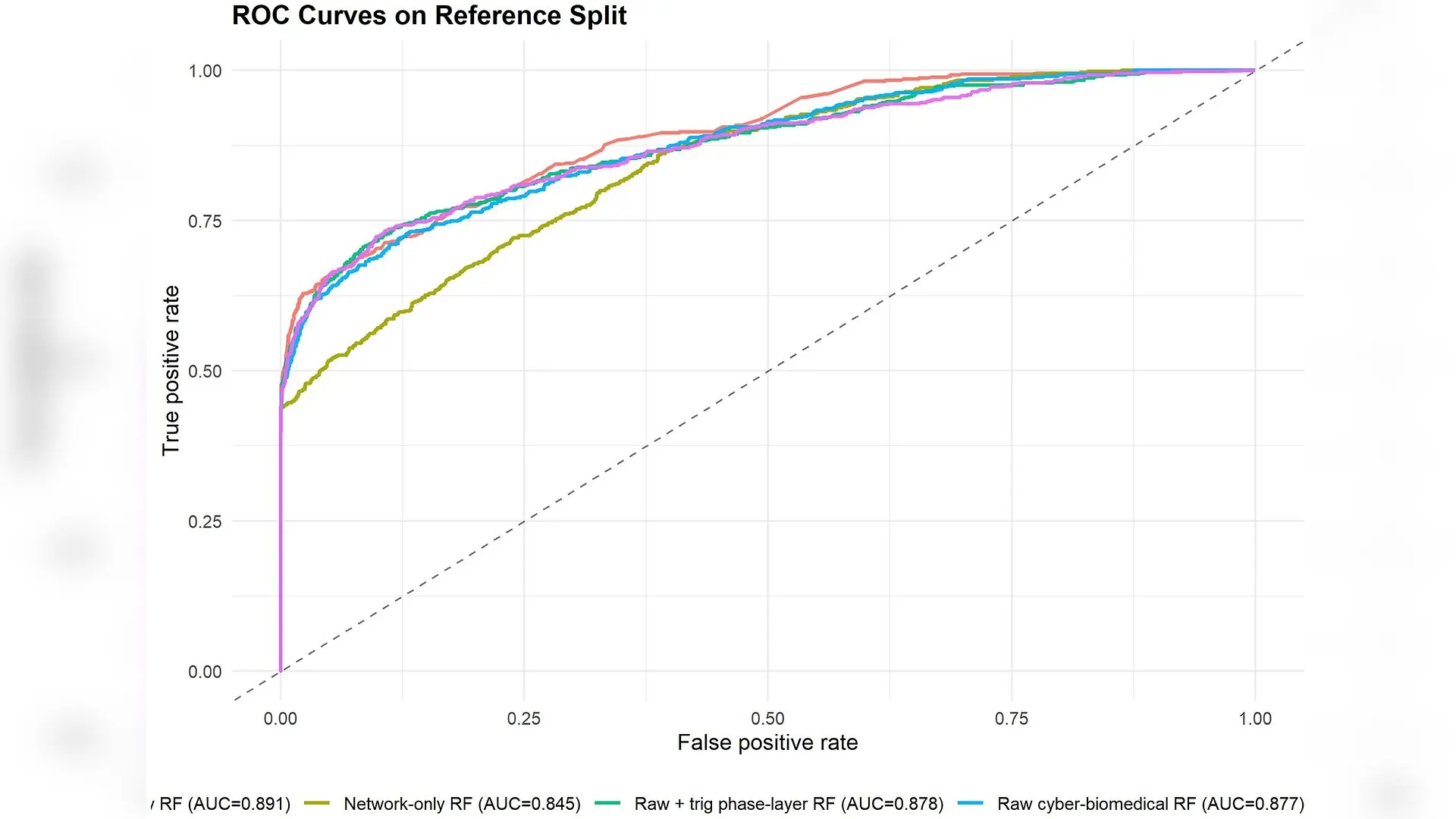
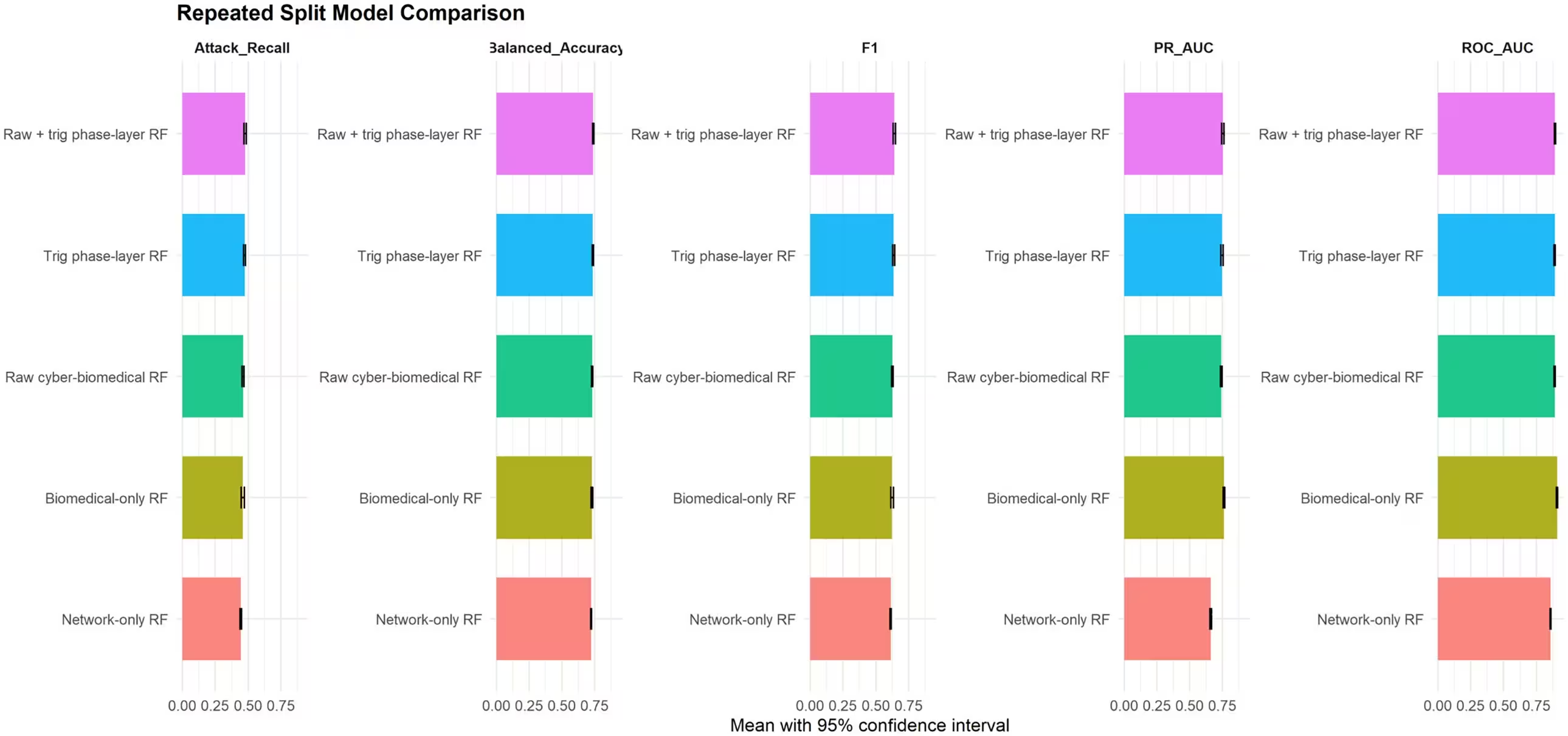
The authors evaluated the representation using the WUSTL-EHMS-2020 dataset, which contains sixteen thousand three hundred eighteen records combining network-flow variables and biomedical measurements. Using ten repeated stratified train-test splits with a seventy-thirty data allocation, the team compared five model views ranging from network-only and biomedical-only classifiers to raw fusion and phase-augmented configurations.
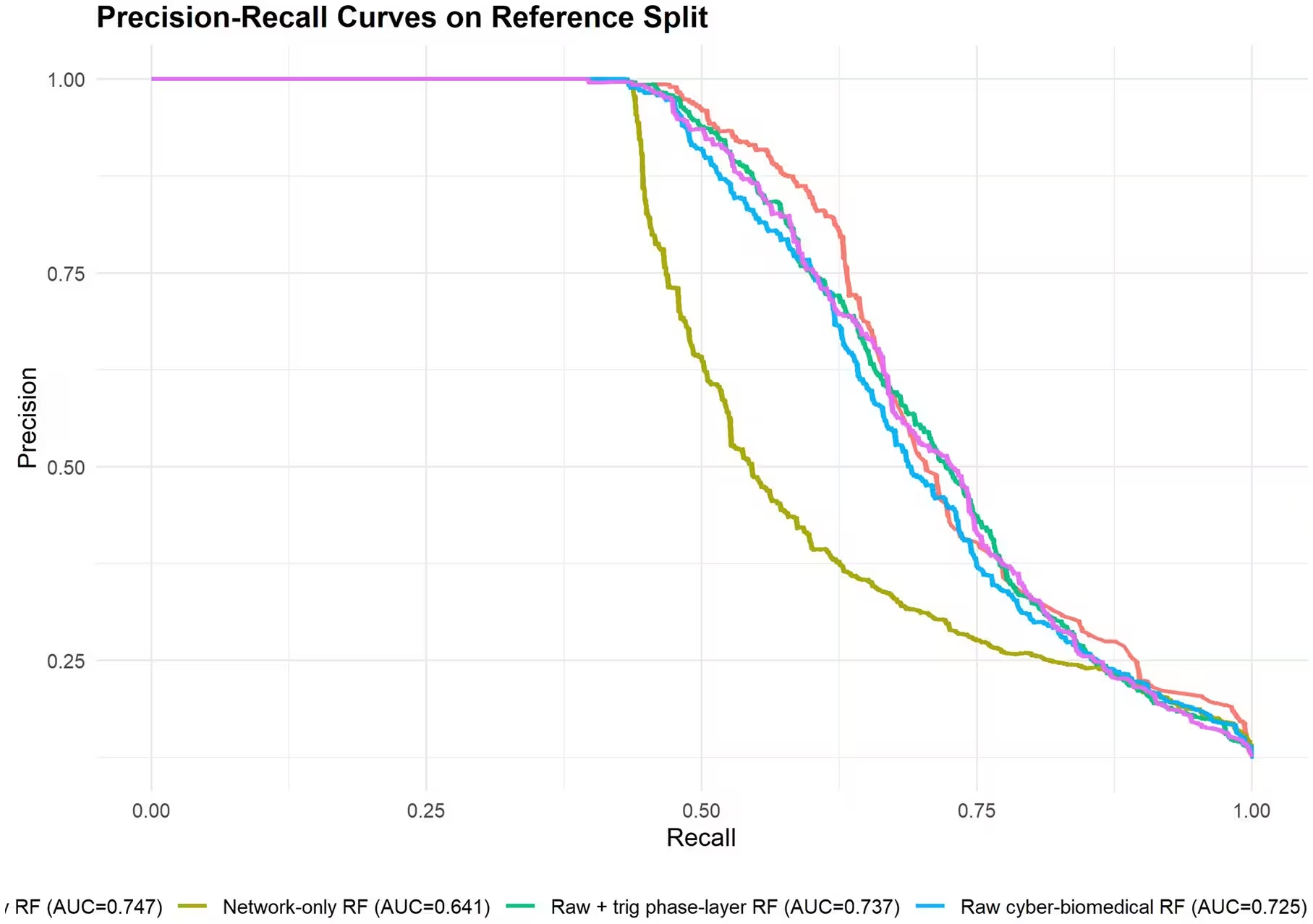
Augmenting raw fusion with the complete phase-derived representation increased balanced accuracy from seventy-three percent to seventy-three point eight percent at a fixed decision threshold of zero point five. Attack recall rose from forty-six point one percent to forty-seven point eight percent, while the precision-recall area under the curve improved from zero point seven hundred forty to zero point seven hundred fifty-one.
Component-level ablation analyses revealed that the performance gains came almost entirely from the phase-gap block rather than from marginal trigonometric coordinates. Adding only the marginal sine-cosine expansion provided little additional held-out benefit, whereas the reduced phase-gap configuration achieved a balanced accuracy of seventy-four point two percent and a precision-recall score of zero point seven hundred sixty-four.
What Are the Limits of the New Detection Method?
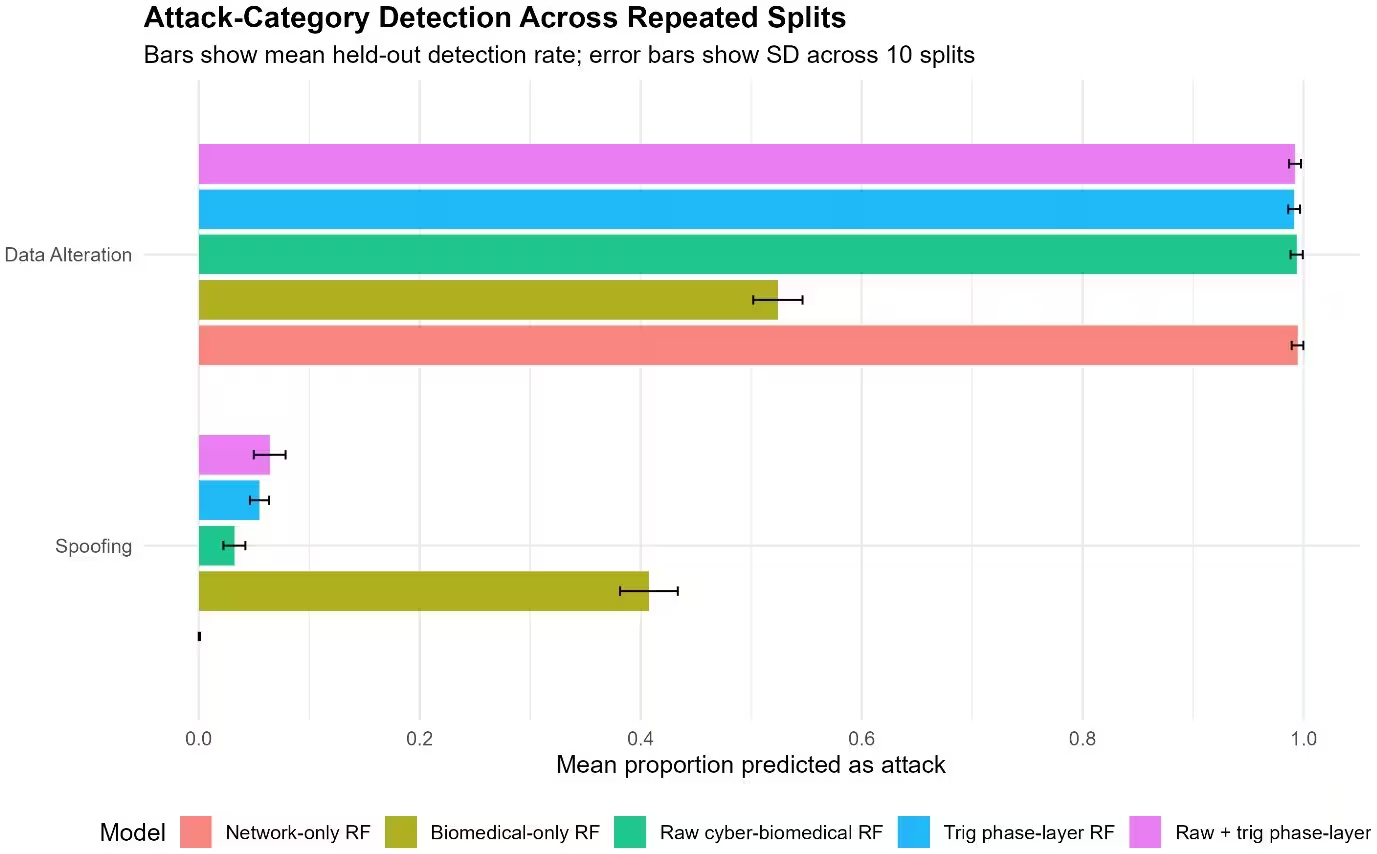
Despite these improvements, the analysis uncovered significant performance disparities across different attack categories. All model views detected data-alteration attacks with sensitivities exceeding ninety-nine percent, but spoofing attacks remained extremely difficult to spot, with detection rates staying below seven percent for the fused models at the default threshold.
The authors note that the validation was performed at the record level within a single benchmark dataset without explicit grouping identifiers for individual devices, patients, or attack sessions. Consequently, the results demonstrate repeated record-level generalization rather than proven robustness across different clinical environments or patient populations. Future work must test whether these phase-gap representations maintain their effectiveness when applied to independent external healthcare systems and calibrated decision thresholds.
The research was published in PLOS One on November 25, 2026.
This article has been fact checked for accuracy, with information verified against reputable sources. Learn more about us and our editorial process.
Last reviewed on .
Article history
- Latest version
Reference(s)
- Bahaddad, Adel Aboud., et al. “Trigonometric cyber-biomedical phase embedding for IoMT attack detection.” PLOS One, vol. 21, no. 11, November 25, 2026, pp. e0353225 Public Library of Science (PLoS), doi: 10.1371/journal.pone.0353225. <https://doi.org/10.1371/journal.pone.0353225>.
Cite this page:
- Posted by Joseph Jackson