ENT Opioid Prescriptions Fell 38 Percent But Oxycodone Doubled
A national Medicare analysis reveals shifting painkiller choices and stark regional divides among ear, nose, and throat surgeons.

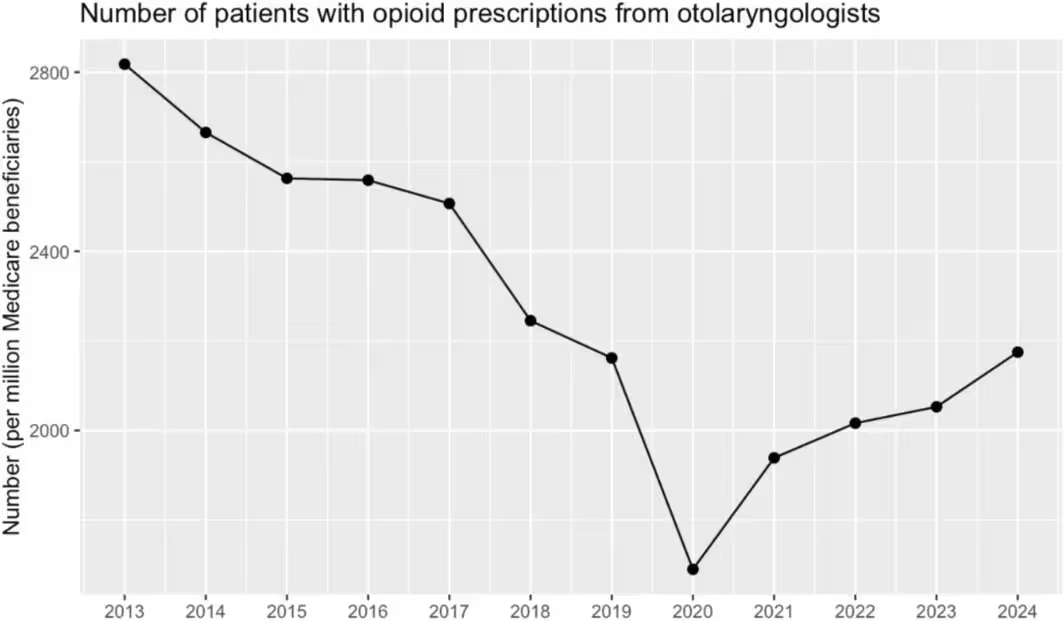
Ear, nose, and throat specialists significantly reduced their overall opioid prescribing rates over an eleven-year period, but their choice of drugs shifted dramatically toward stronger substances like oxycodone. A team of researchers analyzed Medicare Part D claims from 2013 through 2024 to map prescribing habits across the United States. Their findings reveal that while total prescription volume, patient counts, and total days supplied fell sharply, a simultaneous surge in alternative painkillers highlights new challenges for medical stewardship.
How ENT Prescribing Habits Shifted Across a Decade
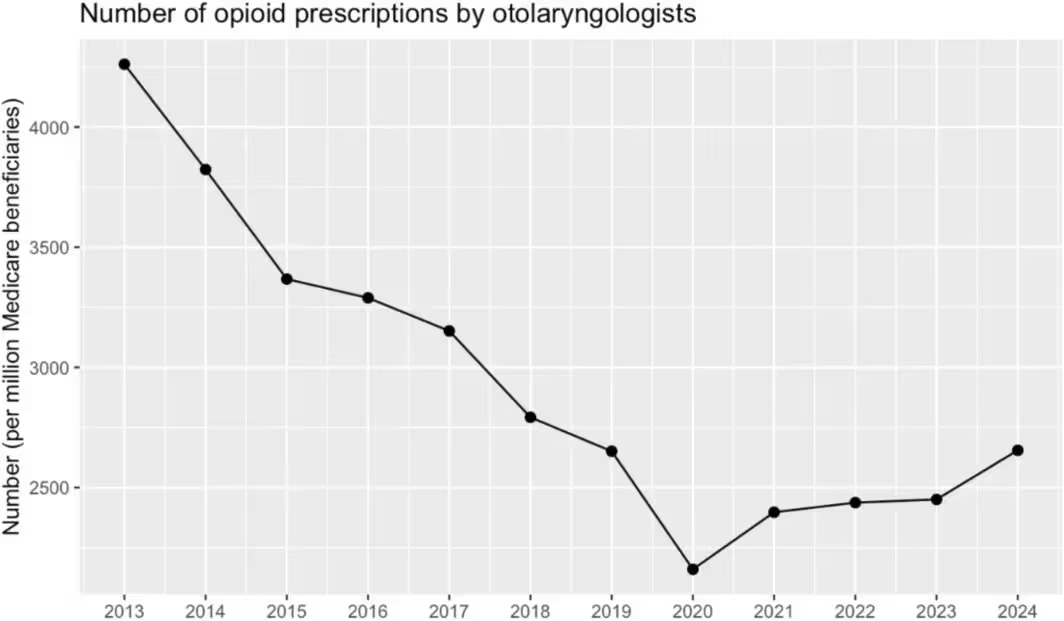
To evaluate longitudinal trends, Larry W. Wang and colleagues examined the Centers for Medicare & Medicaid Services Part D Prescribers database, tracking annual prescription counts, patient counts, total days supplied, and total costs normalized per one million beneficiaries. The complete analysis is published in Laryngoscope Investigative Otolaryngology. Between 2013 and 2024, annual opioid prescriptions issued by otolaryngologists dropped by 37.7%, falling from 4,261 to 2,655 per million beneficiaries. Total days supplied decreased by 44.7%, and inflation-adjusted costs dropped by 53.5%.
Every measured utilization metric reached a low point in 2020, coinciding with the widespread disruption of elective medical procedures during the COVID-19 pandemic. From 2020 onward, annual prescriptions partially rebounded by 22.9%, though they remained well below historical highs. Despite the drop in overall volume, the types of medications prescribed underwent a profound transformation.
Why Hydrocodone Declined While Oxycodone Nearly Doubled
Hydrocodone remained the most frequently prescribed opioid throughout the study period, but its dominance eroded significantly. Hydrocodone prescriptions fell by 57.1%, and its share of all ear, nose, and throat opioid prescriptions dropped from 77.6% in 2013 to 53.4% in 2024. Codeine experienced an even steeper decline of 74.9%, heavily influenced by past federal safety warnings and contraindications regarding pediatric tonsillectomy patients.
In stark contrast, oxycodone prescriptions surged by 92.2%, climbing from 10.9% to 33.5% of the specialty’s total opioid distribution. Statistical models demonstrated that oxycodone drove much of the post-2020 prescribing growth. Meanwhile, tramadol prescriptions increased by 70.0%, rising to 9.6% of the total share. Experts note that the shift toward oxycodone carries clinical implications because it carries a greater overdose risk per prescription than hydrocodone.
Persistent Regional Divides and Study Limitations
The research also uncovered stark geographic disparities in how painkillers are distributed. The Southern region recorded the highest cumulative prescribing volume with 800,507 claims per million beneficiaries, whereas the Northeast recorded the lowest at 136,997 claims. This created a nearly six-fold regional difference in prescribing frequency. States like Alabama, Louisiana, and Delaware topped the distribution lists, while several Northeastern states clustered at the bottom.
The authors acknowledged several limitations inherent to cross-sectional administrative datasets. Medicare Part D claims do not capture specific clinical indications, exact surgical procedures, patient pain severity, or morphine milligram equivalents consumed. Furthermore, the observational design cannot prove direct cause and effect, meaning researchers can only establish temporal associations rather than attribute changes to a single policy or guideline. Nonetheless, the authors emphasize that future stewardship efforts must look beyond raw prescription volumes to address drug composition and regional inequalities.
The research was published in Laryngoscope investigative otolaryngology on December 1, 2026.
This article has been fact checked for accuracy, with information verified against reputable sources. Learn more about us and our editorial process.
Last reviewed on .
Article history
- Latest version
Reference(s)
- Wang, Larry W.., et al. “Opioid Prescription Trends by Otolaryngologists for Medicare Part D Patients.” Laryngoscope Investigative Otolaryngology, vol. 11, no. 6, October 29, 2026 Wiley, doi: 10.1002/lio2.70568. <https://doi.org/10.1002/lio2.70568>.
Cite this page:
- Posted by Sana Malik