Autonomous Vehicle Platoons Cut Road Energy Use By Nearly a Third
Simulations reveal that intelligent platoon leaders can eliminate stop-and-go gridlock and smooth urban traffic flows, though human-driven cars still face efficiency hurdles.
Autonomous vehicles can slash road transport energy use by nearly a third at high adoption levels, but only if they actively take charge of mixed traffic streams containing human drivers. That is the conclusion of a study exploring how connected self-driving cars can guide human-driven vehicles through congested urban corridors to eliminate stop-and-go gridlock.
Road transport is a major contributor to global climate pressure, accounting for roughly three quarters of all energy-related carbon dioxide emissions from the transportation sector. As cities prepare for a transition phase where robotically controlled cars share asphalt with human drivers, researchers have struggled with a major roadblock. While connected autonomous vehicles operate efficiently in isolation, human driving habits typically introduce erratic speed fluctuations that trigger traffic waves and burn extra fuel. To tackle this challenge, a research team published in PLOS ONE investigated a cooperative strategy that uses self-driving cars as platoon leaders to smooth out the flow.
How Autonomous Platoon Leaders Coordinate Mixed Traffic Flows
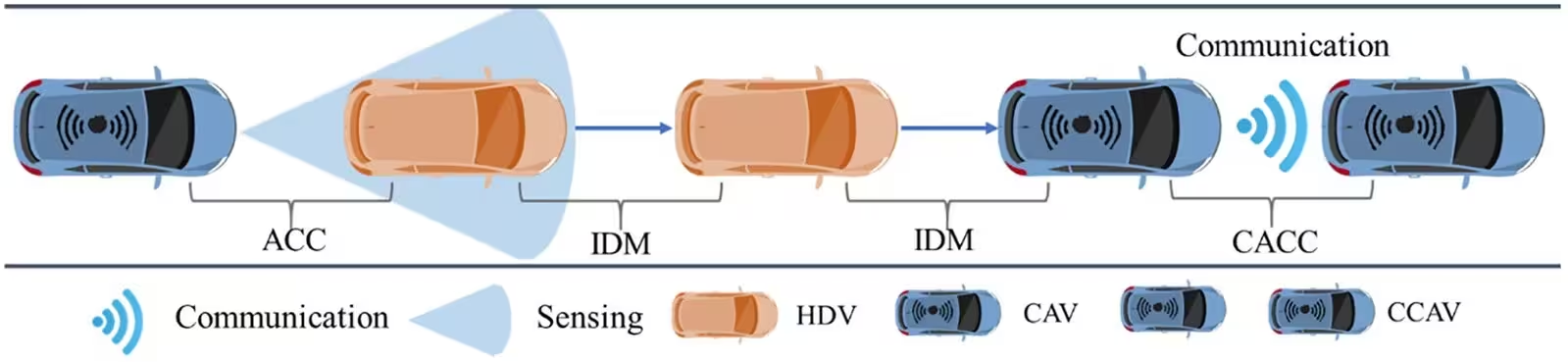
The research team, led by scientists from Yunnan Yunling Highway Science and Technology and the Kunming University of Science and Technology, developed a two-stage control framework designed for signalized intersections. Traditional eco-driving systems usually focus on single vehicles, assuming an idealized environment where every car shares data. In reality, urban streets feature a complex mix of human-driven vehicles (HDVs), connected autonomous vehicles (CAVs) relying on onboard sensors, and fully cooperative connected-automated vehicles (CCAVs) utilizing vehicle-to-vehicle communication.
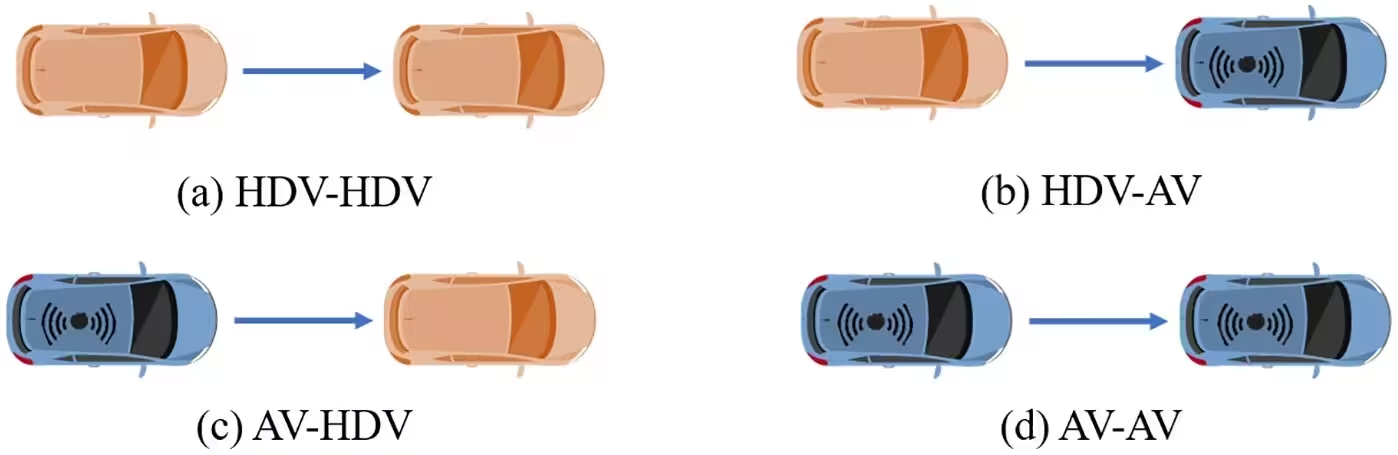
To capture these real-world dynamics, the authors built a mathematical model categorizing four distinct following behaviors, ranging from human-led queues to fully automated platoons. The upper layer of their optimization model adjusts traffic signal timing to maximize green-light utilization based on approaching vehicle groups. Meanwhile, the lower layer optimizes the trajectory of the lead vehicle to minimize fuel consumption. By solving this complex mathematical puzzle using a customized particle swarm optimization algorithm, the team simulated how a two-way, four-lane intersection would handle varying densities of intelligent vehicles.
What Happens When Autonomous Vehicle Penetration Increases
The simulations revealed a striking correlation between the proportion of self-driving cars on the road and overall energy efficiency. When the autonomous vehicle penetration rate reached 80 percent, average energy consumption dropped by approximately 32.6 percent compared to baseline scenarios with only 20 percent adoption. At high adoption levels, cooperative vehicles successfully formed a coordinated green band that virtually eliminated the traditional stop-and-go phenomenon at traffic lights.
The data showed that fully cooperative connected vehicles saw their stops reduced to zero at high penetration rates, while their average intersection delays dropped to between 8 and 30 seconds depending on the exact traffic configuration. Furthermore, the presence of these intelligent platoon leaders helped dampen the disruptive braking waves usually caused by human drivers behind them, reducing human-driven vehicle stopping incidents by about 50 percent.
Why Human Drivers Still Face Energy Challenges
Despite the overall gains, the study uncovered a persistent friction point involving human-driven vehicles. While autonomous cars and cooperative vehicles enjoyed continuous energy reductions as their numbers grew, human-driven vehicles experienced an upward tick in energy consumption under high-penetration conditions.
The authors explain that because human driving behavior remains stochastic and unpredictable, human drivers frequently feel compelled to adjust their speeds to match the dynamic shifts of the surrounding traffic flow. Lacking direct digital communication with the traffic signals or the leading automated cars, these manual adjustments result in micro-accelerations and braking events that generate local energy inefficiencies.
The research team acknowledges certain limitations in their current model, such as focusing primarily on longitudinal dynamics on flat roads and utilizing deterministic simulation runs due to high computational demands. Nevertheless, the findings indicate that managing the transition phase of mixed traffic requires active infrastructural coordination rather than passive automation alone, offering a clear blueprint for greener urban transit systems.
The research was published in PloS one on January 1, 2026.
This article has been fact checked for accuracy, with information verified against reputable sources. Learn more about us and our editorial process.
Last reviewed on .
Article history
- Latest version
Reference(s)
- Wen, Ruoyi., et al. “Two-stage cooperative optimisation of signal timing and vehicle trajectories for eco-driving at signalised intersections under HDV/CAV/CCAV mixed traffic.” PLOS One, vol. 21, no. 10, October 27, 2026, pp. e0359104 Public Library of Science (PLoS), doi: 10.1371/journal.pone.0359104. <https://doi.org/10.1371/journal.pone.0359104>.
Cite this page:
- Posted by Raj Joshi