Engineered Magnetic Nanoparticles Reach Custom Sizes for Improved Drug Delivery
Adjusting reaction heating rates and polymer groups yields tunable iron oxide particles with enhanced biomolecule carrying capacity.
Tiny magnetic iron oxide particles used in medical scans can now be built in customized sizes and surface chemistries through a single-step manufacturing process. This new technique addresses long-standing hurdles in nanomedicine where standard production methods yield uneven particle sizes that limit how many therapeutic molecules they can carry.
Magnetic iron oxide particles are widely used in healthcare, acting as contrast agents in magnetic resonance imaging and as heat-generating agents to help fight brain tumors during hyperthermia treatments. However, conventional manufacturing relies on a cumbersome two-step process involving chemical precipitation followed by separate surface coating steps. This often results in irregular particle dimensions and poor batch consistency, which restricts their clinical utility and makes it difficult to attach precise amounts of targeted drugs.
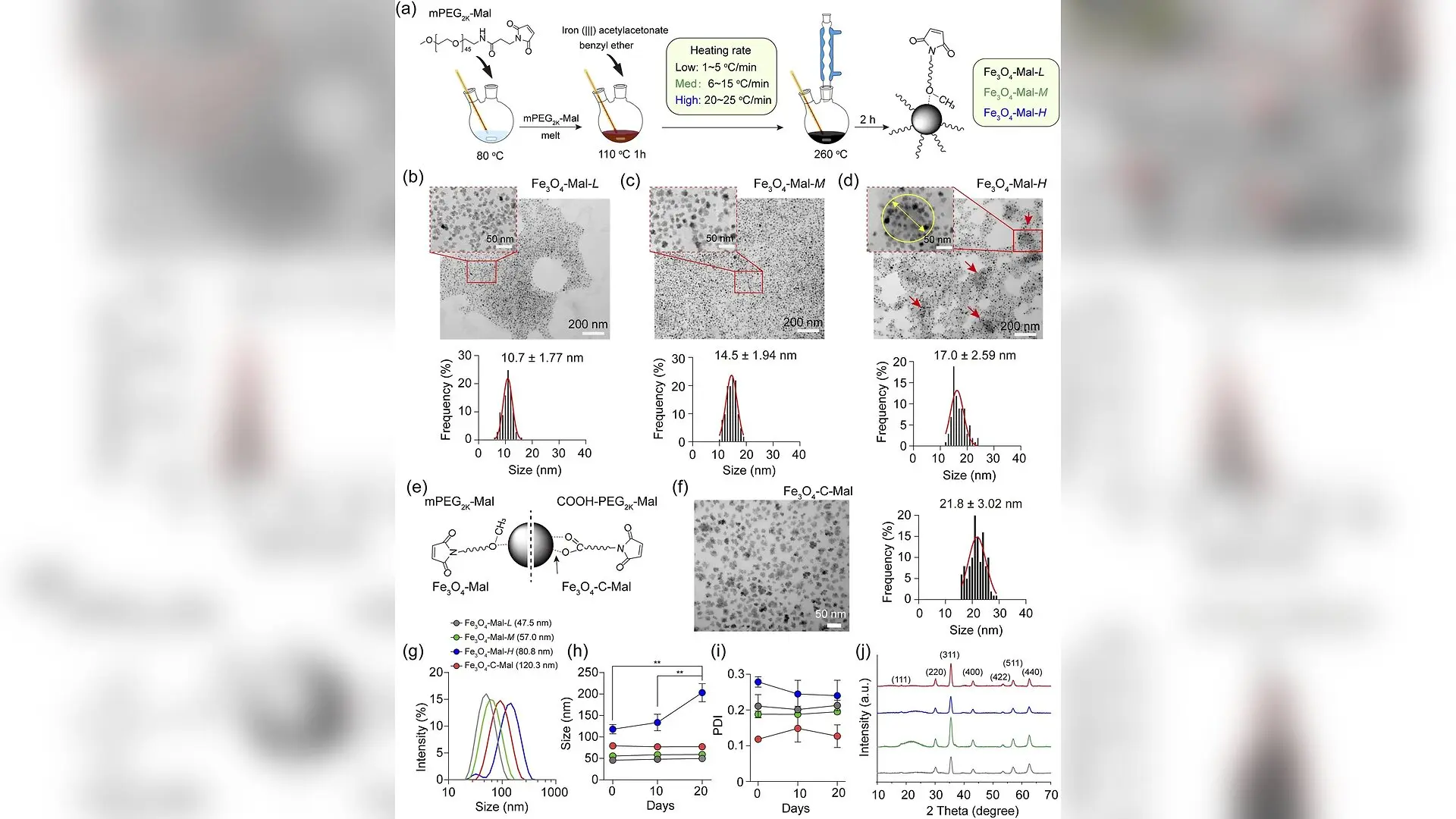
To overcome these manufacturing hurdles, researcher Jianlong Su and colleagues at the Dalian University of Technology developed a refined one-pot synthesis strategy. Their findings are published in RSC Advances, detailing how adjusting heating speeds and chemical terminal groups alters the final dimensions of the particles. By changing the temperature ramping speed from slow to rapid during thermal decomposition, the team controlled the balance between crystal nucleation and surface passivation.
How Does Adjusting Heating Rates Change Particle Growth?
When the researchers increased the heating rate during synthesis, the average diameter of the resulting particles expanded from about ten nanometers up to seventeen nanometers. Rapid heating causes precursor molecules to decompose quickly, creating a high concentration of building blocks that trigger burst nucleation. If surrounding stabilizing molecules cannot keep pace with this rapid growth, larger particles begin to dominate the mixture.
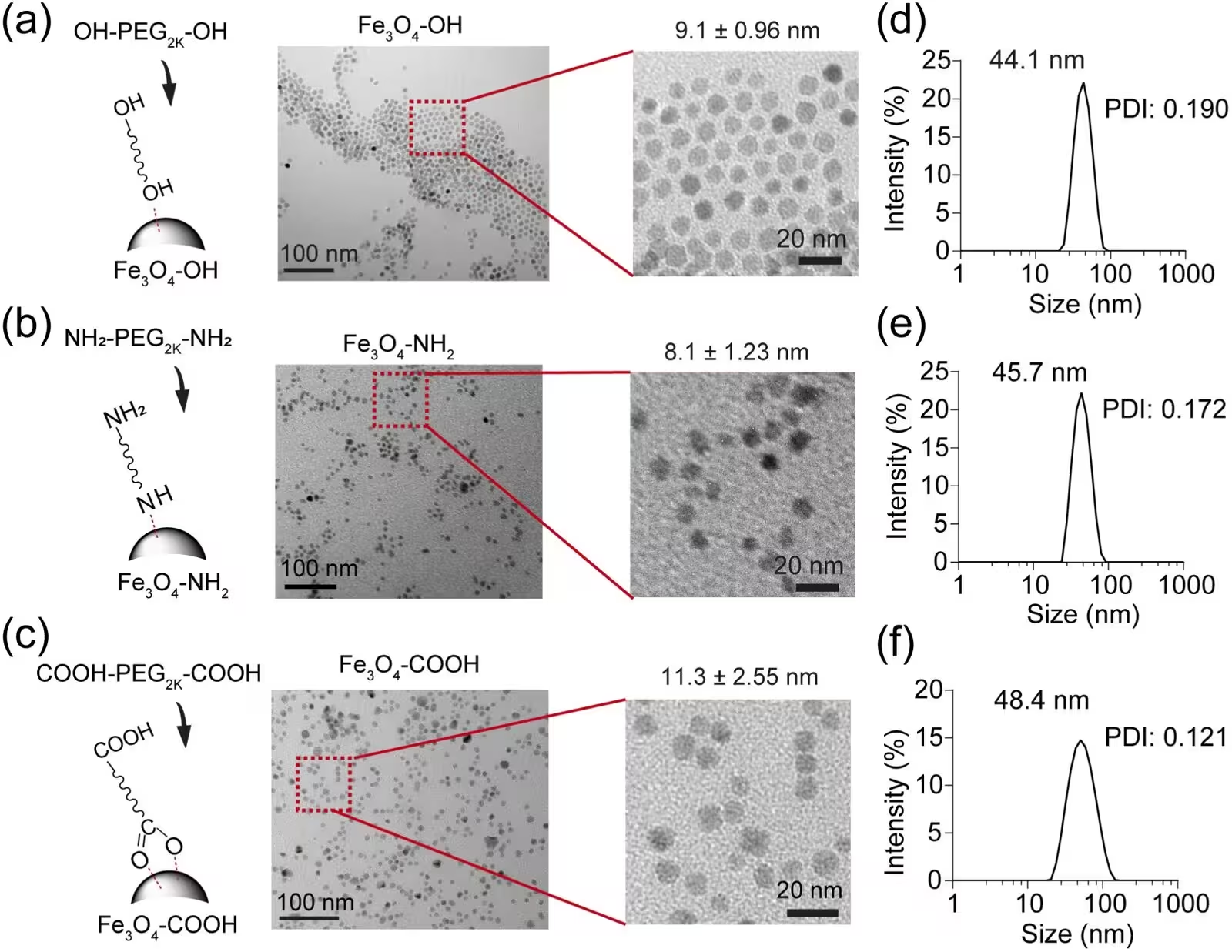
However, pushing the heating rate too high also led to unwanted particle aggregation, creating clumps larger than one hundred nanometers. To prevent this clumping while still achieving larger dimensions, the team substituted the outer chemical groups on the stabilizing polymer chains. Swapping a standard terminal group for a carboxyl group allowed them to produce stable particles measuring about twenty-one nanometers across with no visible aggregation.
Why Do Larger Nanoparticles Improve Drug Delivery Capacity?
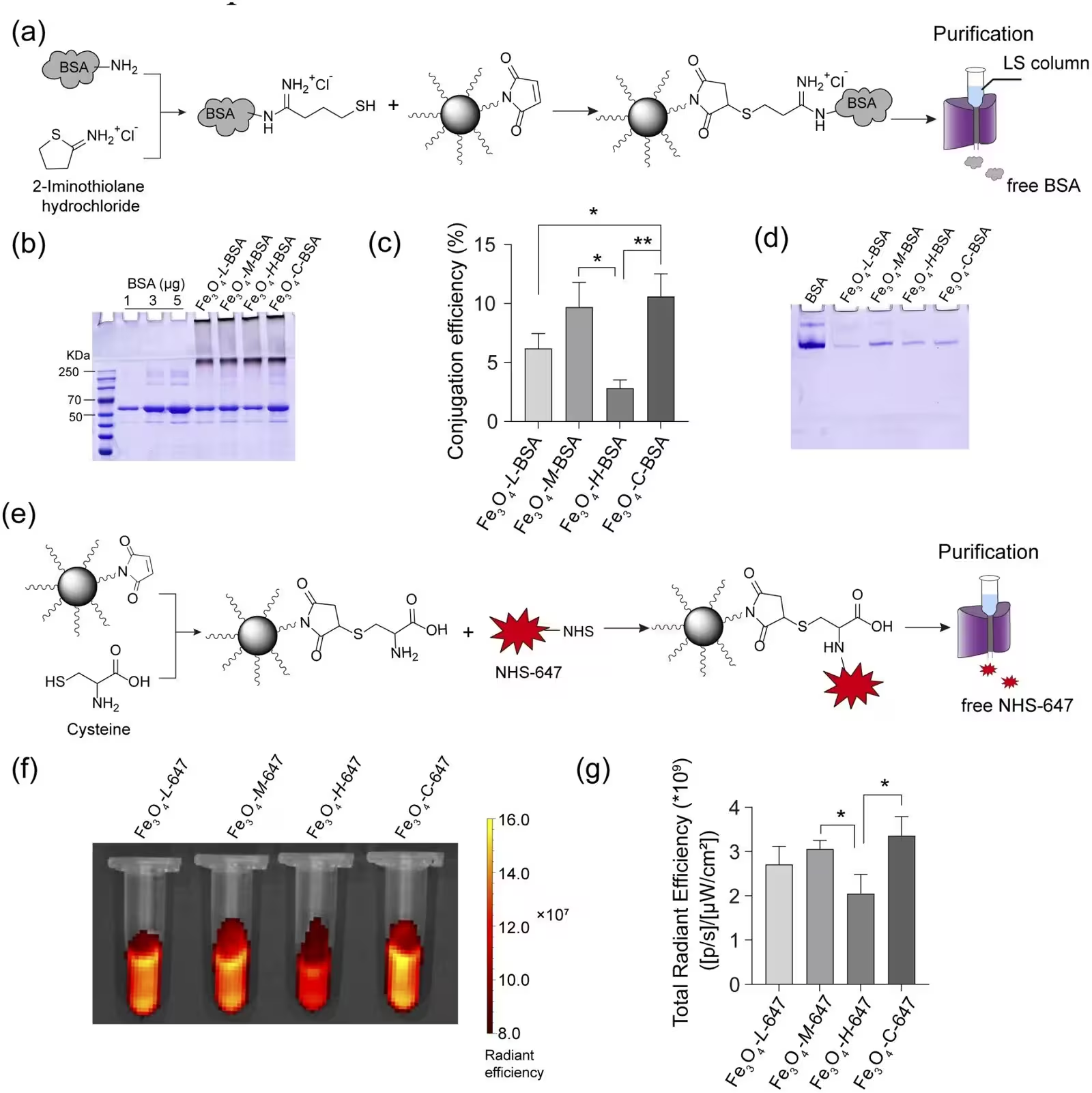
To test how effectively these engineered carriers could hold cargo, the team attached model molecules including proteins and small fluorescent tags to the particle surfaces. Larger particles provided significantly higher conjugation efficiency compared to smaller or clumped variants. This enhanced capacity means that a greater payload of therapeutic proteins or targeting ligands can be attached to each individual carrier, improving their potential for precision medicine.
Biological safety tests in mice further demonstrated that the twenty-one nanometer carboxyl-terminated particles caused no detectable liver toxicity or abnormal tissue inflammation over the testing period. Blood enzyme levels remained normal, and tissue examinations showed healthy cellular structures in major organs including the heart, liver, spleen, lungs, and kidneys.
What Challenges Remain Before Clinical Use?
While the streamlined synthesis avoids separate coating steps and successfully controls particle dimensions, the study highlights distinct trade-offs in manufacturing. Smaller particles generated with certain chemical groups exhibited reduced magnetic responsiveness, requiring alternative purification methods like ultrafiltration instead of magnetic columns. Future work will need to optimize these surface variations further to ensure that scalable production maintains both high magnetic separation efficiency and uniform drug-loading capabilities for diverse clinical and environmental applications.
The research was published in RSC advances on November 23, 2026.
This article has been fact checked for accuracy, with information verified against reputable sources. Learn more about us and our editorial process.
Last reviewed on .
Article history
- Latest version
Reference(s)
- Su, Jianlong., et al. “Size-tunable and surface-functionalized hydrophilic magnetic iron oxide nanoparticles prepared by one-pot synthesis.” RSC Advances, January 1, 2026 Royal Society of Chemistry (RSC), doi: 10.1039/d6ra09913k. <https://doi.org/10.1039/d6ra09913k>.
Cite this page:
- Posted by Rohan Kumar