How Soft Fingertips Sense Invisible Chemical Boundaries On Everyday Surfaces
A new study reveals how soft materials and human skin interact with chemical edges, pointing to unexpected asymmetries in friction perception.
Soft sliding friction plays a major role in human touch, helping us explore textures and objects using our fingertips, but the physical principles behind how we sense changes in surface chemistry have remained poorly understood. Researchers set out to solve the problem of how human skin perceives invisible chemical boundaries on a surface, which could eventually help engineers design better tactile displays and robotic sensors. A team led by Charles B. Dhong at the University studied how a soft, deformable probe slides across a single chemical boundary formed by different silane coatings on silicon wafers. The team discovered that chemical edges trigger complex friction patterns that depend heavily on sliding speed and applied weight, and that humans are surprisingly sensitive to certain types of friction changes while remaining oblivious to others.
How Do Chemical Boundaries Affect Soft Sliding Friction?
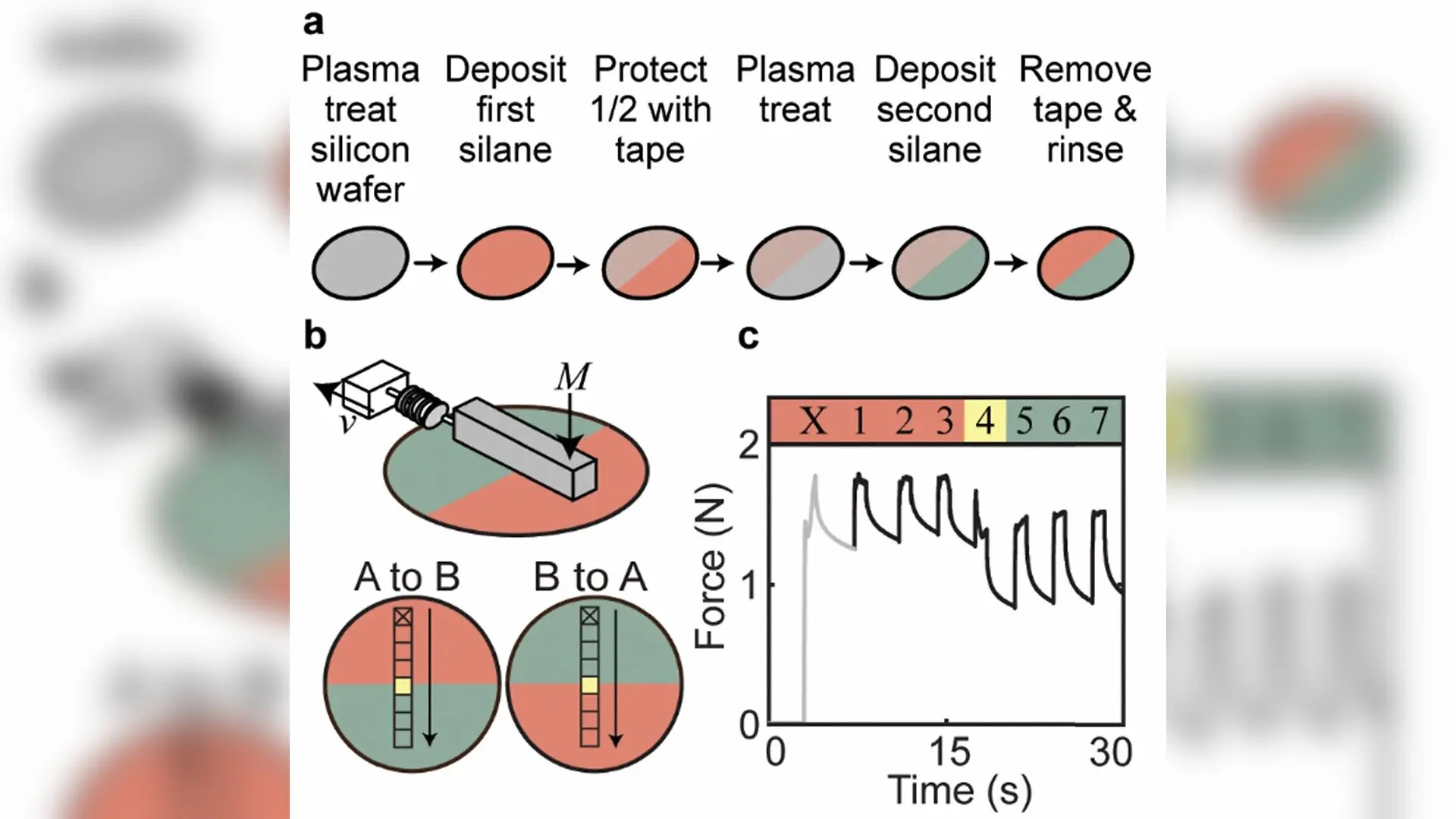
To investigate how microscopic chemical differences influence macroscale touch, Kayla A. Hepler and Leanne Ton fabricated silicon wafers divided into two distinct chemical regions. They used chlorosilanes including n-butyltrichlorosilane, known as C4, n-hexyltrichlorosilane, known as C6, and (3-aminopropyl)trimethoxysilane, known as APTMS, which features a terminal amine group that increases surface energy and water attraction. Because the surface roughness across these boundaries remained exceptionally low with differences of less than one hundred and fifty picometers, physical bumps were virtually eliminated so that chemical properties alone drove the friction.
The researchers mounted a rectangular probe made of polydimethylsiloxane, a flexible silicone elastomer, onto a motorized precision stage. This soft probe featured an embedded rigid rod mimicking the stiffness of a human finger bone. The probe was dragged across the chemical boundary under sixteen different combinations of applied mass ranging from zero to one hundred grams and sliding velocities ranging from five to forty-five millimeters per second. The full details of this investigation are published in Soft Matter, detailing how the mechanical history of sliding alters friction forces over successive passes.
What Surprising Patterns Emerge Across Velocity and Load Maps?
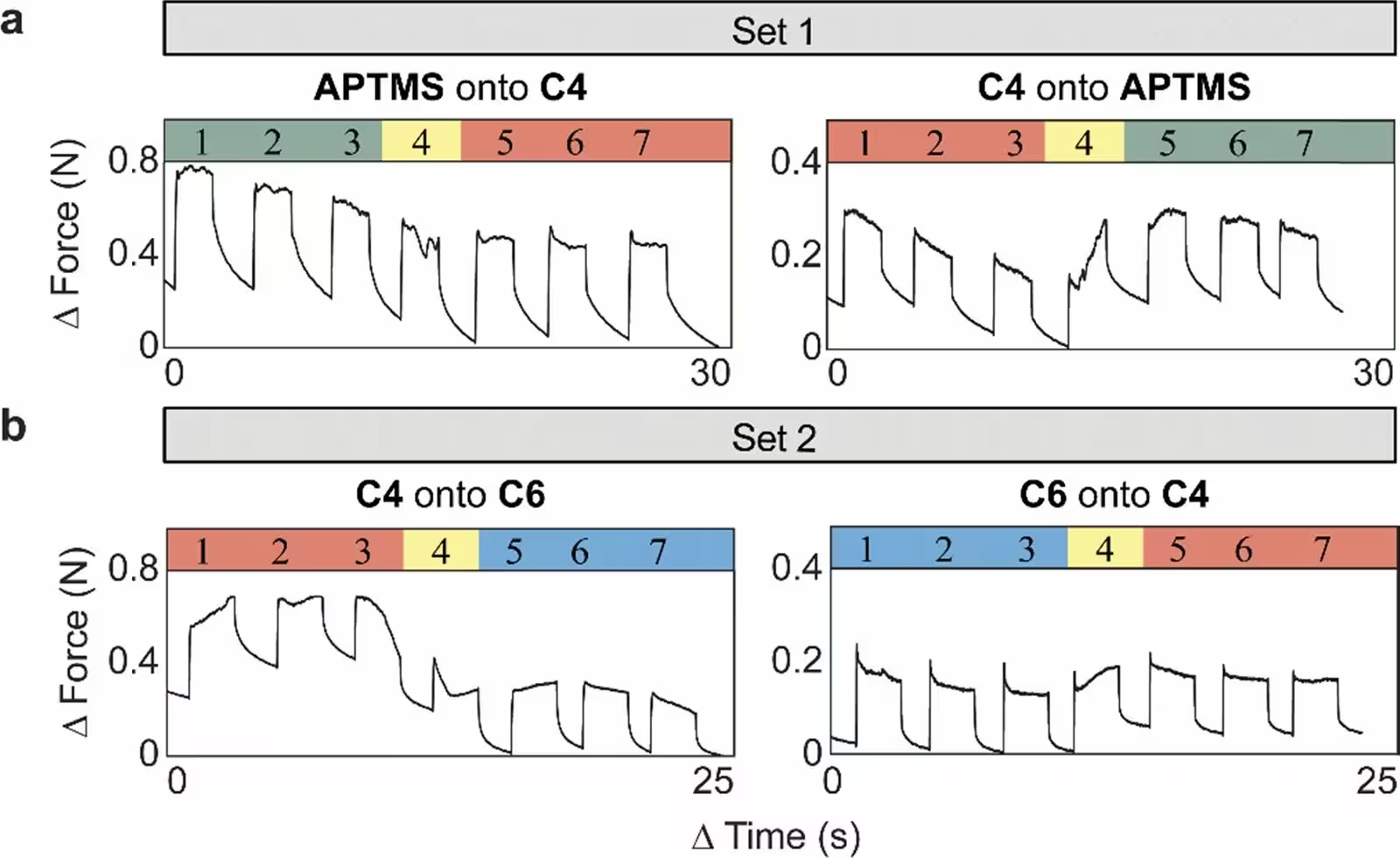
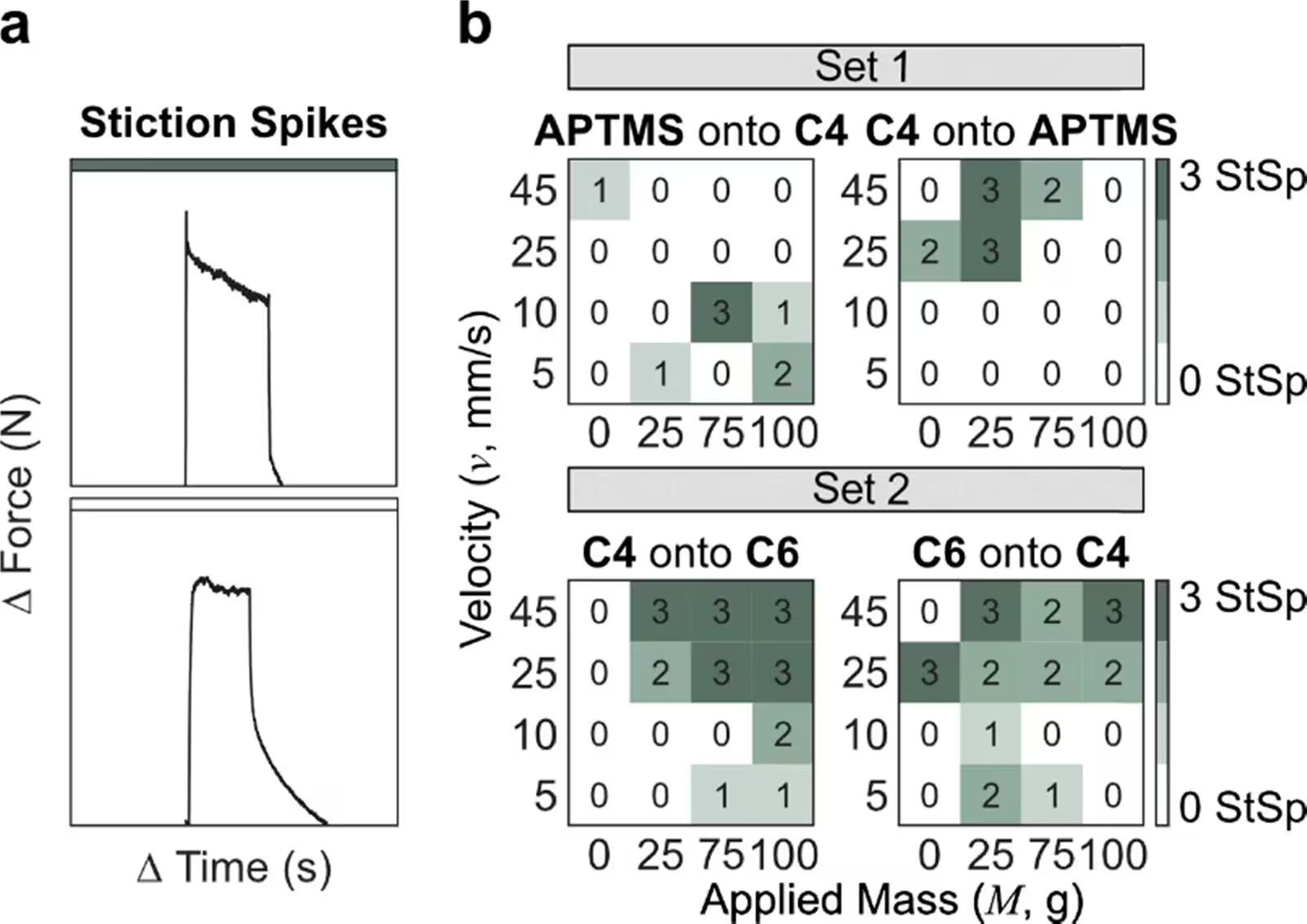
By mapping the friction measurements across different loads and speeds, the team identified four distinct frictional phenomena occurring at the chemical edge: stiction spikes, edge slopes, baseline force shifts, and baseline drift over sequential pulls. Interestingly, pairing C4 with C6, which are chemically very similar, produced remarkably symmetric friction phase maps. When sliding from C4 to C6, the friction force dropped, and when sliding in reverse, it rose symmetrically.
In contrast, pairing C4 with APTMS, which has a much higher chemical contrast and surface energy, created widespread and complex asymmetries. For instance, sliding from APTMS onto C4 often yielded unexpected positive slopes instead of the anticipated friction drop. The authors suggest that at higher velocities, the soft probe becomes pinned on the higher-friction APTMS region as it crosses the boundary, creating a rising resistive force that counteracts the expected drop on the lower-friction surface.
Why Can Humans Detect Some Friction Changes But Miss Others?
To connect these mechanical findings to human perception, ten human participants were asked to find the hidden chemical edge on unmarked samples within thirty seconds using their index fingers. In tests involving the C4 and APTMS pair, participants achieved high success rates around eighty percent regardless of sliding direction. However, in tests involving the C4 and C6 pair, participants successfully identified the edge sixty-eight percent of the time when sliding from C6 to C4, but their accuracy plummeted to forty-two percent in the reverse direction.
Comparing these perceptual outcomes to the physical phase maps revealed that human sensitivity correlates strongly with the slope of the friction force across the edge. Participants easily detected conditions where friction increased over the boundary, but struggled when friction decreased. This insight bridges the gap between material science and human haptic perception, offering a clear pathway for designing tactile graphics and advanced touch-feedback devices that align with human sensory limits.
The research was published in Soft matter on November 24, 2026.
This article has been fact checked for accuracy, with information verified against reputable sources. Learn more about us and our editorial process.
Last reviewed on .
Article history
- Latest version
Reference(s)
- Hepler, Kayla A.., et al. “Role of single chemical heterogeneities in generating anisotropic tactile sensitivity and soft sliding friction phenomena.” Soft Matter, January 1, 2026 Royal Society of Chemistry (RSC), doi: 10.1039/d6sm00588h. <https://doi.org/10.1039/d6sm00588h>.
Cite this page:
- Posted by Rohan Kumar