Microbe-Packed Soil Scaffolds Hide Environmental Risks
A review reveals that lab tests checking if remediation bacteria stay alive miss broader ecological dangers in farm soils.
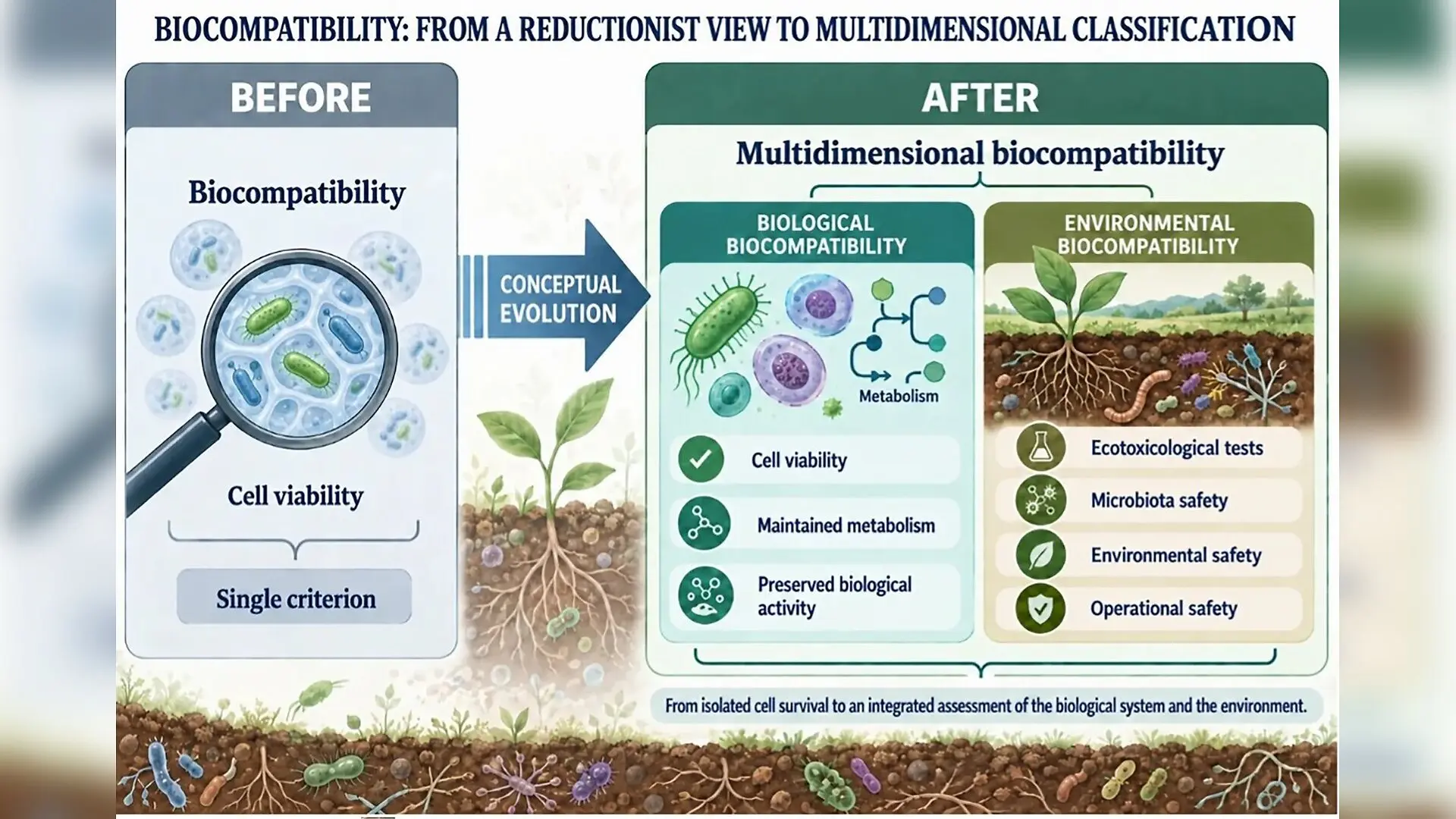
When agricultural scientists wrap beneficial microbes inside protective biomaterials to clean up toxic pesticides in contaminated soils, they often assume that keeping the cells alive means the material is entirely safe for the environment. A comprehensive review published in Biodegradation points out a critical flaw in this approach, revealing that laboratory tests focused solely on cell survival overlook broader ecological risks.
Why Cell Viability Alone Fails to Tell the Full Story
Modern farming relies heavily on synthetic chemicals to boost crop yields, but these compounds leave behind persistent residues that damage soil health. To counteract this, researchers design specialized scaffolds, such as biopolymer matrices, biochar composites, and organic waste supports, that anchor degrading bacteria and fungi directly into polluted earth. While these delivery systems effectively protect microorganisms from harsh environmental stress and boost pesticide degradation rates, scientists frequently stop testing once they confirm the embedded cells remain alive and metabolically active.
The authors of the review examined dozens of recent studies and discovered a widespread tendency to label these delivery structures as fully biocompatible based exclusively on cytocompatibility data. That narrow definition creates a dangerous blind spot. A material can easily support high bacterial survival while simultaneously releasing toxic chemical byproducts, altering local pH levels, or disrupting native microbial networks that maintain natural soil fertility.
The Hidden Dangers Lurking in Agricultural Soil Scaffolds
Introducing foreign support structures into agricultural fields triggers complex interactions that go far beyond simple pollutant breakdown. Synthetic polymers and specific biopolymeric materials can degrade unevenly, sometimes releasing phytotoxic residues or driving soil acidity down to damaging levels. Conversely, natural carriers designed to absorb heavy metals and organic pollutants can occasionally remobilize those dangerous elements back into the surrounding environment if the structural matrix destabilizes.
Furthermore, constant exposure to agricultural chemicals already places enormous pressure on native soil dwelling communities, frequently reducing beneficial populations such as nitrifying bacteria and mycorrhizal fungi. If a newly introduced remediation biomaterial lacks proper ecotoxicological screening, it might inadvertently worsen soil dysbiosis even while successfully neutralizing a targeted pesticide like atrazine or chlorpyrifos. Relying on medical industry testing standards also causes frequent false positives, because medical assays ignore the unique biological and chemical realities found in open agricultural soils.
Toward a Multidimensional Classification Framework
To resolve these widespread inconsistencies, the research team proposes a structured, multicriteria framework that divides biocompatibility into two distinct categories. The first category, biological or structural biocompatibility, evaluates the microenvironmental interface between the support matrix and the immobilized cells. This level confirms whether the carrier successfully preserves cellular adhesion, membrane integrity, and enzymatic activity using advanced techniques like scanning electron microscopy and targeted fluorescent viability assays.
The second category, environmental biocompatibility, requires rigorous ecotoxicological testing to guarantee safety for plants, local wildlife, and the broader soil microbiome. This advanced tier utilizes molecular and omics methods, including metagenomics and quantitative PCR, to map shifts in microbial diversity and ensure biogeochemical cycles remain intact. By establishing these clearer evaluation protocols, researchers hope to bridge the gap between laboratory success and safe, large scale agricultural deployment.
The research was published in Biodegradation on October 24, 2026.
This article has been fact checked for accuracy, with information verified against reputable sources. Learn more about us and our editorial process.
Last reviewed on .
Article history
- Latest version
Reference(s)
- dos Santos, Leidaiany Pereira., et al. “Development of biomaterials for bioremediation in agriculture: the importance of correct classification of the biocompatibility of immobilized microorganisms.” Biodegradation, vol. 37, no. 6, October 24, 2026 Springer Science and Business Media LLC, doi: 10.1007/s10532-026-10384-w. <https://doi.org/10.1007/s10532-026-10384-w>.
Cite this page:
- Posted by Robert Brown