Massive New Simulation Reveals How the Early Universe Transformed Over Two Billion Years
Astronomy

Massive New Simulation Reveals How the Early Universe Transformed Over Two Billion Years

The new Lumina simulation tracks galaxies and radiation across the early universe, offering astronomers a detailed look at how light shaped the cosmos.
By Aisha Ahmed
Published:
Email this Article
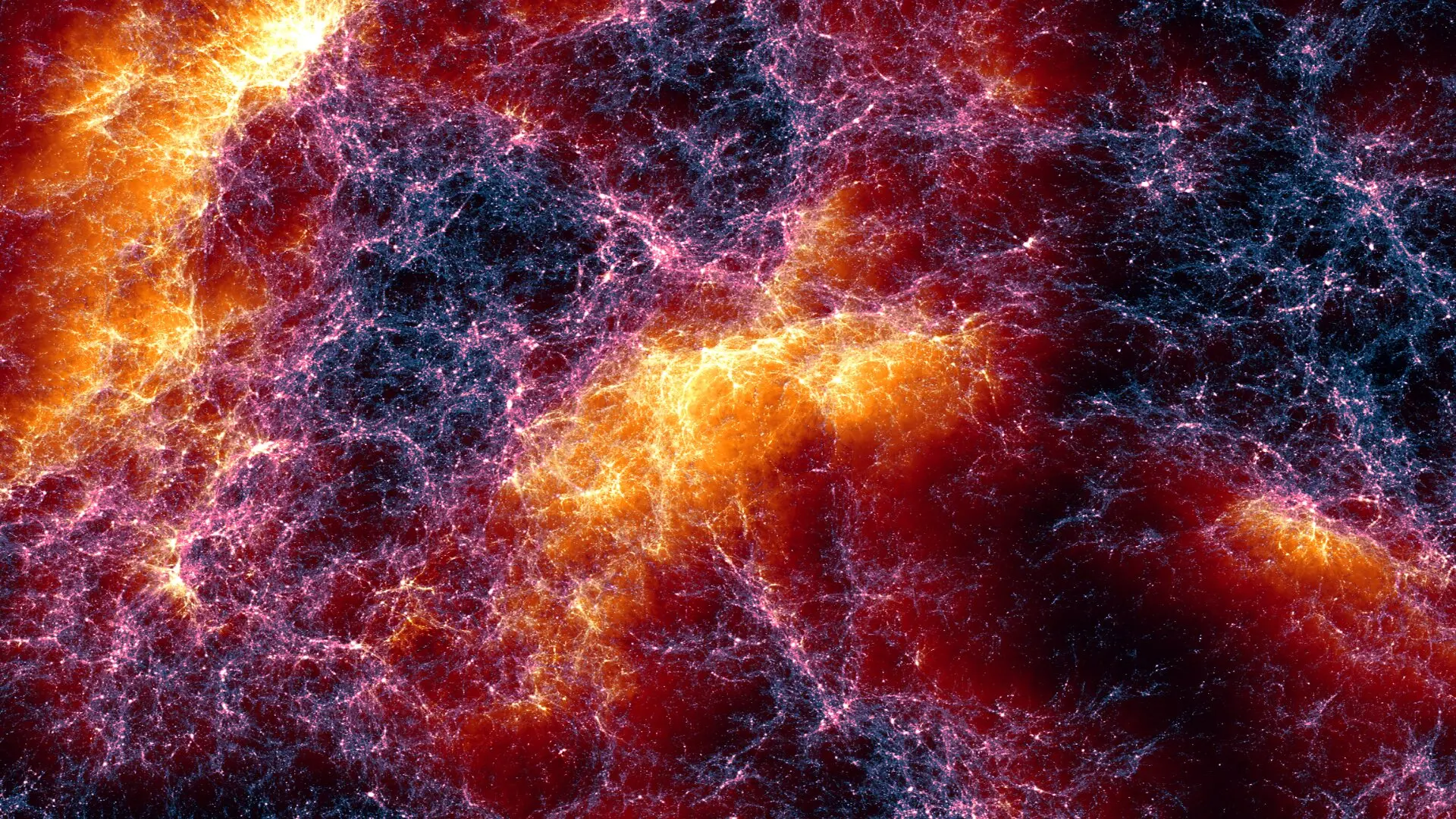
A Lumina simulation reveals 650 million light-years of the cosmic web, with dark matter filaments connecting galaxy clusters and orange-yellow regions highlighting the fastest-moving gas. (CREDIT: Oliver Zier, Center for Astrophysics | Harvard & Smithsonian)

The dawn of the universe was a period of profound transformation, defined not just by the birth of the first stars, but by the way their light fundamentally reshaped the cosmos. As radiation swept through the primordial void, it stripped electrons from neutral gas and heated vast swaths of space, creating a chain reaction that influenced the trajectory of all future galaxy formation. To better understand this complex interplay, an international team of astrophysicists has unveiled Lumina, a sophisticated new simulation that models the first 2 billion years of cosmic history with unprecedented scale.

The study, published in Monthly Notices of the Royal Astronomical Society, was led by researchers at the Center for Astrophysics | Harvard & Smithsonian. By creating a digital laboratory that traces both the gravitational pull of dark matter and the radiative feedback of early galaxies, the team aims to bridge the gap between theoretical models and the data pouring in from next-generation observatories like the James Webb Space Telescope.
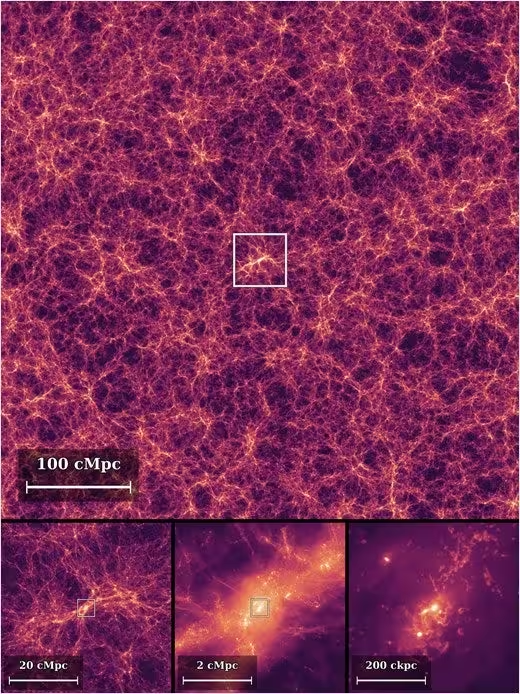
A four-panel LUMINA simulation zooms in on a massive cosmic halo, revealing how vast gas filaments feed its compact stellar core. Each panel offers a closer view, from 500 million parsecs across to just 500,000 parsecs, with white squares marking the next zoom level.
A four-panel LUMINA simulation zooms in on a massive cosmic halo, revealing how vast gas filaments feed its compact stellar core. Each panel offers a closer view, from 500 million parsecs across to just 500,000 parsecs, with white squares marking the next zoom level. (CREDIT: Oliver Zier et al, Monthly Notices of the Royal Astronomical Society 2026)

Capturing the Cosmic Ecosystem

Unlike previous models that often treated galaxy evolution and the surrounding intergalactic medium as separate processes, Lumina integrates gravity, gas dynamics, and radiation transport into a single, cohesive framework. The simulation utilizes the AREPO code, enhanced with radiation calculations optimized for high-performance graphics processors. This allows researchers to witness how luminous objects, such as newborn galaxies and active black holes, influence the temperature and ionization state of the surrounding gas in real-time.

The simulation spans a massive cube measuring 500 comoving megaparsecs—roughly 1.6 billion light-years—on each side. This expansive volume is critical; it allows the model to capture a diverse array of cosmic neighborhoods, from crowded galactic clusters to lonely voids. By sampling this variety, the team avoids the pitfalls of smaller simulations that might mistake a single, anomalous region for the standard state of the universe.
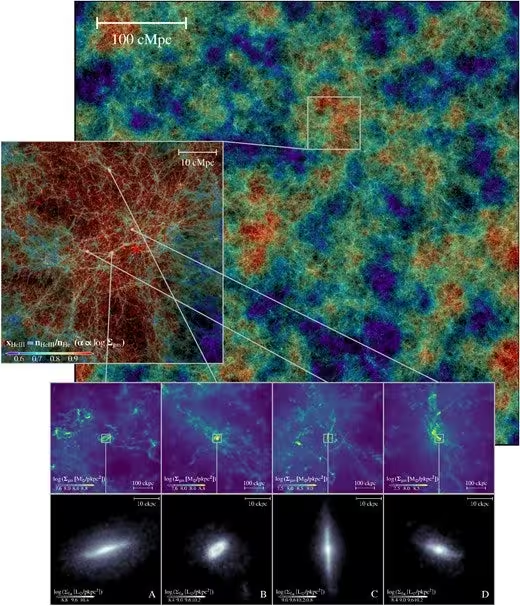
The LUMINA simulation reveals gas distribution and helium ionization across the early universe, highlighting a vast bubble surrounding a cluster of massive galaxies. Close-up views show four galaxies with distinct shapes, including two extended disks and two compact, spherical structures.
The LUMINA simulation reveals gas distribution and helium ionization across the early universe, highlighting a vast bubble surrounding a cluster of massive galaxies. Close-up views show four galaxies with distinct shapes, including two extended disks and two compact, spherical structures. (CREDIT: Oliver Zier et al, Monthly Notices of the Royal Astronomical Society 2026)

Charting Two Phases of Ionization

Lumina offers a comprehensive look at how hydrogen and helium were ionized over time. Hydrogen reionization, the process by which energetic stellar light knocked electrons free from neutral hydrogen atoms, is shown to be an uneven, patchy affair. The simulation tracks these ionization bubbles as they grow and collide, carving out the structure of the early universe.

The team also incorporated helium reionization, a secondary stage driven largely by the intense radiation emanating from active galactic nuclei. Because this process requires significantly more energy than hydrogen reionization, it serves as a critical marker of the universe’s changing energetic environment. By tracking both elements simultaneously, Lumina provides a more holistic view of cosmic history than models that treat these transitions as isolated events.
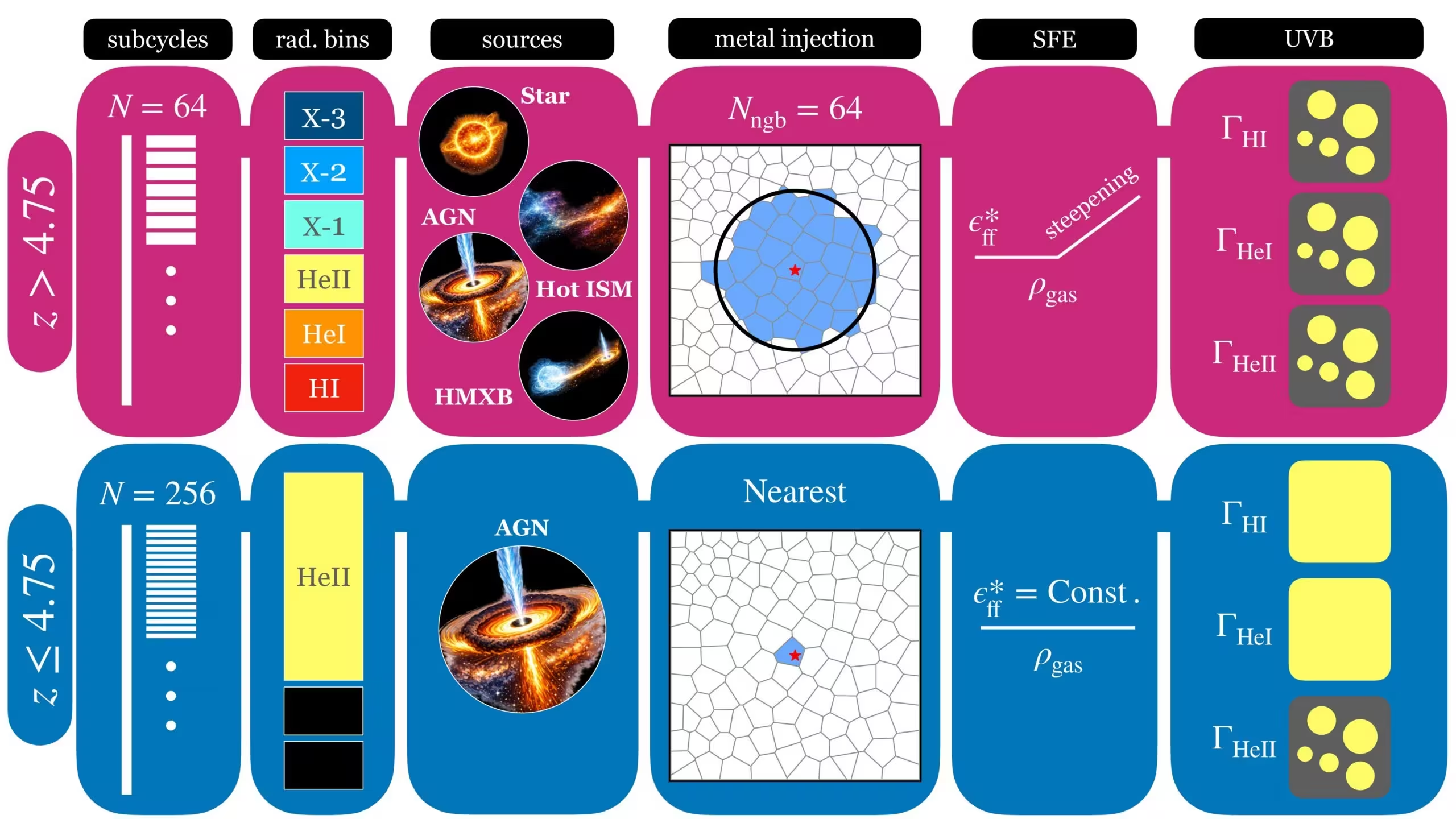
The diagram illustrates changes to a cosmic simulation as it transitions from hydrogen to helium reionization at redshift 4.75, including increased radiation calculations and a focus on active galactic nuclei (AGN). The updated model simplifies metal distribution, restores star formation efficiency, and uses a uniform ultraviolet background to improve computational efficiency.
The diagram illustrates changes to a cosmic simulation as it transitions from hydrogen to helium reionization at redshift 4.75, including increased radiation calculations and a focus on active galactic nuclei (AGN). The updated model simplifies metal distribution, restores star formation efficiency, and uses a uniform ultraviolet background to improve computational efficiency. (CREDIT: Oliver Zier et al, Monthly Notices of the Royal Astronomical Society 2026)

Testing the Model Against Reality

To run such a massive calculation, the team relied on 1,884 nodes of the Frontier supercomputer at Oak Ridge National Laboratory. The results produced a detailed thermal and ionization map that aligns well with existing cosmic background radiation measurements from the Planck mission.

However, the researchers caution that the simulation relies on specific calibrations and computational approximations, such as a reduced speed of light to optimize processing. These constraints mean that if the model ever conflicts with future observations, scientists must first rule out these approximations before suggesting new fundamental physics. The ultimate goal is to generate synthetic observations—data that mimics what a telescope actually sees—to create a direct “apples-to-apples” comparison with real-world astronomical surveys.
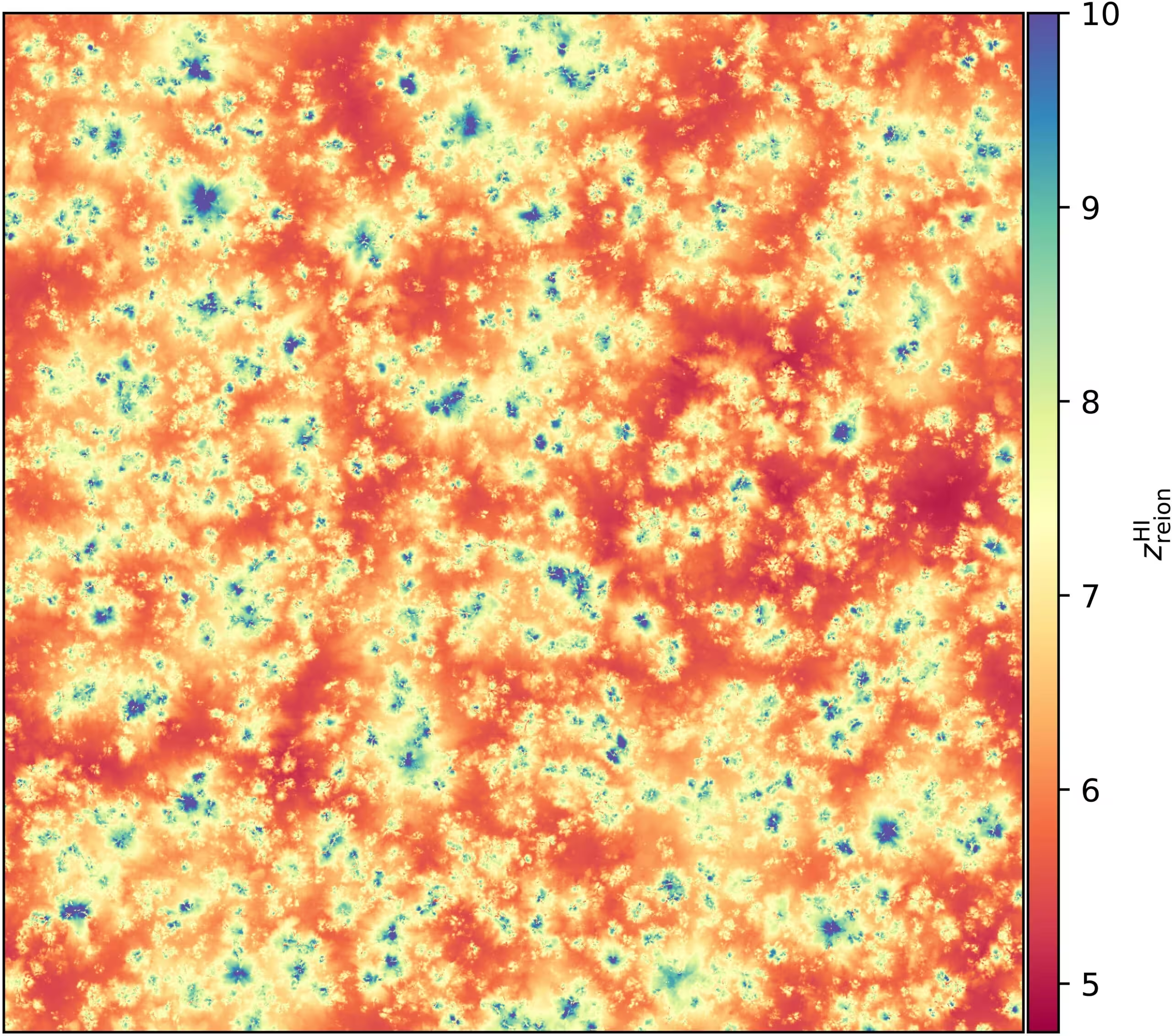
Hydrogen reionization redshift in a single-cell slice through the midplane of the simulation box. We define the reionization redshift of each grid cell as the last time at which the local neutral-hydrogen fraction exceeded 1%, using a Cartesian grid with resolution.
Hydrogen reionization redshift in a single-cell slice through the midplane of the simulation box. We define the reionization redshift of each grid cell as the last time at which the local neutral-hydrogen fraction exceeded 1%, using a Cartesian grid with resolution. (CREDIT: Oliver Zier et al, Monthly Notices of the Royal Astronomical Society 2026)

As project leader Oliver Zier and his colleagues move forward, they view Lumina as a foundational platform for testing the limits of our understanding. By refining the simulation to account for the unique signatures of radio telescopes and galaxy surveys, the team hopes to determine if our current cosmological narrative can truly explain the diverse, chaotic, and beautiful reality of the early universe.
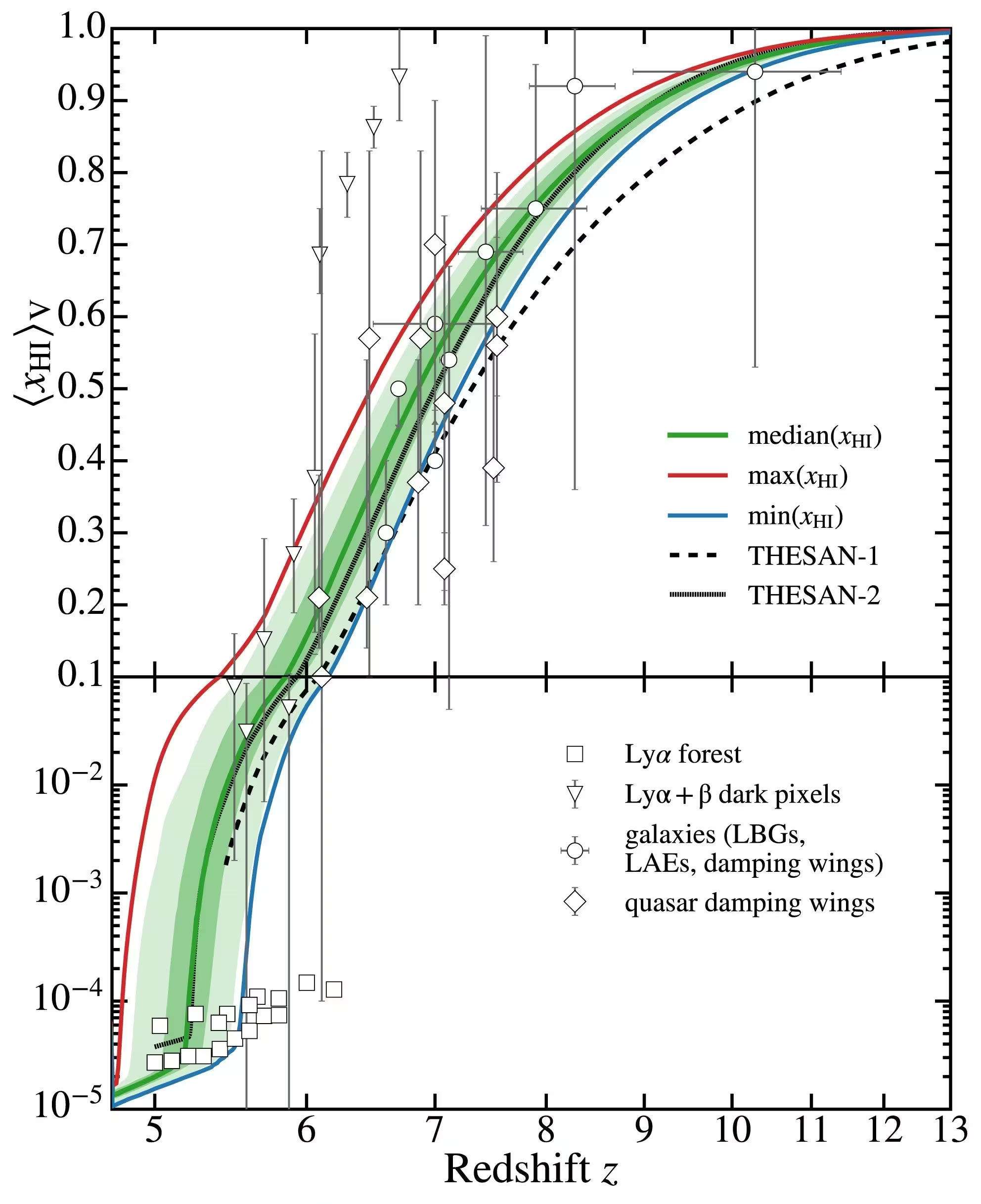
Evolution of the volume-weighted neutral-hydrogen (H I) fraction. We split the full simulation box into 125 sub-boxes of side length 100 cMpc and compute the reionization history of each independently. The median H I fraction across the sub-boxes is shown, together with the central 68.3 and 95.4 percent percentile ranges (shaded bands), as well as the maximum (red) and minimum (blue) values.
Evolution of the volume-weighted neutral-hydrogen (H I) fraction. We split the full simulation box into 125 sub-boxes of side length 100 cMpc and compute the reionization history of each independently. The median H I fraction across the sub-boxes is shown, together with the central 68.3 and 95.4 percent percentile ranges (shaded bands), as well as the maximum (red) and minimum (blue) values. (CREDIT: Oliver Zier et al, Monthly Notices of the Royal Astronomical Society 2026)
Fact Checked

This article has been fact checked for accuracy, with information verified against reputable sources. Learn more about us and our editorial process.

Last reviewed on .

Article history

  • Latest version

Cite this page:

Ahmed, Aisha. “Massive New Simulation Reveals How the Early Universe Transformed Over Two Billion Years.” BioScience. BioScience ISSN 2521-5760, 27 October 2026. <https://www.bioscience.com.pk/en/subject/astronomy/new-cosmic-simulation-recreates-the-universes-earliest-moments-in-unprecedented-detail>. Ahmed, A. (2026, October 27). “Massive New Simulation Reveals How the Early Universe Transformed Over Two Billion Years.” BioScience. ISSN 2521-5760. Retrieved October 27, 2026 from https://www.bioscience.com.pk/en/subject/astronomy/new-cosmic-simulation-recreates-the-universes-earliest-moments-in-unprecedented-detail Ahmed, Aisha. “Massive New Simulation Reveals How the Early Universe Transformed Over Two Billion Years.” BioScience. ISSN 2521-5760. https://www.bioscience.com.pk/en/subject/astronomy/new-cosmic-simulation-recreates-the-universes-earliest-moments-in-unprecedented-detail (accessed October 27, 2026).
End of the article