Proton Therapy Evaluation Upgraded With Probabilistic Modeling
Simulating 10,000 treatments across 60 patient cases reveals that probabilistic metrics could improve clinical decision-making.
Proton therapy for cancer patients relies on extreme precision, but small daily setup shifts or anatomical changes can alter the radiation dose delivered to tumors and healthy tissue. A multi-institutional team of Dutch researchers evaluated whether probabilistic evaluation approaches could replace current scenario-based methods to better support clinical decision-making. The study included 60 intensity-modulated proton therapy treatment plans across three medical centers, covering 20 neuro-oncological cases, 20 head-and-neck cases, and 20 breast cancer cases.
By simulating 10,000 fractionated treatments per case using a method called polynomial chaos expansion, the authors calibrated probabilistic clinical goals at a 90 percent probability level. The detailed findings were available on the arXiv preprint server. When interviewing eight radiation oncologists from the participating institutions, the researchers discovered unanimous agreement that the new probabilistic evaluation metrics are clinically usable and offer clear advantages over existing techniques.
How Probabilistic Evaluation Compares to Current Methods
In standard proton therapy planning, medical teams typically evaluate treatment robustness by checking a set of discrete error scenarios, such as 28 distinct combinations of setup and range errors. This traditional approach yields aggregate minimum and maximum dose distributions, known as voxel-wise minimum and maximum dose distributions, which show worst-case bounds but do not reveal the exact likelihood of achieving specific tumor control or organ-sparing goals.
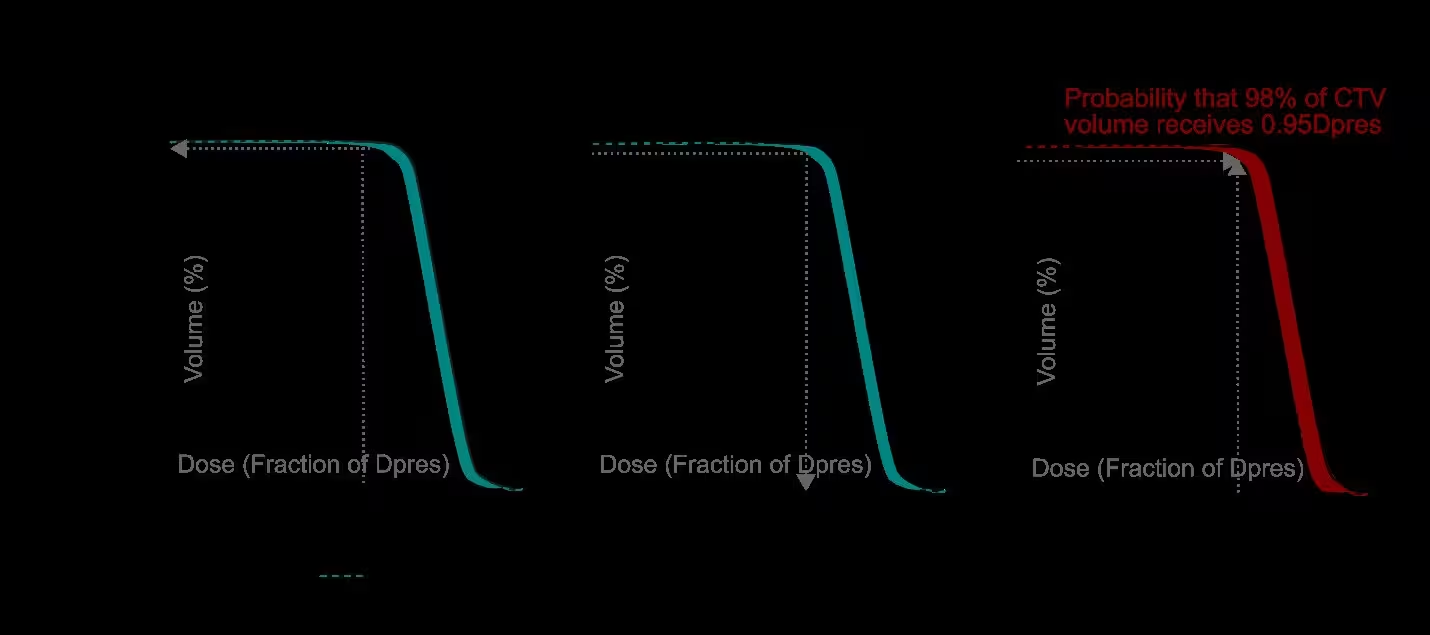
Probabilistic evaluation takes a more comprehensive approach by incorporating the statistical probability distributions of setup and range errors. Instead of treating all error scenarios as equally likely extremes, the technique models the frequency and severity of random and systematic errors over a full course of treatment. The medical physics experts in the study calibrated specific volumetric and dosimetric clinical goals for the clinical target volume, which is the region containing macroscopic tumor tissue.
Calibrating Clinical Goals Across Different Tumor Sites
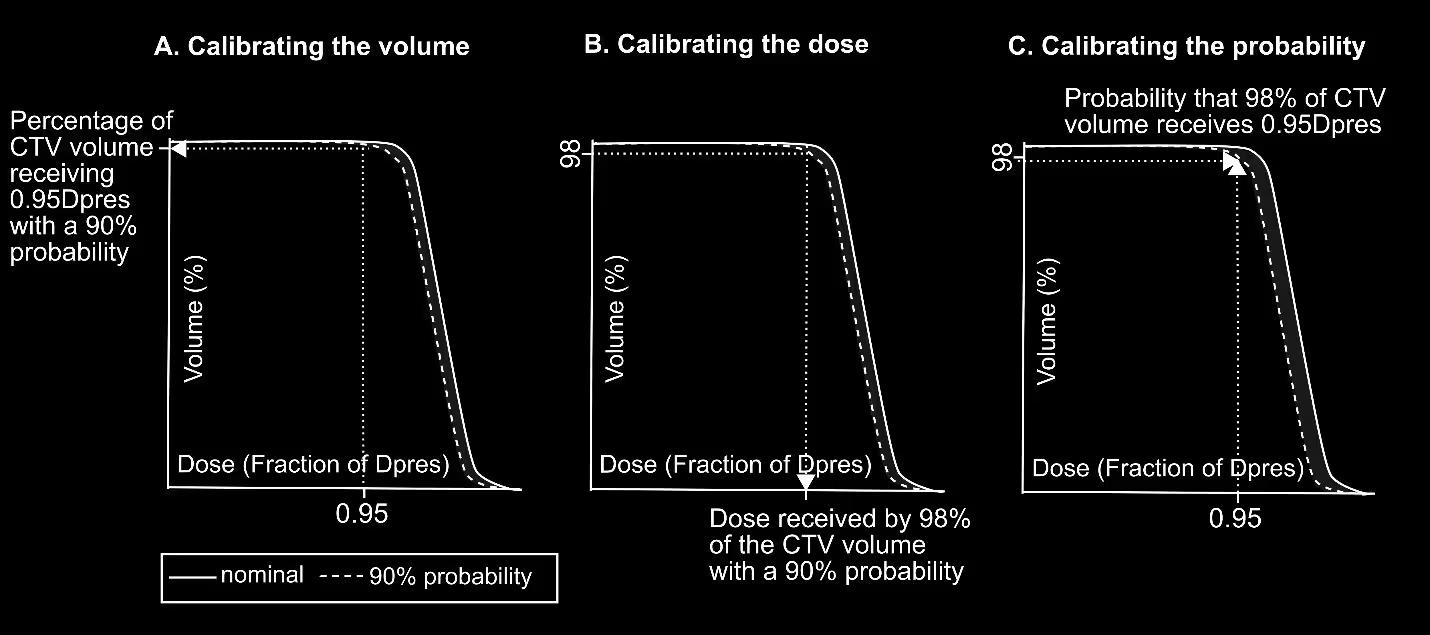
The calibration process established precise benchmarks for each patient cohort. For the 20 neuro-oncological patients, the volumetrically calibrated clinical goal was set at $D_{99.95\%,CTV} = 0.95 D_{pres}$ at a 90 percent probability level, where $D_{pres}$ represents the prescribed dose. For the head-and-neck cohort, the calibrated volumetric goal was $D_{99.80\%,CTV} = 0.95 D_{pres}$, and for the breast cancer cohort, it was $D_{99.54\%,CTV} = 0.95 D_{pres}$.
The corresponding dosimetric goals, evaluated using the dose received by 98 percent of the clinical target volume, were established at $D_{98\%,CTV} = 0.973 D_{pres}$ for neuro-oncological cases, $0.968 D_{pres}$ for head-and-neck cases, and $0.967 D_{pres}$ for breast cases. Statistical analyses using Welch’s independent-samples t-tests revealed significant differences among group comparisons, except for the dosimetric outcomes between the head-and-neck and breast cohorts.
What Radiation Oncologists Think About the New Metrics
During semi-structured interviews, all eight participating radiation oncologists agreed that the tested probabilistic metrics are suitable for clinical decision-making. Half of the clinicians noted that these tools provide deeper insight and more actionable information than current evaluation standards, helping them navigate complex trade-offs between targeting the tumor effectively and sparing critical organs at risk like the brainstem or brachial plexus.
However, preferences regarding specific probability thresholds and individual metrics varied among the physicians. While some clinicians favored volumetric calibration because it closely mirrors traditional photon planning practices, others expressed interest in examining multiple percentiles to understand the exact behavior in the tails of the dose distribution. The authors emphasize that while these probabilistic tools show strong potential for improving clinical workflows, further consensus and extensive clinical validation across both proton and photon therapies are necessary before widespread adoption in routine hospital practice.
The study was posted to the arXiv preprint server on November 18, 2026.
This article has been fact checked for accuracy, with information verified against reputable sources. Learn more about us and our editorial process.
Last reviewed on .
Article history
- Latest version
Reference(s)
- de Jong, Jenneke. “Towards consensus on practical probabilistic evaluation metrics for clinical decision making in radiotherapy.” arXiv.org <http://arxiv.org/abs/2611.25260v1>.
Cite this page:
- Posted by Tariq Hassan