Extra Weight Triggers Accelerated Biological Aging in Young Adults, New Study Reveals
Combining six molecular clocks reveals how excess body fat and larger waist measurements track with faster physiological decline in a young Filipino cohort.

Young adults who carry extra weight show subtle signs of accelerated biological aging long before any chronic health conditions appear. Researchers analyzing a well-characterized group of participants from the Philippines found that higher body mass index and waist measurements track closely with molecular markers of faster physiological decline.
How Can Six Different Molecular Clocks Tell a Unified Story About Aging?
Biological age estimates rely on chemical tags attached to DNA, known as methylation, which change predictably over time and in response to environmental stress. Because different molecular clocks were trained to predict distinct health outcomes and share only a tiny fraction of their underlying genetic sites, combining them has historically proved challenging. Romaniya Voloshchuk and colleagues at the University of North Carolina at Chapel Hill applied a statistical technique called factor analysis to merge six prominent epigenetic clocks into a single, unified metric of biological age acceleration. This combined approach, published in PLOS One, allows researchers to filter out biological noise and capture the shared signal of physiological wear and tear across multiple cellular pathways.
The study utilized data from one thousand seven hundred forty-five participants in the Cebu Longitudinal Health and Nutrition Survey, consisting of young adults with an average age of about twenty-one years. About forty-five percent of the participants were female, and the cohort provided a valuable window into lower-middle-income countries that are historically underrepresented in aging research. The team examined body mass index, waist circumference, and waist-to-height ratio, comparing these physical measurements against both individual molecular clocks and the newly created composite factor scores.
Why Do Waist Measurements and Body Mass Index Trigger Accelerated Aging?
Excess adiposity, particularly around the midsection, promotes systemic inflammation and metabolic dysregulation that imprint directly onto white blood cells through altered DNA methylation. Statistical models revealed that standard factor scores and principal component-based factor scores were consistently associated with higher body mass index, waist circumference, and waist-to-height ratio. Among the individual clocks, versions adjusted for statistical noise showed stronger ties to body composition than older models, with specific metrics like PhenoAge and Hannum displaying robust positive correlations with excess weight.
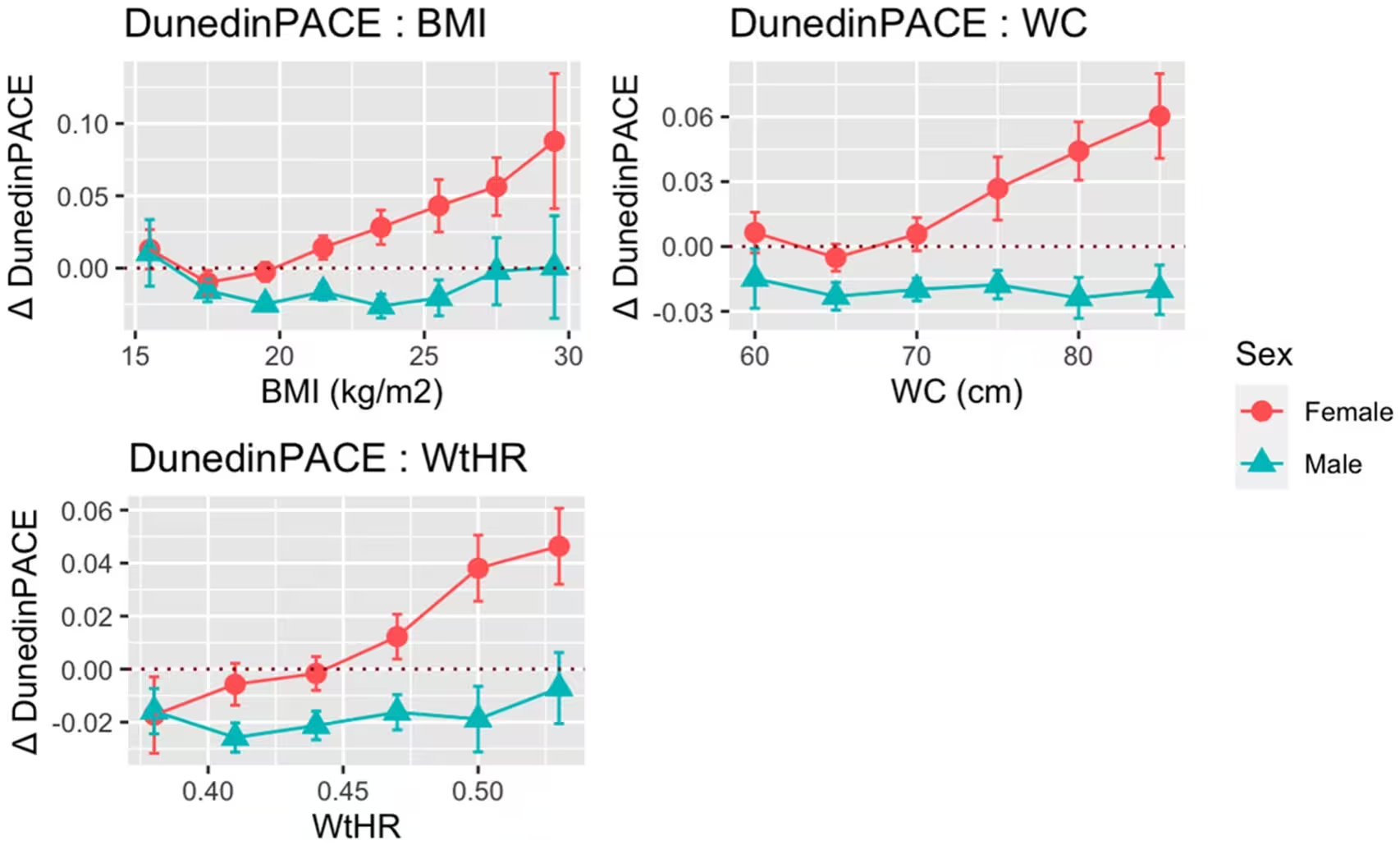
Interestingly, the pace of aging metric known as DunedinPACE exhibited pronounced sex-specific patterns. In female participants, this pace of aging showed a strong positive relationship with all three physical adiposity measurements, while the associations were weaker or absent among male participants. The researchers suggest that differing baseline physical activity levels, body composition, and lifestyle factors between young men and women in the region could help account for these differences in how excess weight registers at the molecular level.
What Are the Limits of These Molecular Aging Measures in Young Populations?
While the findings point to a clear connection between extra weight and accelerated biological aging, the authors emphasize several limitations. The study cohort consisted entirely of young adults in a specific socioeconomic setting, meaning the results may not automatically generalize to older populations or different ancestral backgrounds. Furthermore, because the work is observational, it cannot prove direct causation between adiposity and cellular aging, and further investigation is needed to determine whether weight-loss interventions can reverse these epigenetic shifts.
The research was published in PLOS One on November 25, 2026.
This article has been fact checked for accuracy, with information verified against reputable sources. Learn more about us and our editorial process.
Last reviewed on .
Article history
- Latest version
Reference(s)
- Voloshchuk, Romaniya S.., et al. “Greater than the sum of its parts: Combining epigenetic clocks to characterize the association of biological age acceleration and adiposity in young Filipino adults.” PLOS One, vol. 21, no. 11, November 25, 2026, pp. e0347070 Public Library of Science (PLoS), doi: 10.1371/journal.pone.0347070. <https://doi.org/10.1371/journal.pone.0347070>.
Cite this page:
- Posted by Elizabeth Taylor