Massive Supergene Turns Ant Larvae Into Wingless Queens By Hijacking Winter Growth Pathways
Researchers discover a 6.5-million-base genetic switch that reroutes queen development in moss ants, solving a long-standing evolutionary mystery.

A colossal 6.5-million-base genetic region in moss ants acts as a master switch, turning winged queen larvae into wingless reproductive rulers through a surprising developmental rerouting.
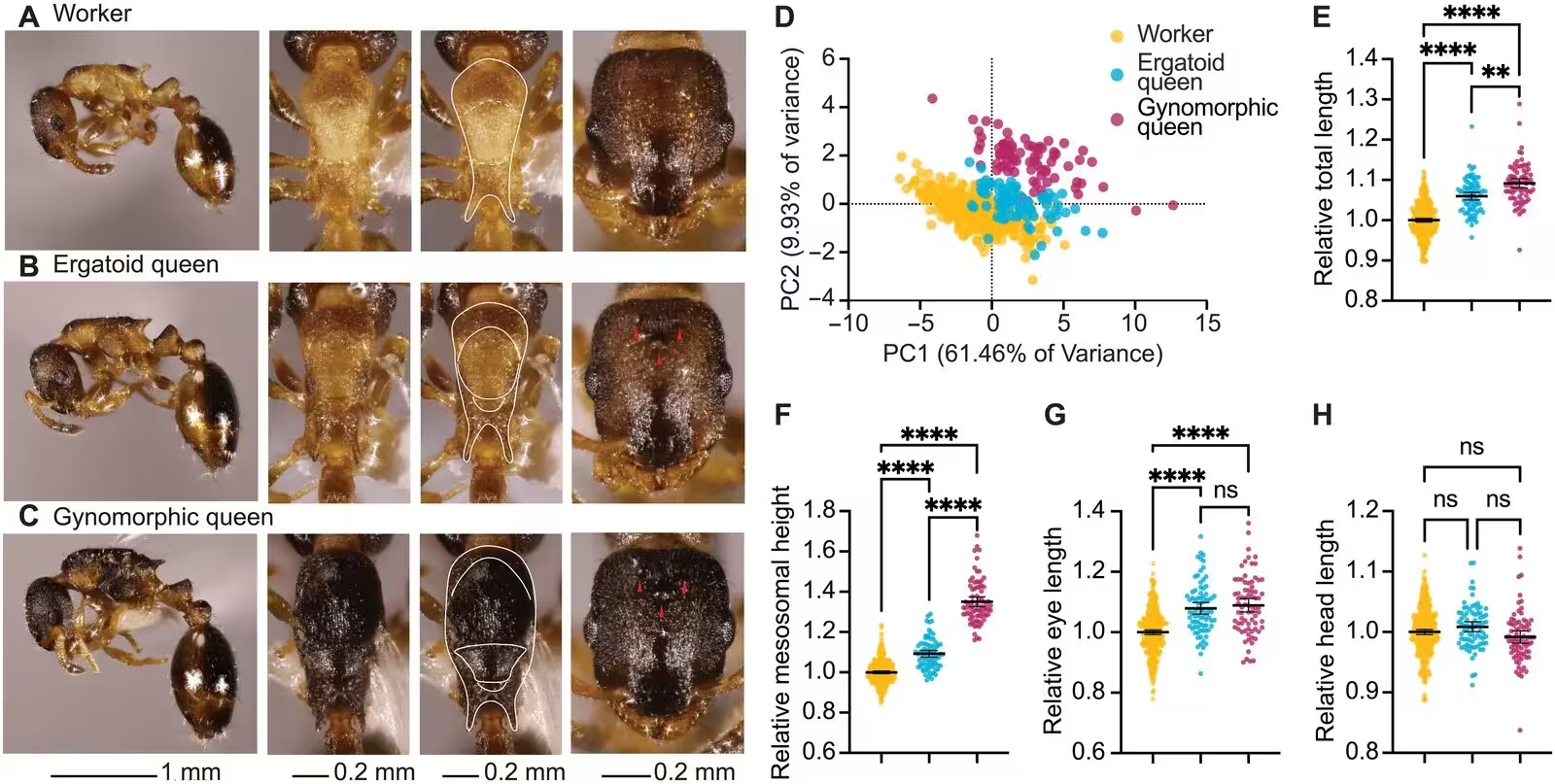
In many social insect colonies, a female larva’s fate is sealed early in development, splitting strictly between sterile workers and winged queens. However, evolutionary biologists have long debated how entirely novel physical castes emerge from this system. Researchers investigated an undescribed species of moss ant known as Leptothorax AF-erg, where colonies regularly substitute traditional winged queens with wingless ones called ergatoid queens. Led by Samuel V Arsenault and Waring Trible from Harvard University and the University of Georgia, the team published in Science Advances that a single large-effect supergene controls this striking transformation.
How Does a Massive Supergene Redirect Ant Development?
By sequencing the genomes of 28 ergatoid queens and 25 winged queens, the authors identified a 6.5-megabase genetic region on chromosome 1 that is perfectly associated with the wingless phenotype. This segment exhibits heavily suppressed recombination, meaning genes inside it are inherited as a single inflexible package rather than shuffling during cell division. This makes the region a social supergene similar to those found in fire ants and other social insects. Genetic screening across 142 additional queens confirmed that inheriting this variant is both necessary and sufficient to produce the wingless queen caste.
To pinpoint how this supergene operates, the researchers tested competing evolutionary models. One hypothesis suggested the genetic element forces worker-destined larvae to develop into queens, while another proposed it triggers an entirely new larval population. Through multiyear colony tracking and cross-fostering experiments, the team ruled out both ideas. Instead, they discovered that the supergene modifies larvae that were already destined to become queens during their winter hibernation period.
What Molecular Pathways Drive the Caste Transformation?
When the authors analyzed gene activity using ribonucleic acid sequencing across winter and spring phases, they found thousands of differences concentrated before spring growth resumed. The data revealed that the supergene alters key hormonal and growth networks, pointing strongly toward the ecdysone signaling pathway, which controls developmental timing in insects, alongside downstream insulin signaling. A risk-scoring analysis highlighted a specific gene called cyp6a14 as a top candidate driving the physical changes.
While ergatoid queens look superficially similar to workers because they lack wings, they retain distinct queen-like reproductive capabilities. The findings demonstrate that caste determination and tissue differentiation are separable. An early commitment to become a queen does not lock every single body part into a winged template, proving that ancestral developmental plasticity can be reshaped by a single genetic element to forge evolutionary novelty.
The research was published in Science advances on November 20, 2026.
This article has been fact checked for accuracy, with information verified against reputable sources. Learn more about us and our editorial process.
Last reviewed on .
Article history
- Latest version
Reference(s)
- Arsenault, Samuel V.., et al. “A supergene converts queen-destined larvae into a novel caste in ants.” Science Advances, vol. 12, no. 47, November 20, 2026 American Association for the Advancement of Science (AAAS), doi: 10.1126/sciadv.aei5142. <https://doi.org/10.1126/sciadv.aei5142>.
Cite this page:
- Posted by Elizabeth Taylor