Stress Biology And Vaginal Microbiome Dynamics Tracked In New Cervical Screening Study
A multimodal prospective cohort is following 270 diverse women to uncover how psychological stress and microbial shifts influence abnormal cervical screening outcomes.
When women receive an abnormal cervical cancer screening result, they often face a stressful waiting period before receiving a definitive diagnosis, and a new research protocol aims to track how daily stress, cortisol levels, and vaginal microbiome shifts influence whether these abnormalities resolve or persist over time.
Cervical cancer screening identifies elevated risk rather than actual precancerous disease, meaning that many abnormal findings eventually clear up on their own. However, the interval between an abnormal screen and a diagnostic evaluation through colposcopy, which is a specialized examination of the cervix using a magnifying instrument, can trigger unnecessary worry and medical procedures. To better understand what drives these health outcomes, Katherine Tossas at Virginia Commonwealth University and colleagues published in JMIR Research Protocols details a comprehensive prospective cohort study protocol designed to capture the complex biological and psychological factors at play during this critical window.
How Do 270 Women Track Stress and Biology Over Time?
The study aims to enroll 270 women aged 21 to 65 years who have received an abnormal cervical screening result and are awaiting diagnostic evaluation. The cohort is intentionally diverse, evenly split among 90 Latina, 90 non-Latina Black, and 90 non-Latina White participants. Researchers integrated electronic health records with a multi-step screening and onboarding process to capture data across multiple time points, starting with historical residual Papanicolaou test material from the initial abnormal screen.
Participants complete a 14-day home monitoring period following an initial baseline visit. During this two-week stretch, they answer twice-daily ecological momentary assessments on their smartphones to log mood, stress, coping mechanisms, and daily routines. They also collect home salivary cortisol samples twice daily upon waking and at bedtime to measure diurnal cortisol slope, a key indicator of physiological stress regulation. Additionally, participants wear a Fitbit device passively to track activity and rest metrics, while providing blood, urine, saliva, vaginal pH, and self-collected vaginal swabs at baseline.
Why Does the Vaginal Microbiome Matter for Screening Outcomes?
Scientists increasingly recognize that the community of bacteria residing in the vaginal tract plays a major role in human papillomavirus persistence and cervical lesion behavior. Chronic psychosocial stress and dysregulated cortisol patterns may alter this delicate microbial ecology and immune response, offering a biological pathway through which social inequities become embedded in physical health. By combining microbiome profiling with hormone tracking and clinical data, the study team can evaluate whether stress markers and microbial dynamics jointly influence the resolution or persistence of abnormal screening findings.
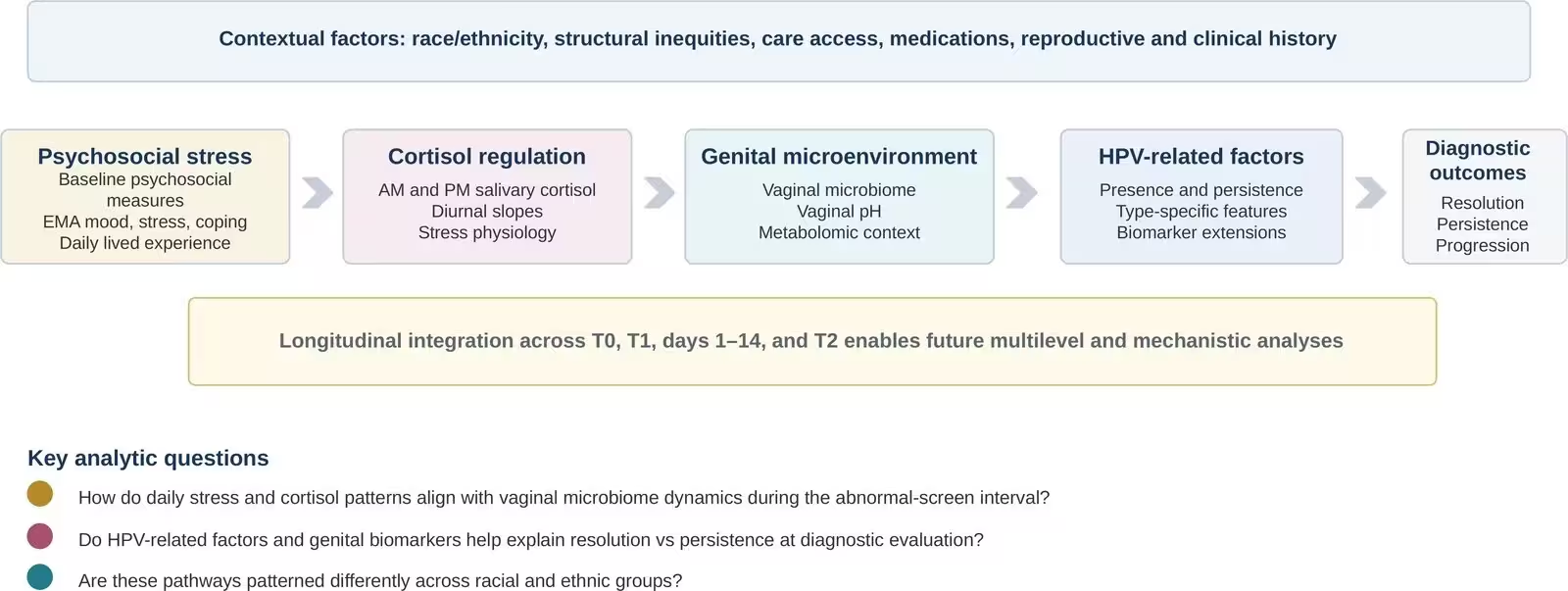
The primary outcome of the study is the diagnostic classification at the follow-up colposcopy visit, categorized either as resolution or nonpersistence, which indicates benign changes or low-grade abnormalities without significant disease, versus persistence, which points to clinically significant abnormalities requiring ongoing high-grade management. The team plans to use Firth bias-reduced logistic regression models to analyze how a standardized baseline 10-item Perceived Stress Scale score and participant-level mean diurnal cortisol slopes relate to these diagnostic outcomes, controlling for age, race, ethnicity, and initial screening risk stratum.
What Implementation Hurdles and Cultural Adaptations Shape the Study?
Because the protocol requires digital onboarding, repeated mobile logging, home freezer storage for biological samples, and multiple in-person clinic visits, participant burden is a major design consideration. To reduce barriers and build trust, the study team collaborated with a community advisory board to culturally and linguistically adapt all participant materials using a transcreation framework. Rather than a literal translation, the materials use a broadly accessible Spanish vernacular designed to enhance health literacy and cultural safety.
Early recruitment metrics illustrate the challenges of enrolling patients during a vulnerable healthcare interval. Out of 180 women prescreened through electronic health records by July 15, 2026, 142 were confirmed ineligible, most frequently because they lacked a qualifying abnormal screen, had no colposcopy recommended, or had already completed their follow-up evaluation too soon. Three participants had successfully enrolled and two had completed the full protocol out of 25 women who met initial criteria. Recruitment and longitudinal data collection are scheduled to run through December 2028, providing a robust framework for future equity-focused women’s health research.
The research was published in JMIR research protocols on November 19, 2026.
This article has been fact checked for accuracy, with information verified against reputable sources. Learn more about us and our editorial process.
Last reviewed on .
Article history
- Latest version
Reference(s)
- Tossas, Katherine., et al. “Stress Biology, Vaginal Microbiome Dynamics, and Diagnostic Outcomes After Abnormal Cervical Cancer Screening: Protocol for a Digitally Enabled Multimodal Prospective Cohort Study.” JMIR Research Protocols, vol. 15, November 19, 2026, pp. e97887-e97887. JMIR Publications Inc., doi: 10.2196/97887. <https://doi.org/10.2196/97887>.
Cite this page:
- Posted by Priya Sharma