Astronomers Detect Mysterious Dark Galaxy Containing Two Billion Suns Worth of Gas
Astronomers have discovered a mysterious object 310 million light-years away containing 2 billion suns of hydrogen, but remarkably, it has no visible stars.
Astronomers have uncovered a massive, elusive structure located roughly 310 million light-years away that challenges our understanding of galaxy formation. Cataloged as AGC 322753, the object serves as a dense reservoir of neutral hydrogen, containing enough gas to forge countless stars. Yet, despite its gargantuan proportions, the object remains virtually invisible to optical telescopes, fueling speculation that it may be a rare example of a dark galaxy.
A Cosmic Reservoir Without Stars
In the standard model of galactic evolution, large clouds of hydrogen serve as the primary fuel for star formation. Under the influence of gravity, this gas condenses into dense pockets where nuclear fusion ignites, eventually populating the galaxy with light-emitting stars. AGC 322753, however, defies this conventional lifecycle.
Research estimates suggest the object holds approximately 2 billion solar masses of neutral hydrogen. Despite possessing the raw materials equivalent to two billion suns, the system produces no detectable starlight. Perhaps most compelling is the data indicating that this vast gas supply is not drifting aimlessly; radio observations reveal a double-peaked spectral profile consistent with a rotating disk. This structural organization suggests that the gas is gravitationally bound, mimicking the form of a galaxy without the characteristic stellar glow.
The existence of such an object raises fundamental questions: Is star formation occurring at an incredibly sluggish pace, or are the stars simply too diffuse to be seen with current technology? Alternatively, AGC 322753 may represent an evolutionary dead-end, a system that managed to aggregate a massive gas supply but failed to trigger the typical transition into a star-forming galaxy.
Evidence from Radio Astronomy
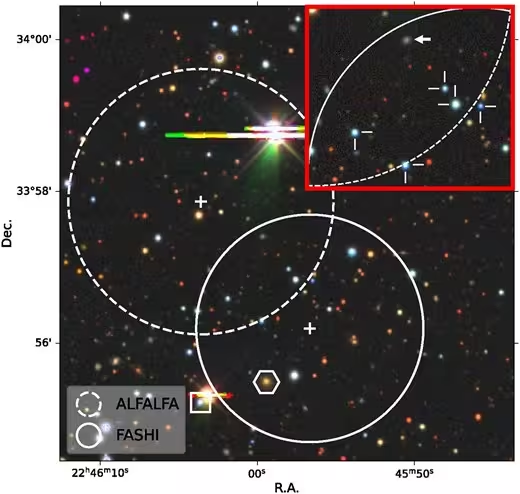
The discovery, led by Marco Monaci and a team at the Swinburne University of Technology, was published in the Monthly Notices of the Royal Astronomical Society. The researchers arrived at their findings by cross-referencing archival data from two major radio surveys: the ALFALFA survey, conducted at the decommissioned Arecibo Observatory, and China’s Five-hundred-meter Aperture Spherical Radio Telescope (FAST).
Unlike optical instruments, these radio telescopes are tuned to detect the 21-centimeter emission line, a specific signature of neutral hydrogen. By analyzing the data, the team identified 13 potential candidates for dark galaxies. AGC 322753 emerged as the most significant, as both independent facilities captured identical velocity signatures and spectral shapes at the same coordinates, effectively ruling out instrumentation errors or radio interference.
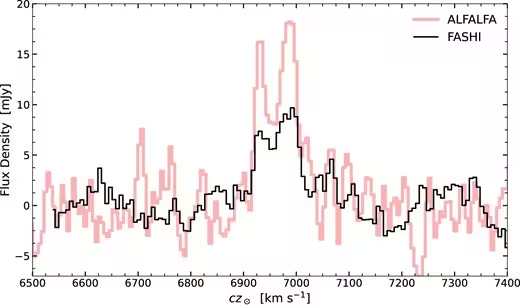
The double-peaked signal detected by the radio telescopes is a telltale sign of rotational motion. While the team could not visually confirm a disk structure due to the lack of optical light, the data strongly supports the presence of a gravitationally organized system. As astronomers continue to probe the void, AGC 322753 remains a crucial case study for understanding the mysterious, invisible components of the universe.
This article has been fact checked for accuracy, with information verified against reputable sources. Learn more about us and our editorial process.
Last reviewed on .
Article history
- Latest version
Cite this page:
- Posted by Aisha Ahmed