Why Preeclampsia Legacies In Sub-Saharan Africa Demand A New Biosocial Approach
Researchers argue that treating preeclampsia solely as an acute obstetric emergency overlooks lifelong health risks and social inequities across sub-Saharan Africa.

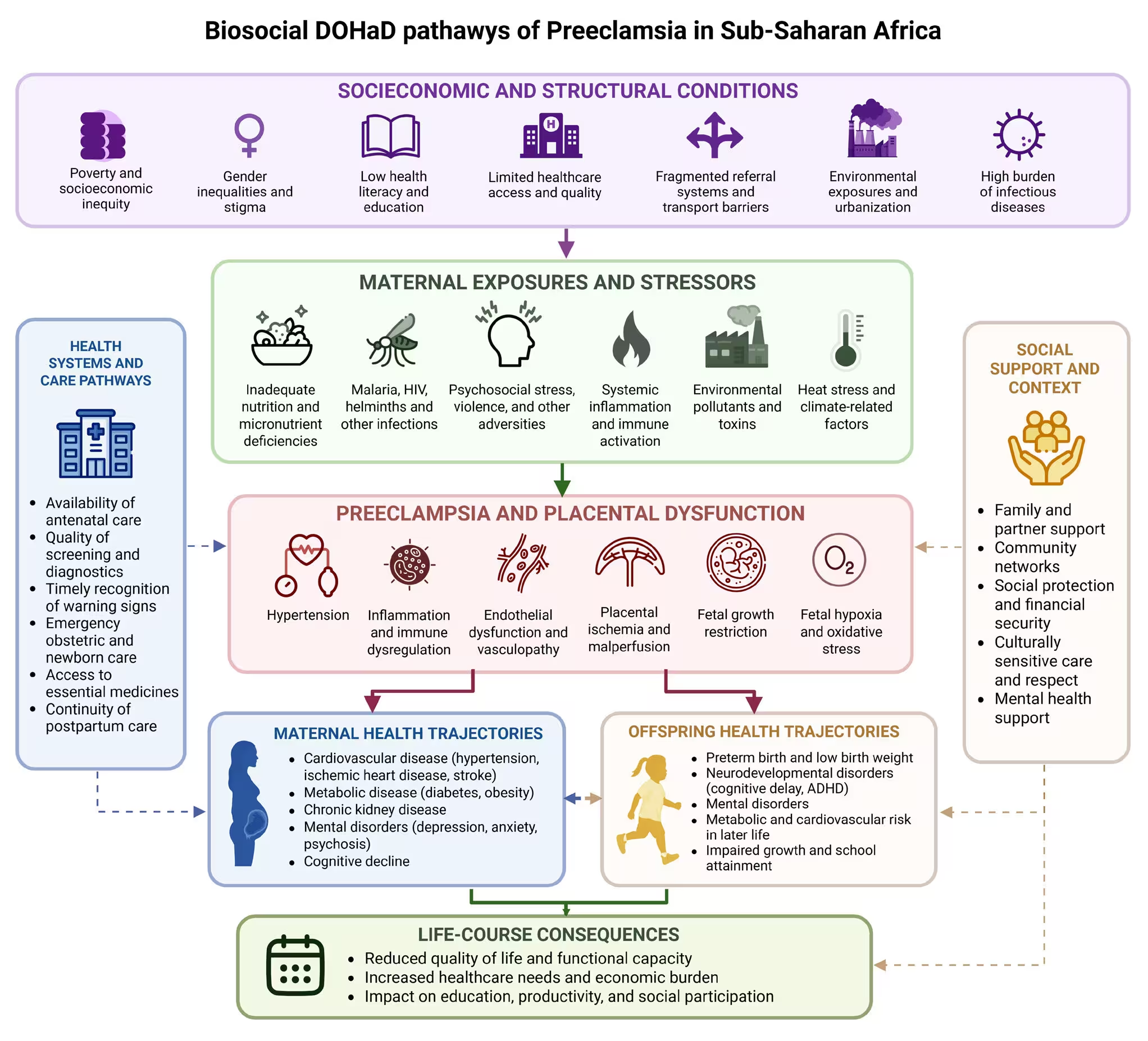
Preeclampsia is a dangerous pregnancy complication marked by high blood pressure that affects roughly five to eight percent of pregnancies globally, yet its long-term impact on mothers and children in sub-Saharan Africa remains largely overlooked. Led by Michael Penkler from the University of Applied Sciences Wiener Neustadt and the Technical University of Munich alongside a large multidisciplinary team, researchers published in the Journal of global health arguing that traditional biomedical approaches fail to capture the full scope of the disease in resource-constrained regions. The authors propose using a biosocial framework rooted in the Developmental Origins of Health and Disease paradigm, which examines how biological processes interact with social, environmental, and structural conditions over a lifetime.
How Does Local Context Shape Disease Pathways?
While high-income countries rely heavily on established biological risk models and biomarker screenings like the sFlt-1/PlGF ratio for short-term risk stratification, these tools are rarely implemented across sub-Saharan Africa due to infrastructural costs and a lack of local validation. The region carries a disproportionately high burden of infectious diseases such as malaria, human immunodeficiency virus, and chronic helminth infections, which trigger persistent immune activation and systemic inflammation. These chronic infections can cause placental ischemia and endothelial dysfunction, serving as major drivers of preeclampsia pathogenesis that standard models developed elsewhere often fail to account for.
Why Do Cultural Beliefs and Healthcare Gaps Delay Care?
Qualitative research from countries like Ghana and Tanzania reveals that women frequently experience preeclampsia and eclampsia as socially and emotionally disruptive crises characterized by fear, stigma, and limited health literacy. In some communities, eclampsia symptoms are misconstrued as epilepsy or attributed to spiritual possession, leading to severe social isolation and dangerous delays in seeking medical attention. Furthermore, rural communities face acute shortages in healthcare infrastructure, transport barriers, drug stockouts, and financial constraints that prevent timely diagnosis and intervention even when warning signs are recognized.
What Are the Long-Term Consequences for Mothers and Children?
Delayed diagnoses frequently result in patients arriving at clinics at a critical stage involving multi-organ dysfunction or eclamptic seizures, which significantly worsens maternal and perinatal mortality. For women who survive, a history of preeclampsia elevates the long-term risk of developing cardiovascular disease, stroke, and chronic kidney disease later in life. Meanwhile, children exposed to intrauterine stress and prematurity face an increased cumulative risk of neurodevelopmental disorders, attention-deficit hyperactivity disorder, and metabolic complications, highlighting a critical need for integrated life-course monitoring.
How Can Future Research Bridge These Critical Gaps?
To address these systemic challenges, the research team outlines three major priorities for future scientific inquiry and health policy. First, investigators should strengthen existing longitudinal research infrastructures, such as birth cohorts and demographic surveillance systems, by incorporating long-term follow-ups for women with hypertensive disorders of pregnancy. Second, public health initiatives must move beyond observational studies toward interventional research that evaluates strategies combining maternal nutrition programs, infectious disease management, and enhanced postpartum care. Finally, studies must adopt genuinely interdisciplinary designs that blend clinical, epidemiological, and qualitative methods to understand how biological and social factors jointly shape lifelong health trajectories.
The research was published in Journal of global health on November 20, 2026.
This article has been fact checked for accuracy, with information verified against reputable sources. Learn more about us and our editorial process.
Last reviewed on .
Article history
- Latest version
Reference(s)
- Penkler, Michael., et al. “Underrecognised legacies of preeclampsia: a biosocial DOHaD perspective for research in sub-Saharan Africa.” Journal of Global Health, vol. 16, November 20, 2026 International Society of Global Health, doi: 10.7189/jogh.16.03040. <https://doi.org/10.7189/jogh.16.03040>.
- Posted by Tariq Hassan