New Multi-Agent AI Architecture Dramatically Improves Vehicle Safety Decisions
By separating text generation from independent safety validation and local runtime fallback, a new lightweight AI framework significantly boosts semantic decision reliability in vehicle interfaces.
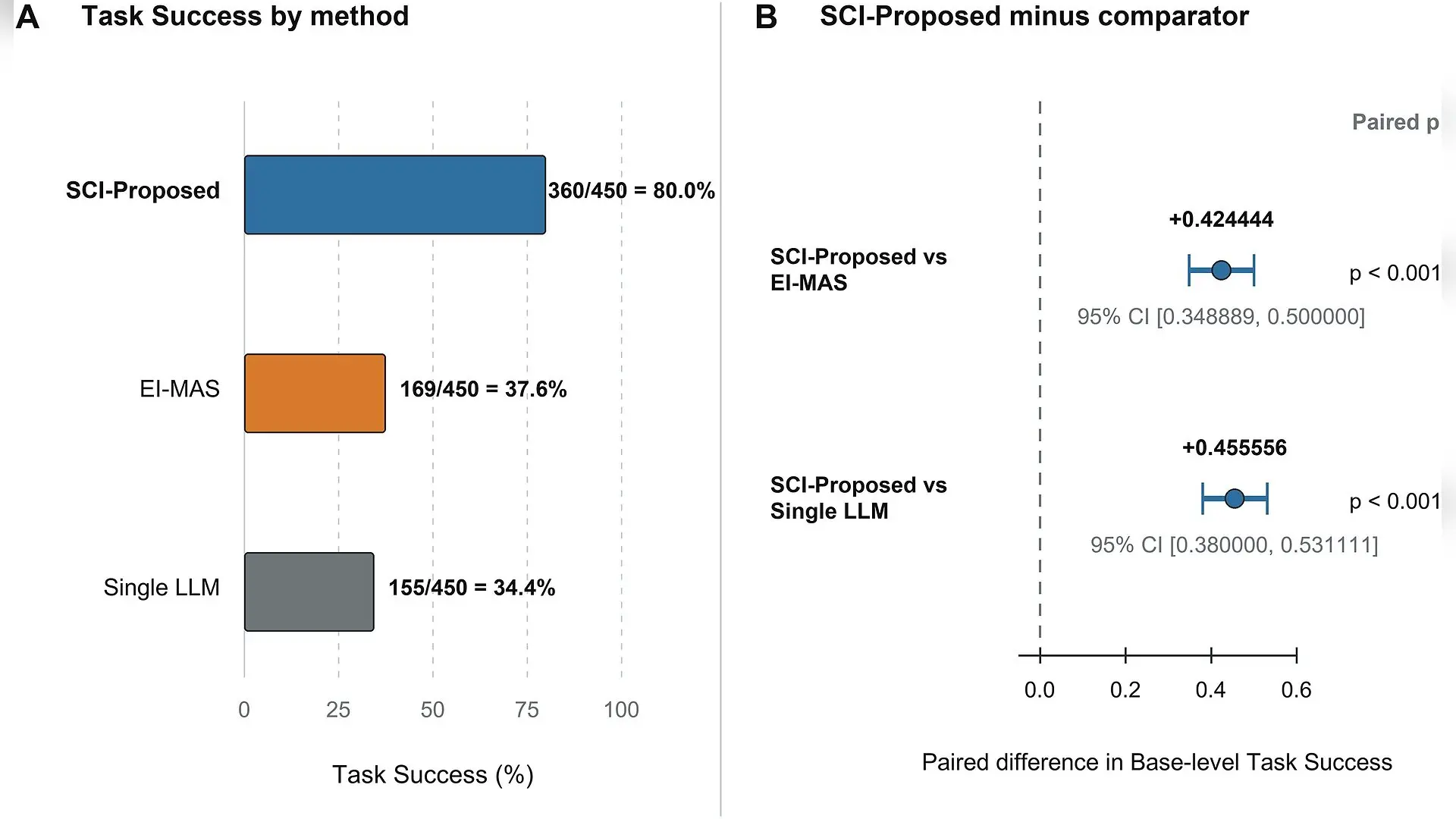
Large language models can process natural-language instructions and structured driving context, but their probabilistic nature, multi-agent disagreements, and occasional provider failures complicate safety-sensitive applications. Researchers recently developed a lightweight multi-agent semantic decision architecture called SCI-Proposed-v1.0, which combines transparent risk-informed routing with an independent Safety Validator and a deterministic local Runtime Fallback. Tested extensively on a frozen benchmark, the system completed 360 out of 450 inputs successfully, achieving an 80 percent success rate compared to 37.6 percent for an architecture-matched multi-agent baseline and 34.4 percent for a single language model.
The study, published in PLOS One on October 30, 2026, by authors Wei Dang and Lijun Gao from the Beijing Information Technology College, focuses specifically on semantic cockpit interfaces rather than direct low-level vehicle control. Instead of generating steering angles, braking commands, or physical trajectories, the architecture produces canonical semantic actions such as safety warnings, driver break recommendations, confirmation prompts, navigation intents, or diagnostic request denials.
How Layered Safety Validation Improves Decision Reliability
The core motivation behind the new architecture is that successful text generation does not guarantee an admissible or safe action. Even when a language model completes a prompt, its output might omit a mandatory warning or suggest an unsupported operation. To address this, the authors decoupled text generation from policy enforcement by introducing an independent Safety Validator that screens candidate action sets against a frozen safety policy.
In a frozen confirmatory benchmark of 150 unseen base scenarios, complete Safety Requirement Satisfaction reached 87.8 percent for the new architecture, compared to just 28.1 percent for the multi-agent comparator. The Safety Validator functioned by canonicalizing aliases, rejecting unknown or malformed actions, blocking forbidden operations such as direct diagnostic code clearing, and inserting context-required interventions like fatigue warnings or low-energy constraints.
Can Runtime Fallback Recover Failed Model Calls?
When provider-dependent paths encounter timeouts, API failures, or unavailable agents, standard multi-agent systems often stall or return malformed outputs. The SCI-Proposed architecture incorporates a deterministic local Runtime Fallback mechanism that engages exclusively during represented runtime failures, bypassing the failed model entirely to derive bounded safety actions from local structured facts.
Across 30 failure base scenarios involving 90 language inputs, the runtime fallback achieved a failure recovery rate of 36.7 percent, whereas baseline multi-agent systems achieved zero recovery. Detailed breakdown analyses revealed that the fallback successfully recovered all application programming interface failures and timeouts, alongside several unavailable-agent and malformed-output cases. However, it did not recover arbitrary, compound, or unknown failure states.
What Did Component Ablation Reveal About Architecture Design?
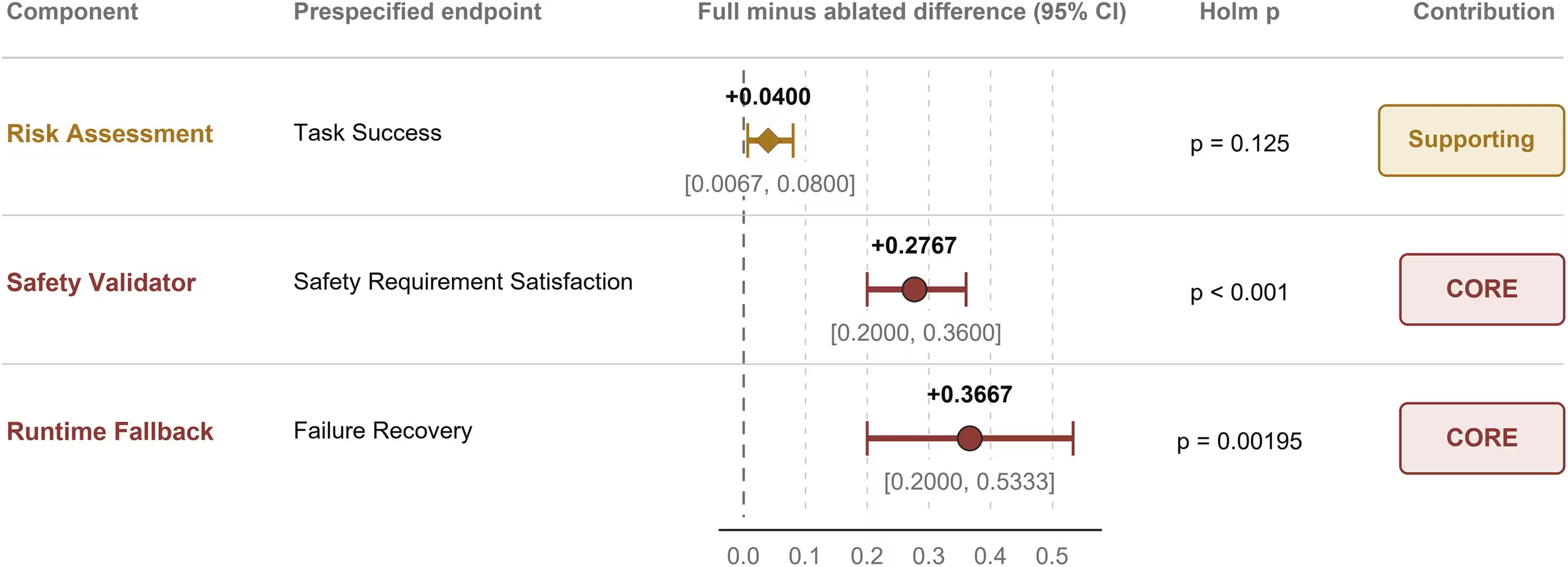
To determine which parts of the system drove its performance, the researchers conducted a frozen component ablation experiment removing individual modules one by one. Removing the Safety Validator significantly reduced complete safety requirement satisfaction by 27.67 percentage points, and removing the Runtime Fallback eliminated failure recovery entirely. These findings confirmed that both components provide core, independently measurable contributions to system dependability.
Conversely, removing the Risk Assessment module resulted in a smaller task success drop that did not meet the adjusted statistical significance threshold, leading the authors to classify risk-informed routing as useful supporting architecture rather than an independent core mechanism. A decision stability test involving repeated executions further showed that 27 out of 30 scenarios produced identical canonical action sets across all repetitions, yielding a 90 percent exact stability rate.
What Are the Limits of These Findings?
The authors emphasize strict boundaries regarding what these findings establish and what they do not. The experiments utilized synthetic, research-constructed semantic scenarios and an isolated hardware-in-the-sandbox environment rather than physical vehicle motion on public roads. The work does not establish autonomous-driving capability, broader vehicle-system safety, physical control reliability, or readiness for commercial deployment.
Future research must validate these architectures across additional model families, independently authored datasets, larger sample sizes, and broader fault classes. Within its defined scope, the study demonstrates that separating generative reasoning from independent safety validation and bounded local fallback can materially improve semantic decision dependability for intelligent vehicle interfaces.
The research was published in PLOS One on October 30, 2026.
This article has been fact checked for accuracy, with information verified against reputable sources. Learn more about us and our editorial process.
Last reviewed on .
Article history
- Latest version
Reference(s)
- Dang, Wei., et al. “Safety-constrained and runtime-assured LLM multi-agent decision making for intelligent vehicle systems.” PLOS One, vol. 21, no. 10, October 30, 2026, pp. e0357928 Public Library of Science (PLoS), doi: 10.1371/journal.pone.0357928. <https://doi.org/10.1371/journal.pone.0357928>.
Cite this page:
- Posted by David Anderson