Researchers Launch 24-Week Exercise Plan For 151 Psychosis Patients, And Target Metabolic Side Effects
A new clinical protocol evaluates whether supervised fitness routines can improve physical and mental health in patients receiving long-acting injectable antipsychotics.

Researchers at the University of Trás-os-Montes and Alto Douro designed a structured exercise program for 151 adult patients with psychotic disorders to test if physical training can counteract the severe metabolic side effects of long-acting injectable antipsychotics.
People living with conditions like schizophrenia often face a heavy burden of physical illness, weight gain, and insulin resistance driven by their essential medications. While physical activity is known to help, organizing reliable exercise routines within psychiatric care remains difficult. The new study, published in JMIR Research Protocols, details a structured 24-week multimodal intervention aimed at improving both mental health and physical fitness.
How Does The 24-Week Exercise Program Work For Patients?
The intervention, named Physical Exercise for Psychosis, combines aerobic movements, strength training, mobility work, and balance exercises into supervised circuit sessions held twice weekly. Sofia Silva and colleagues structured the program into distinct phases, beginning with supervised training and adding a 30-minute autonomous walking component in the second phase to build long-term habits.
Participants are adults aged 18 or older who have received long-acting injectable antipsychotics for at least 6 months and are clinically stable. Because random assignment is impractical due to travel and scheduling barriers, the team chose a nonrandomized controlled design while employing advanced statistical methods like propensity score weighting to ensure reliable comparisons between groups.
What Biomarkers And Health Outcomes Are Being Measured?
The research tracks a wide range of health indicators across 4 separate evaluation points, including baseline, 12 weeks, 24 weeks, and an 8-week follow-up. Investigators are measuring body composition, waist circumference, lower and upper limb strength, depressive symptoms, and overall quality of life.
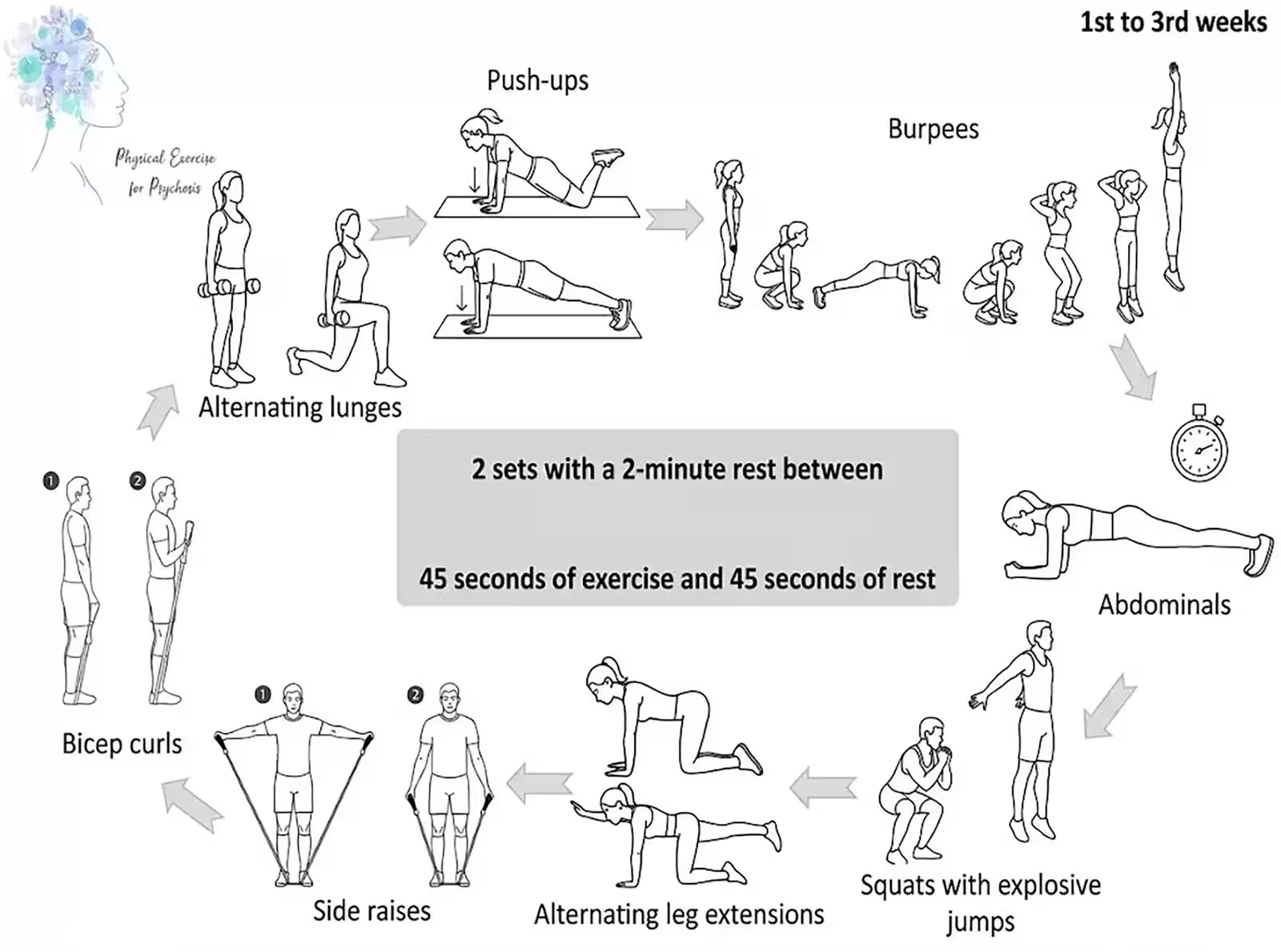
Beyond physical fitness, the team is exploring neurobiological markers such as brain-derived neurotrophic factor, which is a protein involved in brain plasticity and neuronal survival. They are also monitoring circulating levels of dopamine and serotonin, alongside routine lipid profiles and blood glucose, to understand the biological mechanisms linking physical activity to better psychiatric recovery.
What Are The Safety Protocols And Study Limitations?
Intense physical exercise can sometimes influence how depot antipsychotics are absorbed by increasing blood flow near the injection site, which requires careful medical oversight. To protect participants, the research team implemented moderate exercise intensity, continuous clinical monitoring, and close coordination with hospital psychiatrists to watch for any unexpected side effects or movement symptoms.
The authors note that the nonrandomized design and modest sample size mean findings must be interpreted carefully as adjusted associations rather than direct proof of cause and effect. Maintaining long-term attendance in physical exercise programs for individuals with severe mental disorders remains challenging, making adherence tracking an essential part of evaluating real-world feasibility.
The research was published in JMIR research protocols on November 26, 2026.
This article has been fact checked for accuracy, with information verified against reputable sources. Learn more about us and our editorial process.
Last reviewed on .
Article history
- Latest version
Reference(s)
- Silva, Sofia., et al. “A Structured Exercise Intervention for Individuals With Psychotic Disorders Treated With Long-Acting Injectable Antipsychotics: Protocol for a Nonrandomized Controlled Study.” JMIR Research Protocols, vol. 15, November 26, 2026, pp. e95789-e95789. JMIR Publications Inc., doi: 10.2196/95789. <https://doi.org/10.2196/95789>.
Cite this page:
- Posted by David Anderson