Protein-Mediated DNA Tethering Helps Bacterial Cells Survive Severe Genetic Damage
Longer physical pairing between replicated sister strands speeds up molecular repairs and preserves genetic fidelity in bacteria.
When genetic damage strikes specific bacterial regions, specialized cellular machinery keeps newly duplicated DNA strands tightly paired to accelerate repair and protect the genetic code. A team of researchers discovered that localized chromosome organization in Escherichia coli bacteria, driven by a specialized protein that binds tightly to repeated chemical motifs, holds sister DNA strands together much longer after replication. This prolonged embrace gives cells a vital survival advantage when dangerous breaks occur in their chromosomes, ensuring the damage is mended quickly and accurately before cell division goes awry.
How Does Sister Strand Cohesion Protect Bacterial Genomes?
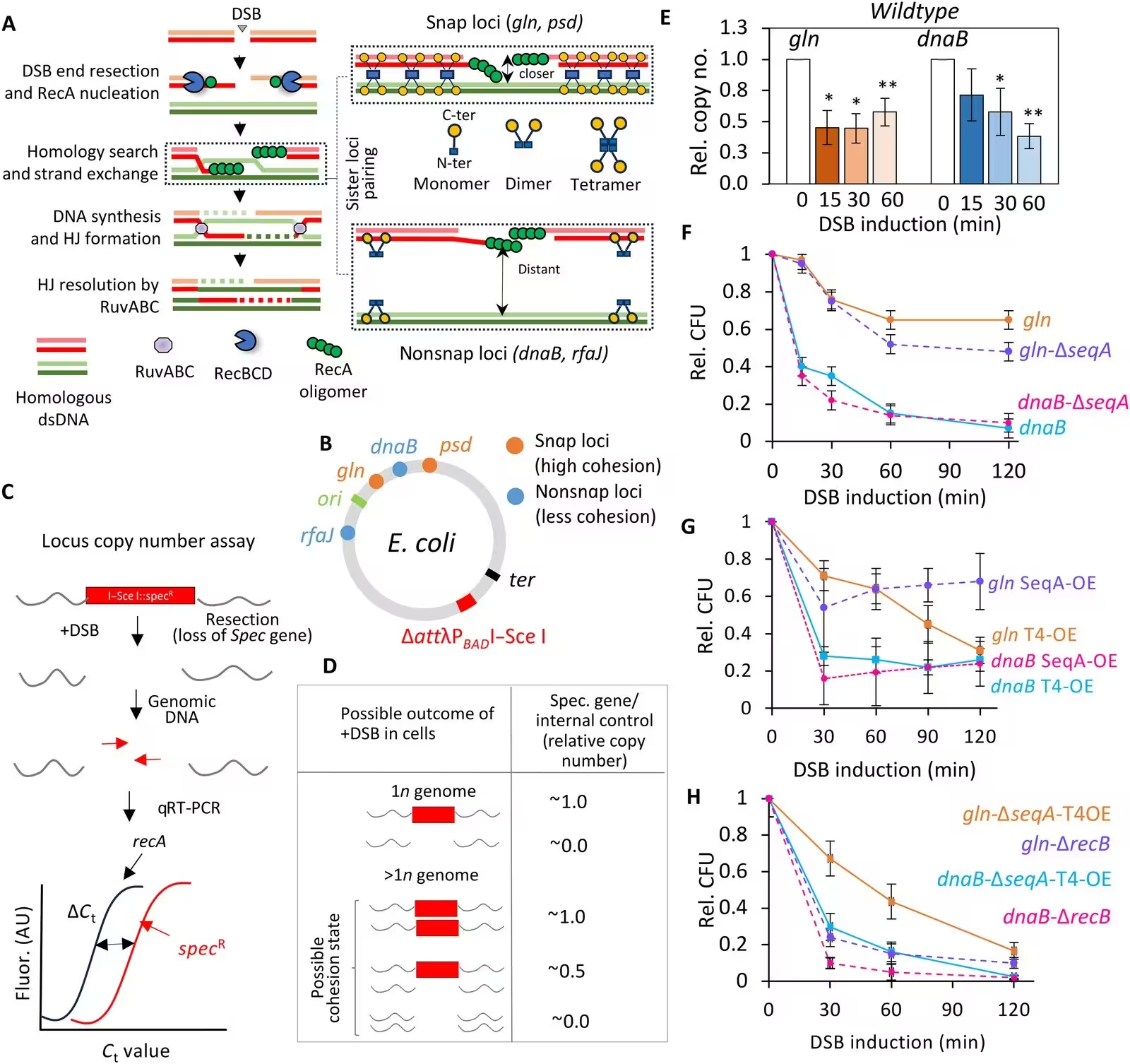
DNA double-strand breaks, where both strands of the double helix snap apart, threaten the survival of all living organisms by disrupting genetic stability. To mend these catastrophic fractures, cells typically rely on homologous recombination, a universal repair process that uses an undamaged identical sequence as a template to patch the broken region. In bacterial species such as Escherichia coli, this homology search requires the cell to locate a matching DNA sequence within a crowded molecular interior. Previous studies noted that certain chromosomal sites, known as snap loci, remain physically colocalized for up to thirty minutes after replication, whereas typical regions separate within five to seven minutes.
The research team, led by molecular biologists Deepak K. Singh and Mohan C. Joshi at Jamia Millia Islamia in New Delhi, investigated whether this prolonged physical proximity directly improves repair efficiency. The findings were published in Science Advances, detailing how the protein SeqA binds excessively to hemimethylated GATC sequences, which are chemical tags added to newly synthesized DNA. This abundant binding creates topological changes that delay topoisomerase IV, an enzyme responsible for untangling sister chromosomes. By keeping sister strands tethered together longer, the cell restricts the physical search space, allowing the protein RecA to find a homologous template much faster.
What Happens When Sister Loci Cohesion Is Disrupted?
To test the impact of this architectural arrangement, the investigators introduced engineered restriction enzyme cut sites into both snap loci and control regions known as nonsnap loci, inducing site-specific breaks. Wildtype bacteria suffered far fewer cell deaths when breaks occurred at snap loci compared to nonsnap regions. However, when the researchers disrupted sister chromatid cohesion by deleting the gene encoding SeqA or by overexpressing topoisomerase IV to force early chromosome separation, that survival advantage dropped significantly. Strains lacking both systems retained only a brief, transient benefit, proving that structural tethering plays a foundational role in recovery.
Why Do Snap Loci Form Shorter and Thinner Repair Filaments?
Microscopic tracking of living cells revealed distinct differences in how repair proteins behave across different genomic addresses. When breaks formed at snap loci, fluorescently labeled RecA proteins assembled into short, thin filaments that lasted for a shorter duration, averaging about eighty-nine minutes. In contrast, breaks at nonsnap loci triggered the formation of thick, extended assemblies that persisted for more than one hundred thirty minutes. The authors note that these longer assemblies reflect a prolonged and difficult search for matching templates across a wider physical distance.
Do These Specialized Chromosomal Regions Accumulate Fewer Mutations?
Faster repair alone does not guarantee accuracy, so the team measured mutation rates using a site-specific frameshift reversion assay. Under both normal growth conditions and stress induced by sublethal doses of the antibiotic ciprofloxacin, snap loci accumulated substantially fewer mutations than nonsnap loci. Furthermore, comparative genomic analysis of ninety-four diverse bacterial strains confirmed that snap regions display higher sequence conservation and lower nucleotide diversity across natural populations. These observations demonstrate that spatial chromosome organization not only speeds up recovery from genetic damage but also preserves the long-term fidelity of the bacterial genome.
The research was published in Science advances on November 20, 2026.
This article has been fact checked for accuracy, with information verified against reputable sources. Learn more about us and our editorial process.
Last reviewed on .
Article history
- Latest version
Reference(s)
- Singh, Deepak K.., et al. “SeqA-mediated sister loci cohesion regulates the efficiency and fidelity of DNA double-strand break repair across the E. coli genome.” Science Advances, vol. 12, no. 47, November 20, 2026 American Association for the Advancement of Science (AAAS), doi: 10.1126/sciadv.ady3050. <https://doi.org/10.1126/sciadv.ady3050>.
Cite this page:
- Posted by Elizabeth Taylor