University Of Toronto Researchers Track Spruce Budworm Outbreak And Reveal That Genetic Adaptation Signals Vanish As Populations Expand
Spruce budworm genetic scans reveal that signals of local adaptation are transient and heavily skewed by outbreak dynamics.

University of Toronto researchers tracking an eastern spruce budworm outbreak found that genetic signatures of adaptation nearly vanished as populations expanded, raising questions about standard landscape genomic methods. By analyzing thousands of single-nucleotide polymorphisms across 4 years of field sampling, the team demonstrated that common genome scans yield wildly unstable results depending on outbreak timing and demographic shifts.
Landscape genomics aims to link specific DNA variations to environmental conditions, helping scientists understand how native species adapt to local climates. These analytical approaches generally assume that genetic patterns remain relatively stable across time. However, that core assumption breaks down in outbreaking species whose population sizes, spatial distributions, and connectivity fluctuate dramatically. During major population expansions, demographic forces such as rapid dispersal and genetic drift can generate strong spatial patterns in allele frequencies, which are the alternative versions of a gene found at the same chromosomal locus, that closely mimic natural selection.
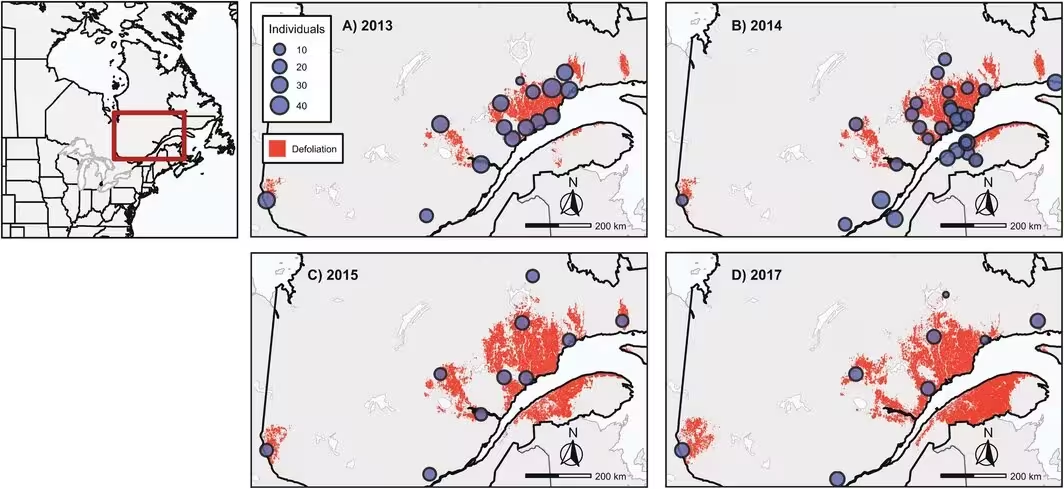
João Pedro Fontenelle and Patrick M. A. James analyzed samples collected between 2013 and 2017 across deforested regions in Quebec, Canada, utilizing single-nucleotide polymorphisms, which are common genetic variations involving a single building block of DNA, to map adaptive traits. The study, published in Ecology and Evolution, evaluated three popular outlier detection techniques named OutFLANK, LFMM, and redundancy analysis. The researchers sought to discover whether these methods could reliably separate true genetic adaptation from shifting demographic noise as forest insect populations surged.
How Fast Did Adaptive Signals Disappear Across Outbreak Years?
Across all three analytical methods, the number of candidate adaptive genes detected peaked early in the outbreak before plummeting close to zero in later years. In 2013 and 2014, genome scans flagged dozens of outlier loci linked to environmental variables. By 2015 and 2017, those signals had largely evaporated, leaving little to no evidence of local adaptation. The researchers found minimal overlap in specific gene identities from one year to the next, indicating that the flagged genomic regions were transient.
The identity of detected genetic variants also showed stark disagreement among the different statistical techniques. In 2013, methods like OutFLANK and redundancy analysis identified largely separate sets of candidate genes, with virtually no consensus across all three approaches. Even when sample sizes were standardized through computer resampling to eliminate numerical biases, the same pattern persisted. The data suggest that single snapshots of genetic variation capture temporary demographic processes rather than permanent evolutionary adaptations.
Why Do Population Expansions Trick Genomic Scans?
During the early phases of an insect outbreak, low population connectivity and spatial barriers help maintain clear genetic structures across the landscape. As populations multiply and moths disperse across thousands of kilometers, increased gene flow homogenizes allele frequencies. This widespread mixing dilutes local genetic differences and weakens the statistical correlation between environmental gradients and genomic variation. Consequently, standard genome scans mistake the spatial consequences of range expansion for signals of natural selection, inflating false positives during expansion phases.
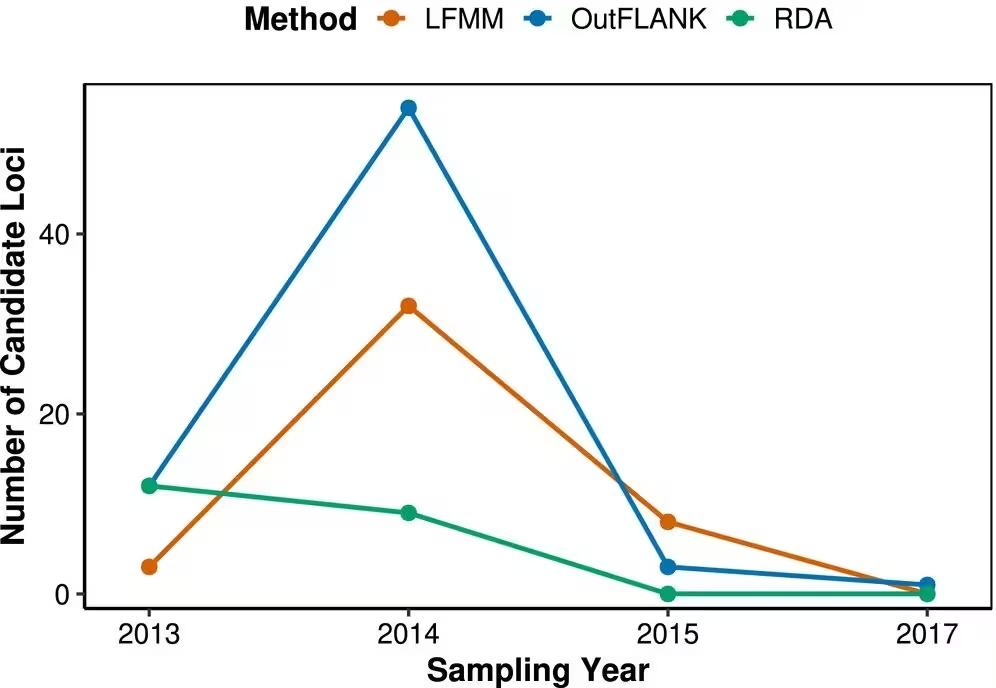
The team notes that different analytical tools exhibit distinct sensitivities to these demographic changes. Differentiation-based approaches identified more candidate genes early on because they rely strictly on genetic divergence measures that easily capture spatial structure caused by population bottlenecks. Conversely, univariate models that account for hidden population history through latent factors proved more conservative. As connectivity increased, both categories of tests lost their statistical power as spatial differentiation dissolved.
What Are the Risks for Forest Management and Conservation?
Relying on genetic data collected during a single point in time carries major risks for monitoring native forest pests and endangered wildlife. If conservationists or pest managers base decisions on transient genomic signals, they may misidentify environmental drivers or prioritize landscape features that are not actually under selection. Furthermore, demographic disruptions can obscure true adaptive potential, complicating efforts to track dispersal pathways and source populations.
The authors emphasize that genomic patterns in outbreaking systems are highly timing-sensitive. Future monitoring programs will likely need novel sampling designs and simulation models that account for shifting population dynamics. Without factoring in demographic context, genome scans risk misinterpreting temporary population movements as permanent evolutionary milestones.
The research was published in Ecology and evolution on November 26, 2026.
This article has been fact checked for accuracy, with information verified against reputable sources. Learn more about us and our editorial process.
Last reviewed on .
Article history
- Latest version
Reference(s)
- Fontenelle, João Pedro., et al. “Sensitivity of Landscape Genomic Outlier Detection to Outbreak Dynamics.” Ecology and Evolution, vol. 16, no. 12, November 26, 2026 Wiley, doi: 10.1002/ece3.74794. <https://doi.org/10.1002/ece3.74794>.
Cite this page:
- Posted by Elizabeth Taylor