Clickbait Packaging Inflicts the Heaviest Reputational Damage on Accurate Science Facts
Experimental data reveals sensationalized framing reduces user engagement and disproportionately destroys trust in true information.
Sensationalized headlines designed to grab attention online do not just annoy readers, as new experimental data reveals they inflict the heaviest reputational damage precisely on facts that are completely true. When trustworthy sources adopt exaggerated phrasing, emojis, and urgent exclamation marks, the penalty to their perceived credibility is significantly worse for accurate information than for outright falsehoods.
The research, published in PLOS One by Michael Craig and colleagues at Northumbria University, examined how story framing and factual accuracy shape what young adults believe and choose to share on social media. While previous discussions often assumed clickbait style lures people in regardless of content, the new findings show that sensationalized presentation actively lowers user engagement while eroding institutional trust across the board.
How Did the Experiment Test 203 Participants Using Simulated Posts?
The research team recruited 203 participants with an average age of 25.9 years through the online platform Prolific between June 18 and June 25, 2024. Eligible participants were restricted to social media users aged 18 to 35 living in the United Kingdom, a demographic known for heavy digital media consumption and vulnerability to online falsehoods.
During the online experiment hosted on Qualtrics, each participant evaluated 20 custom-designed social media posts modeled after typical Facebook content. These simulated posts covered five contentious or widely discussed topics, namely COVID-19 vaccination side effects, the origin of the coronavirus, climate change causes, cellular phone radiation, and generative artificial intelligence agency.
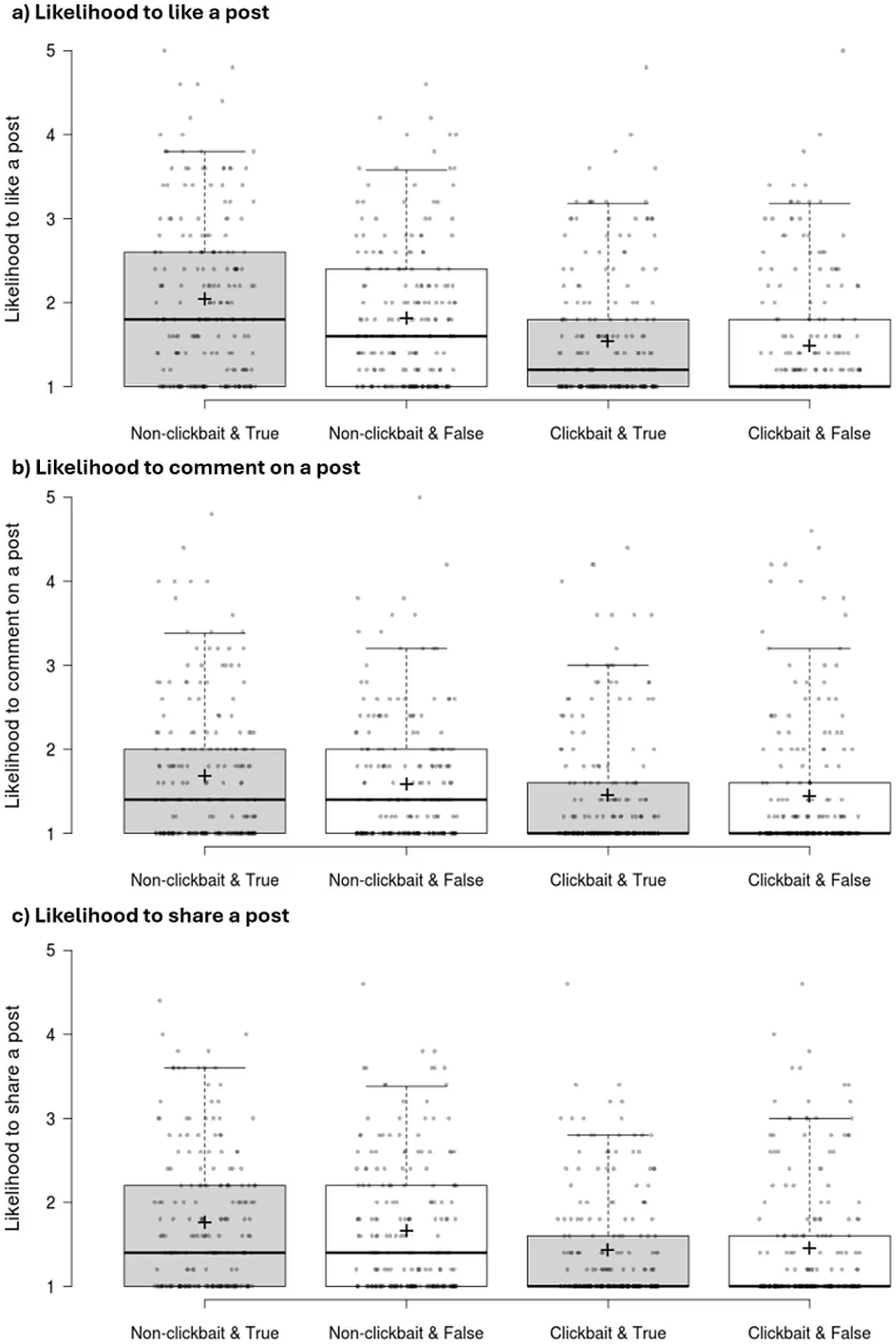
The stimuli were structured around a two-by-two factorial design combining article style, split into clickbait and non-clickbait, with content accuracy, split into true and false information. Clickbait items incorporated typical markers such as sensationalized language, forward referencing questions, spectacularization, and consecutive punctuation or emojis. Participants rated their likelihood of liking, commenting on, and sharing each post on five-point scales, alongside assessing perceived truthfulness and credibility.
Why Does Sensational Framing Hurt Accurate Science More Than Falsehoods?
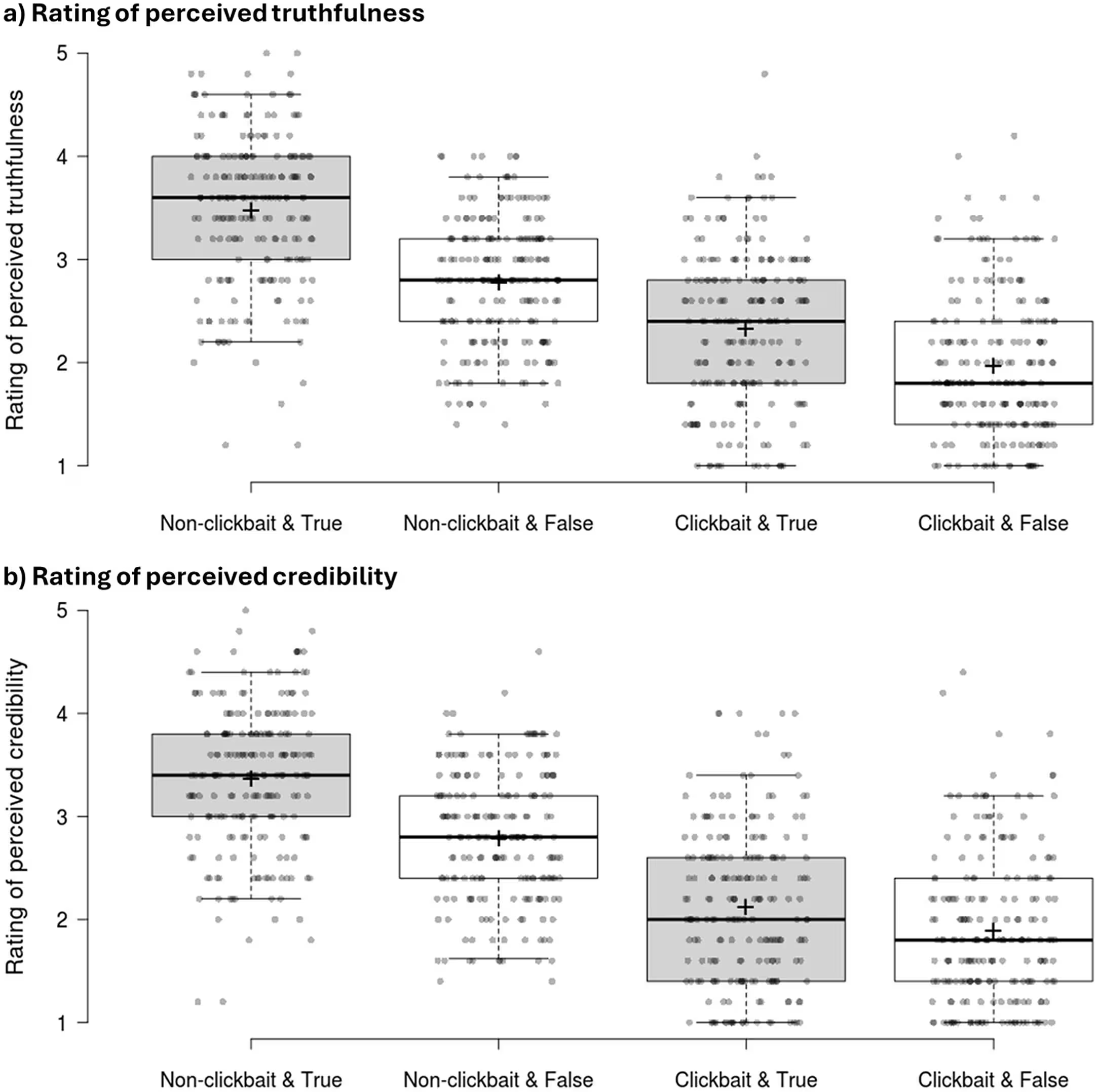
The results showed significant main effects of both style and accuracy on perceived veracity and engagement. Across all measures, clickbait formatting reduced ratings of truthfulness and credibility while also decreasing self-reported intentions to like, comment, or share the content.
Crucially, a significant interaction emerged showing that the negative impact of clickbait was more pronounced for posts containing accurate information than for those containing false claims. True content started from a higher baseline of perceived trustworthiness and therefore had further to fall when subjected to sensationalized packaging. False information, by contrast, already triggered deep skepticism based purely on its substance, leaving little room for a clickbait penalty to cause further damage.
Furthermore, the data revealed a stark dissociation between engagement types. While content accuracy influenced whether participants were willing to like or comment on a post, it had no effect on sharing behavior. Participants reported being willing to share true and false content at equal rates if other social or emotional triggers were present, providing a mechanism for how unverified claims spread despite general user skepticism.
What Role Do Media Literacy and Misinformation Susceptibility Play?
The authors also measured individual differences using the News Media Literacy Scale and the Misinformation Susceptibility Test. When media literacy was included as a covariate, higher literacy scores amplified the negative penalty that participants applied to clickbait posts, indicating that media-literate individuals were more discerning in spotting and discounting manipulative framing.
Conversely, participants who scored higher on misinformation susceptibility showed less ability to discriminate between true and false content overall, regardless of how the text was styled. The authors acknowledge limitations in their work, including the artificial nature of a survey-based experimental setting, the absence of real-time behavioral tracking for actual clicks, and the bundling of multiple clickbait features into single headlines without isolating individual linguistic components.
Despite these caveats, the findings carry important implications for public health communicators and scientific institutions. Adopting sensationalized presentation styles to compete for attention online appears to be self-defeating, eroding the hard-earned credibility of trustworthy organizations while failing to secure a meaningful boost in public engagement.
The research was published in PLOS One on November 25, 2026.
This article has been fact checked for accuracy, with information verified against reputable sources. Learn more about us and our editorial process.
Last reviewed on .
Article history
- Latest version
Reference(s)
- Craig, Michael., et al. “The clickbait paradox: Why sensationalist styling damages trustworthy content most.” PLOS One, vol. 21, no. 11, November 25, 2026, pp. e0361560 Public Library of Science (PLoS), doi: 10.1371/journal.pone.0361560. <https://doi.org/10.1371/journal.pone.0361560>.
Cite this page:
- Posted by William Moore