Can a Four-Part Therapy Tackle Advanced Unresectable Liver Cancer?
A new clinical trial protocol combines arterial chemotherapy, targeted drugs, and immunotherapy while tracking cellular changes in thirty-four patients.
A new clinical trial protocol aims to test a four-part combination therapy for thirty-four patients with advanced liver cancer who cannot undergo surgery, investigating whether delivering chemotherapy directly into tumor arteries alongside targeted drugs and immunotherapy can shrink tumors and reshape the body’s immune response. Hepatocellular carcinoma, the most common form of primary liver cancer, is frequently diagnosed at an advanced stage when curative operations are no longer an option, leaving patients with limited life expectancy and a median progression-free survival of only about six and a half months under standard systemic care.
To address this challenge, researchers Yang Fang and Songnan Zhang at the Affiliated Hospital of Yanbian University designed a prospective, single-arm, phase II clinical trial published in PloS one to evaluate a treatment regimen that combines localized arterial drug delivery with modern immunotherapy. While previous retrospective observations have hinted that merging local interventional treatments with systemic medications can enhance tumor shrinkage, prospective evidence defining the exact cellular mechanisms and optimal sequencing remains scarce. The new study protocol outlines a structured schedule to track patient responses at both the tumor tissue level and the systemic circulation level.
How Can Delivering Drugs Directly Into Liver Arteries Change Tumor Growth?
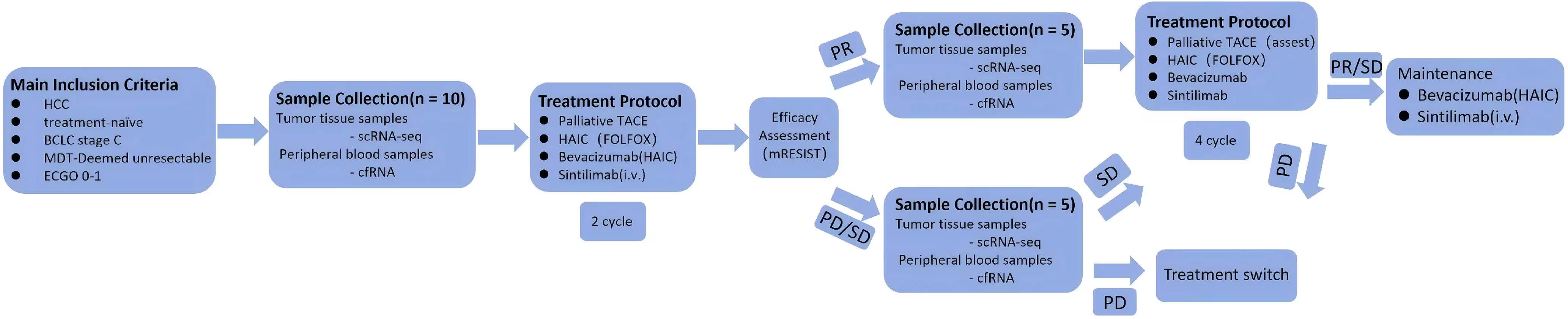
The therapeutic approach relies on two localized procedures performed in a specialized imaging suite to cut off blood supply to the malignancy while flooding the tissue with high-dose chemotherapy. Doctors introduce a catheter into the main blood vessels feeding the liver to perform palliative transarterial chemoembolization, which uses a mixture of iodized oil and the chemotherapy drug epirubicin to reduce antegrade blood flow and diminish abnormal tumor staining without causing complete vessel blockage. Immediately afterward, patients undergo hepatic arterial infusion chemotherapy using a modified FOLFOX regimen, consisting of oxaliplatin, leucovorin, and fluorouracil delivered continuously over forty-six hours every three weeks for up to six cycles.
By targeting the main tumor-feeding vessels with chemoembolization and reaching poorly perfused areas with infusion chemotherapy, the local interventions aim to achieve rapid tumor reduction. Furthermore, these local procedures are thought to induce immunogenic cell death, meaning dying cancer cells release tumor-associated antigens and inflammatory signals that can awaken the patient’s immune system. However, such interventions can also trigger local hypoxia, which sometimes stimulates new blood vessel growth and creates an immunosuppressive environment that shields the tumor from immune attacks.

Why Add Targeted Drugs and Immunotherapy to Local Treatment?
To counteract hypoxia-driven blood vessel formation and boost immune activation, the protocol incorporates sequential targeted therapy and immunotherapy immediately following local interventions. Patients receive an intra-arterial infusion of the anti-angiogenic drug bevacizumab right after the local procedure, followed by intravenous administration of the immune checkpoint inhibitor sintilimab every three weeks. Bevacizumab helps normalize newly formed blood vessels and lowers the risk of recurrence, while sintilimab blocks inhibitory pathways on immune cells, allowing T-cells to infiltrate the tumor microenvironment more effectively.
After completing two treatment cycles, clinicians will assess the radiological response using modified criteria known as mRECIST to categorize patients based on how well their tumors responded. The primary endpoint of the trial is the objective response rate, defined as the proportion of patients achieving a complete or partial reduction in tumor size, with a target response rate of seventy-five percent based on historical data. Secondary endpoints include progression-free survival, overall survival, depth of response, and the careful logging of any adverse events according to standard toxicity criteria.
What Can Single-Cell Sequencing and Blood Tests Reveal About Patient Differences?
A major focus of the trial involves exploring the tumor immune microenvironment to understand why different patients experience widely varying results. Prior studies show that while some individuals respond exceptionally well to quadruple therapy, others experience rapid disease progression or high recurrence rates, reflecting deep biological heterogeneity. To uncover the molecular underpinnings of these diverse trajectories, the researchers will collect fresh tumor biopsies and peripheral blood samples at baseline and at specific intervals during treatment for advanced molecular profiling.
Using single-cell ribonucleic acid sequencing on the SeekOne platform, the team will map the cellular composition, functional states, and communication networks within the tumor tissues at single-cell resolution. Simultaneously, plasma circulating cell-free RNA extracted from blood samples will be sequenced using high-throughput platforms to track systemic gene expression dynamics and identify potential non-invasive biomarkers. By integrating tissue-level cell maps with blood-based monitoring, the investigators hope to establish a clearer mechanistic framework for personalizing combination therapies in advanced liver cancer.
The investigators acknowledge that the trial is limited by its single-center design and small sample size of thirty-four patients, which may introduce selection bias and restrict the broader generalizability of the findings. Because the cellular analyses will be conducted in a limited cohort, the identified molecular mechanisms will require validation in larger, multi-center trials before they can guide routine clinical practice. Nevertheless, the prospective protocol provides a rigorous framework for evaluating the safety and efficacy of sequential quadruple therapy while shedding light on the complex immune dynamics of unresectable liver cancer.
The research was published in PloS one on November 19, 2026.
This article has been fact checked for accuracy, with information verified against reputable sources. Learn more about us and our editorial process.
Last reviewed on .
Article history
- Latest version
Reference(s)
- Fang, Yang., et al. “Efficacy and safety of hepatic arterial infusion chemotherapy combined with palliative transarterial chemoembolization followed by targeted therapy and immunotherapy in patients with BCLC stage C hepatocellular carcinoma: Clinical trial protocol.” PLOS One, vol. 21, no. 11, November 19, 2026, pp. e0363254 Public Library of Science (PLoS), doi: 10.1371/journal.pone.0363254. <https://doi.org/10.1371/journal.pone.0363254>.
Cite this page:
- Posted by Susan White