New Algorithm Ranks Ancient Historical Figures by Network Power
Researchers use a modified search-engine algorithm to decode centuries-old texts and pinpoint the main drivers of historical narratives.

A new computational framework has been developed to analyze complex ancient histories by tracking the interactions of historical figures, revealing the key drivers behind massive texts such as the Records of the Three Kingdoms. By transforming intricate social webs into mathematical graphs, the study successfully pinpointed the top figures who shape centuries of historical narrative.
The research is published in PLOS One, detailing an automated system that uses network science to decode dense literary and historical records. Historiographical texts serve as cultural mirrors, encapsulating the social, political, economic, and ideological conditions of past epochs. However, confronting expansive narratives featuring dozens of figures and spanning hundreds of pages presents a formidable barrier to reader comprehension.
How Network Science Uncovers Hidden Narrative Engines
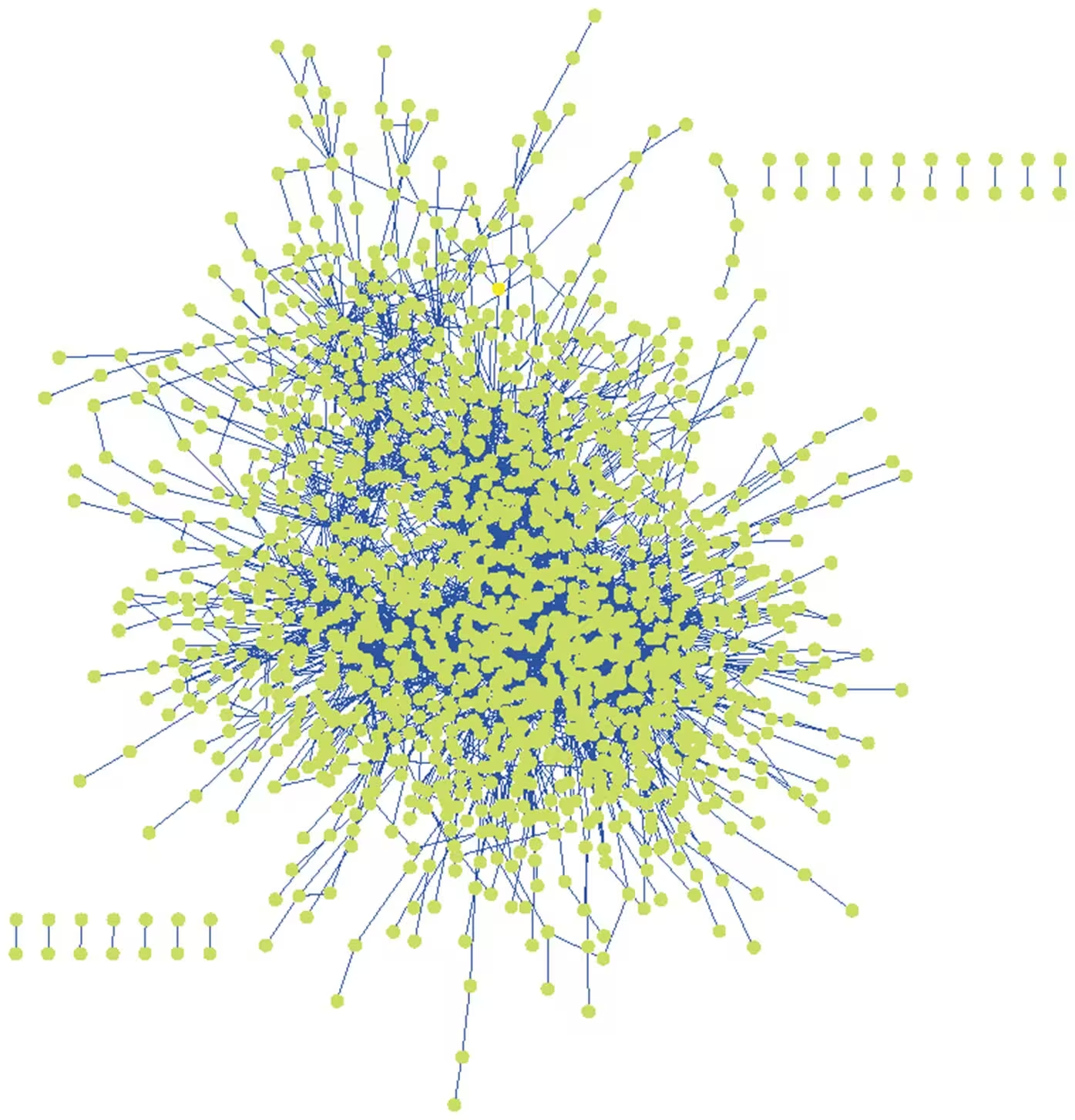
To overcome the cognitive tax of close reading long texts, the authors introduced a system called IFST, which stands for Identifying key Figures in Chinese historiographical texts through figure-centric Social networks and self-seeded TrustRank. The approach operates by constructing a Figure-Centric Social Network, where nodes represent historical figures and edges denote their co-appearance within sentences. Edge weights correspond to the frequency of textual co-occurrences, capturing the intensity of interpersonal coupling.

Unlike basic connectivity counts, the method deploys a self-seeded TrustRank algorithm. Originally designed for web-search ranking and spam filtering, TrustRank propagates reliability scores from a trusted seed set through the network. In this historical context, the team used PageRank to automatically select the top 20 percent of nodes as trusted seeds, bypassing the need for subjective human annotation. This mechanism assigns continuous real-valued importance scores to every historical entity, successfully filtering out peripheral noise.
Testing the Algorithm on Ancient Chinese History
The team evaluated their framework on the Records of the Three Kingdoms, an authoritative 3rd-century text compiled by Chen Shou. The resulting network comprised 1,529 distinct figures and 3,700 weighted edges. When ranked by their algorithm, the top three figures identified were Cao Cao, Sun Quan, and Liu Bei, matching the historical consensus regarding the founders of the three rival states.
Further down the ranking, figures such as Zhuge Liang and Yuan Shao occupied positions that closely mirrored scholarly interpretations of their historical influence. Statistical evaluations demonstrated that the proposed method significantly outperformed six conventional centrality baselines, including standard PageRank, betweenness centrality, and closeness centrality, yielding large effect sizes across precision, recall, and F1-score metrics.
Limitations and Future Historical Applications
Despite its high accuracy in recovering consensus key figures, the current model relies strictly on undirected sentence-level co-occurrence. It does not encode relationship directionality or fine-grained semantic types such as alliances, kinship, or enmity. Furthermore, the operational definition of a key figure measures narrative salience within this specific text rather than independent real-world historical impact.
The authors note that the generated ranked lists can serve as foundational semantic carriers for future digital humanities applications. These include automatic extraction of core storylines, domain-specific knowledge graph construction, and intelligent text summarization for large historical archives.
The research was published in PLOS One on November 19, 2026.
This article has been fact checked for accuracy, with information verified against reputable sources. Learn more about us and our editorial process.
Last reviewed on .
Article history
- Latest version
Reference(s)
- Zhou, Shiyuan., et al. “Identifying key figures in Chinese historiographical texts via figure-centric social networks and self-seeded TrustRank.” PLOS One, vol. 21, no. 11, November 19, 2026, pp. e0362803 Public Library of Science (PLoS), doi: 10.1371/journal.pone.0362803. <https://doi.org/10.1371/journal.pone.0362803>.
- Posted by Joseph Jackson