Speed-Tracked Weightlifting Cuts Acrobatics Errors in Half
Real-time velocity feedback during workouts helps lion dance performers master high-pole stunts much faster than standard weightlifting routines.

A traditional six-week strength training upgrade cuts technical mistakes in half for collegiate performers executing complex acrobatics in lion dance. The study, published in PLOS One, reveals that tracking barbell speed during workouts helps athletes master high-pole routines much faster than traditional weightlifting routines.
How Speed Tracking Changes Traditional Strength Training
Competitive lion dance, particularly southern lion performance on elevated platforms and narrow plum-blossom poles, demands extraordinary explosive power, rapid force generation, and precise neuromuscular coordination between paired partners. Within this choreography, sitting on shoulders and standing on thighs are core difficulty elements that test balance and stability under physical fatigue. Controlling technical errors is a constant challenge because exhaustion often leads to dangerous missteps and point deductions in competitions.
To address this, researcher Mu Yuan Yang recruited thirty collegiate lion dance athletes forming fifteen fixed head-tail pairs and assigned them to three groups for a six-week trial. While all groups maintained their regular five-day-a-week practice schedule, two groups added three weekly supervised strength sessions. One group used traditional percentage-based training, which calculates barbell loads from a static one-repetition maximum, while the second group used velocity-based training with linear position transducers to provide real-time feedback on bar speed and cap fatigue within a ten percent velocity loss threshold.
Surprising Results in Technical Error Rates
Weekly evaluations showed that technical mistakes dropped across all training regimens, but the speed-monitored group pulled ahead by the fifth week. For the sitting-on-shoulder technique, error rates plummeted from sixty-four percent down to eight percent in the velocity-trained group, compared to twenty-eight percent in the percentage-trained group and forty-four percent in the control group. A nearly identical trajectory appeared in the standing-on-leg maneuver, where errors fell to twelve percent for the speed-monitored participants.
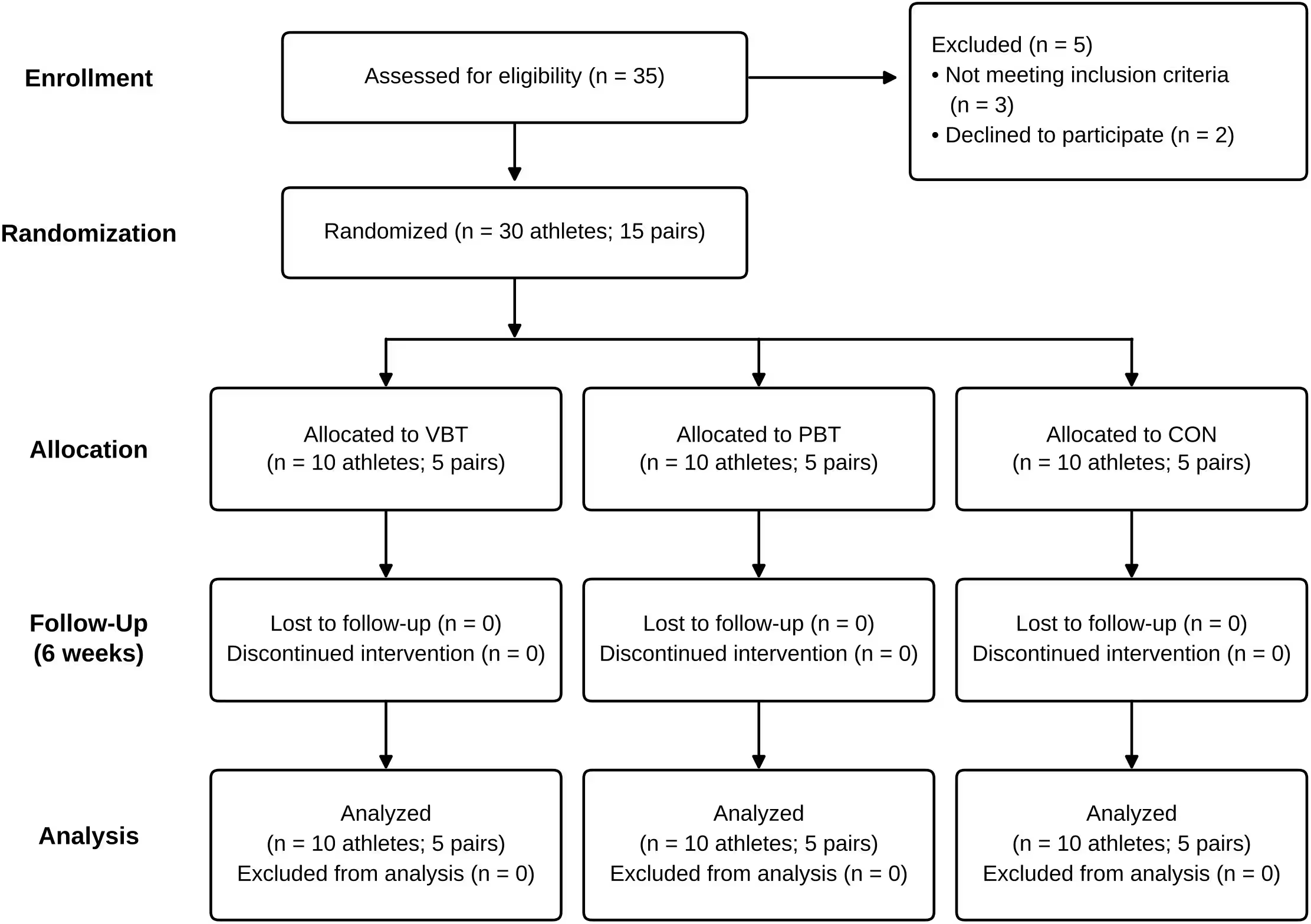
Both structured strength programs produced comparable maximal strength gains in squats and overhead presses, outperforming regular practice alone. However, the speed-tracked group achieved significantly lower error rates than the standard weightlifting group despite lifting similar maximum loads. This dissociation suggests that real-time velocity feedback improves athletic technique through mechanisms beyond raw muscle strength development, likely by preserving motor control and enhancing the rate of force development under physical fatigue.
Study Limitations and Future Questions
The authors note several important limitations in their work, including a small sample size of just fifteen pairs of male athletes from a single university team. The intervention lasted only six weeks, meaning long-term effects remain unknown. Additionally, the study did not directly measure underlying neuromuscular changes, such as muscle activation patterns or force coupling between partners, leaving the precise mechanical pathways open for future investigation.
The research was published in PLOS One on November 19, 2026.
This article has been fact checked for accuracy, with information verified against reputable sources. Learn more about us and our editorial process.
Last reviewed on .
Article history
- Latest version
Reference(s)
- Yang, Mu Yuan. “Effects of velocity-based strength training versus percentage-based strength training on technical error rates in collegiate lion dance athletes: A randomized controlled trial.” PLOS One, vol. 21, no. 11, November 19, 2026, pp. e0363133 Public Library of Science (PLoS), doi: 10.1371/journal.pone.0363133. <https://doi.org/10.1371/journal.pone.0363133>.
Cite this page:
- Posted by Rabia Shah