New Machine Learning Framework Predicts Thermoelectric Materials Without Shortcuts
By independently modeling transport properties and tracking prediction uncertainty, scientists are making materials discovery safer and more reliable.
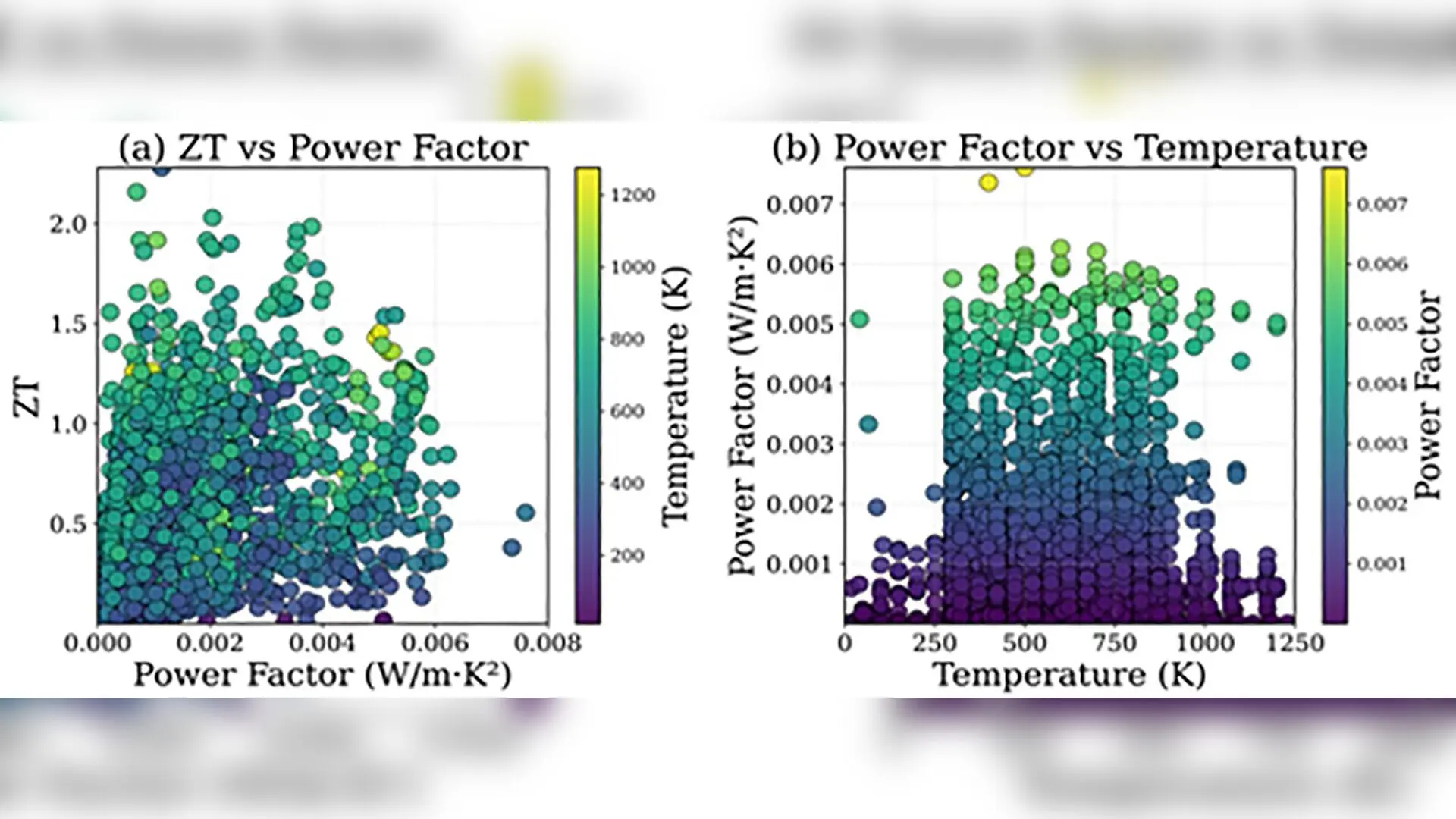
Finding materials that can efficiently convert waste heat directly into electricity remains a major bottleneck in sustainable energy technology, largely because the core physical properties governing efficiency pull against each other in complex ways. When scientists try to boost electrical conductivity, thermal conductivity often rises too, which ruins the delicate balance required for high performance. Machine learning has emerged as a powerful tool to speed up this search, but standard prediction models often take shortcuts that create hidden statistical traps and overly optimistic performance scores.
Physics-Guided Modeling Overcomes Target Leaks
To build a more reliable discovery pipeline, researchers developed a physics-guided and uncertainty-aware machine learning framework that avoids direct shortcuts, as published in PLOS One on November 2, 2026. Led by authors Abid Ahmad, Mohammad Naved Qureshi, Shabbab Ali Algamdi, and Shaha Faisal, the team chose not to predict the overall thermoelectric figure of merit, known as ZT, in a single step. Direct regression models can unintentionally exploit hidden mathematical correlations in training data, leading to target leakage and inflated accuracy.
Instead, the team trained independent Random Forest regressor models for each constituent transport property, using elemental composition descriptors and temperature as inputs. These separate models predicted the Seebeck coefficient, electrical conductivity, and thermal conductivity individually. Thermoelectric performance was subsequently evaluated using the standard analytical formula rather than raw guessing.
Ensemble Learning Quantifies Prediction Confidence
To ensure the models did not overfit, the researchers applied a strict material-wise validation strategy using data from the publicly available Experimental Thermoelectric Materials (ESTM) database. Exact chemical formulas were kept exclusively in either the training subset or the held-out test subset, meaning measurements of the same material at different temperatures never crossed over. This approach tested how well the models generalized to completely unseen chemical compositions.
Predictive uncertainty was captured using five-member ensemble learning, where the standard deviation across ensemble predictions served as a proxy for model-dependent epistemic uncertainty. The authors found a positive Spearman correlation of 0.583 between predicted uncertainty and absolute prediction error, meaning higher uncertainty scores reliably pointed to less reliable predictions. These uncertainties were then propagated into the analytical ZT calculations using first-order error propagation theory and joint ensemble propagation.
Lower Confidence Bounds Prioritize Safe Candidates
To rank potential materials safely, the team implemented a lower-confidence-bound screening strategy that penalized candidates carrying high model uncertainty, even if their predicted performance looked exceptional. Using a risk-aversion parameter of one standard deviation, the top-ranked held-out sample was Sb0.15Ge0.85Te at 823 Kelvin with a predicted ZT of 1.578 and an uncertainty of 0.200, yielding a final score of 1.378.
While a direct Random Forest model trained on ZT achieved a higher R-squared score of 0.732 compared to 0.579 for the physics-guided framework, the transport-property approach offers superior physical interpretability and structural transparency. The authors note that the dataset relied solely on composition and temperature descriptors, leaving out microstructural factors like carrier concentration and grain size. Future work will aim to incorporate these complex physical parameters to further refine materials discovery.
The research was published in PLOS One on November 2, 2026.
This article has been fact checked for accuracy, with information verified against reputable sources. Learn more about us and our editorial process.
Last reviewed on .
Article history
- Latest version
Reference(s)
- Ahmad, Abid., et al. “Machine learning-based thermoelectric materials screening with physical consistency and uncertainty propagation.” PLOS One, vol. 21, no. 11, November 2, 2026, pp. e0360053 Public Library of Science (PLoS), doi: 10.1371/journal.pone.0360053. <https://doi.org/10.1371/journal.pone.0360053>.
Cite this page:
- Posted by Rabia Shah