Brain Wave Asymmetry May Track How Shoppers Update Satisfaction After Seeing Prices
A new pilot study examines whether frontal electroencephalography signals reflect the intensity of consumer valuation shifts.
When consumers see a price tag, their brains instantly recalculate how much they want an item, a subtle mental shift that can now be tracked using electrical brain signals. A new pilot study reveals that brain wave patterns linked to motivational drive fluctuate when shoppers revise their satisfaction ratings after discovering what a product costs.
Researchers at Mahidol University set out to investigate whether brain activity during a brief price-reveal window reflects the size and direction of a consumer’s evaluative update. Traditional studies often treat purchasing choices as a simple yes-or-no question, ignoring how strongly a person’s mind changes. To capture this nuance, the team measured brain activity while participants evaluated everyday consumer goods under laboratory conditions.
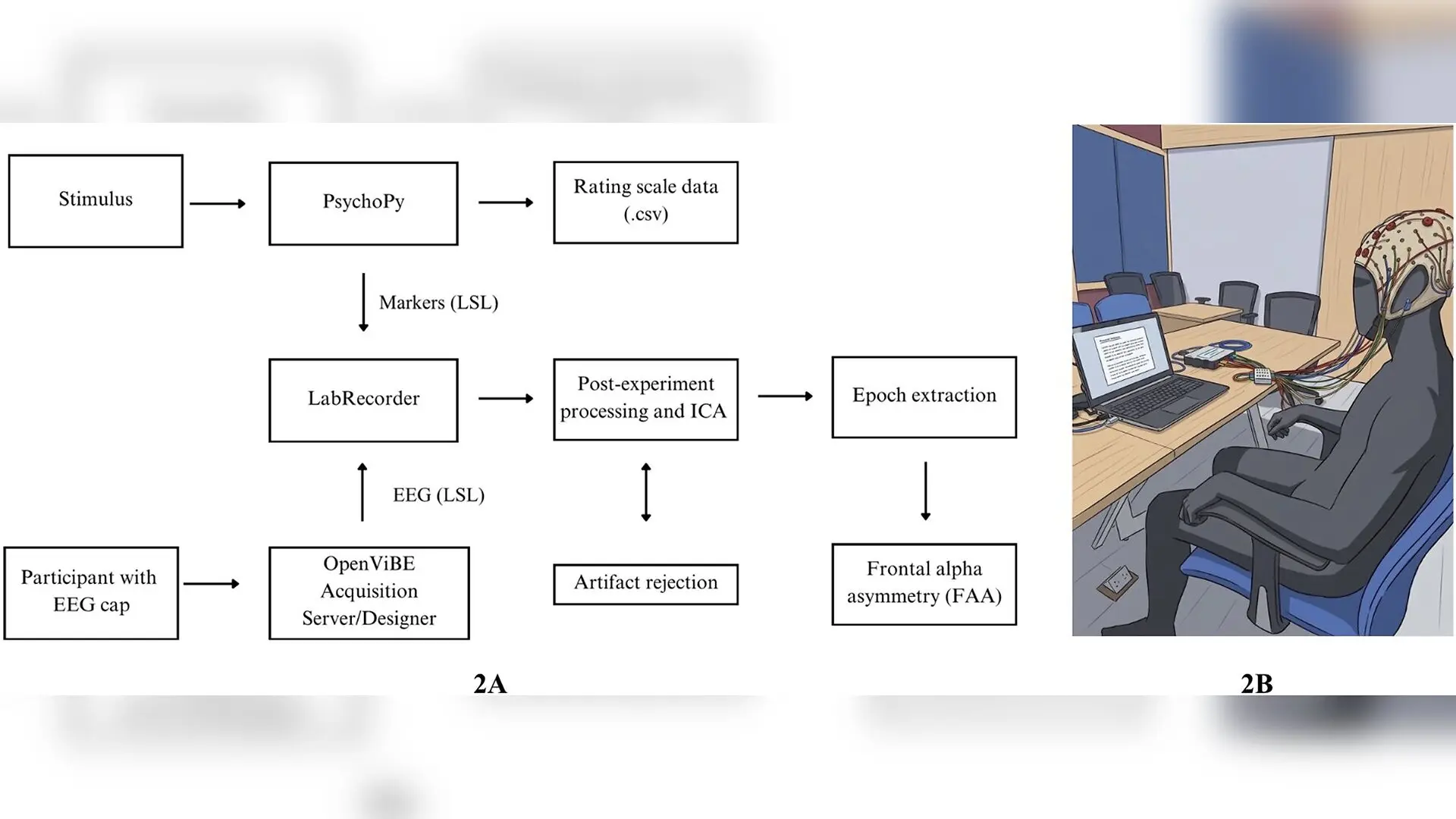
The study, published in PLOS One, involved 21 young adults aged 18 to 27 who completed shopping simulation tasks. Participants viewed product photographs, provided an initial satisfaction rating on a 1-to-9 scale, viewed the price for three seconds, and then gave a second satisfaction rating. The investigators focused specifically on Frontal Alpha Asymmetry, an electroencephalography metric that compares brain wave power between the left and right frontal regions to gauge approach or withdrawal tendencies.
In the first session of the experiment, statistical models pointed to an association where the relationship between brain wave asymmetry and the magnitude of the rating change depended on whether satisfaction went up or down. However, the primary pooled analysis across both sessions yielded inconclusive results, and similar patterns of brain activity appeared even before the price was shown. Because baseline measurements taken prior to price presentation showed comparable associations, the authors caution that the findings cannot be attributed solely to price evaluation.
Understanding the Consumer Mind Through Brain Waves
Pricing is the critical moment where subjective preference transforms into perceived value. While buyers often rely on quick intuitive feelings, measuring these rapid cognitive updates remains a challenge in behavioral science. Electroencephalography offers millisecond-level precision, making it a valuable tool for tracking real-time mental processing without invasive procedures.
In this experiment, participants evaluated 60 items across three categories, including bags, electrical appliances, and furniture. Prices ranged from 11 Thai Baht to 12,232 Baht, reflecting realistic online shopping platforms in Thailand. To ensure active engagement, participants were instructed to adjust their satisfaction scores after seeing the price, unless their initial rating was already at the absolute scale limit.
The team quantified the size of each rating shift as an absolute difference score, providing a continuous measure of how much opinions moved. They then analyzed brain electrical activity recorded at electrode pair F3/F4 during the three-second price display window. Relative alpha power was calculated to normalize overall spectral differences across participants and recording blocks.
Evaluating the Statistical Signals and Limitations
Although initial session-specific models suggested a reliable interaction between shift direction and rating magnitude, subsequent checks revealed important complexities. Small-sample corrections and alternative statistical estimators shifted the p-values closer to the threshold of uncertainty. Furthermore, single-trial classification analyses showed that brain asymmetry alone could not reliably predict the direction of a rating change out of sample.
The investigation also highlighted methodological challenges common in neuroimaging work. Pre-price baseline windows exhibited similar statistical interactions as the post-price presentation intervals, complicating direct causal claims about price-evoked neural responses. Additionally, session effects and varying stimulus sets introduced confounding factors that future research must disentangle through rigorous experimental design.
The authors emphasize that these exploratory insights are strictly preliminary. They serve as a methodological foundation for future investigations rather than a definitive marker of consumer decision-making. Future research with larger, pre-registered cohorts and unconstrained rating conditions will be necessary to clarify how neural asymmetries track subjective consumer choices.
The research was published in PLOS One on November 2, 2026.
This article has been fact checked for accuracy, with information verified against reputable sources. Learn more about us and our editorial process.
Last reviewed on .
Article history
- Latest version
Reference(s)
- Limmeechokchai, Passavorn., et al. “Frontal alpha asymmetry and instructed satisfaction-rating changes after price presentation: An exploratory pilot study.” PLOS One, vol. 21, no. 11, November 2, 2026, pp. e0361622 Public Library of Science (PLoS), doi: 10.1371/journal.pone.0361622. <https://doi.org/10.1371/journal.pone.0361622>.
Cite this page:
- Posted by Rabia Shah